Cardellini Marina, Rovella Valentina, Scimeca Manuel, Anemona Lucia, Bischetti Simone, Casella Sara, Saggini Andrea, Bonanno Elena, Ballanti Marta, Davato Francesca, Menghini Rossella, Ippoliti Arnaldo, Santeusanio Giuseppe, Di Daniele Nicola, Federici Massimo, Mauriello Alessandro
1Center for Atherosclerosis, Department of Medicine, Policlinico Tor Vergata, Rome, and Department of Systems Medicine, University of Rome Tor Vergata, Italy.
2Hypertension and Nephrology Unit, Department of Systems Medicine, University of Rome Tor Vergata, Italy.
Aging Dis. 2019 Feb 1;10(1):71-81. doi: 10.14336/AD.2018.0117. eCollection 2019 Feb.
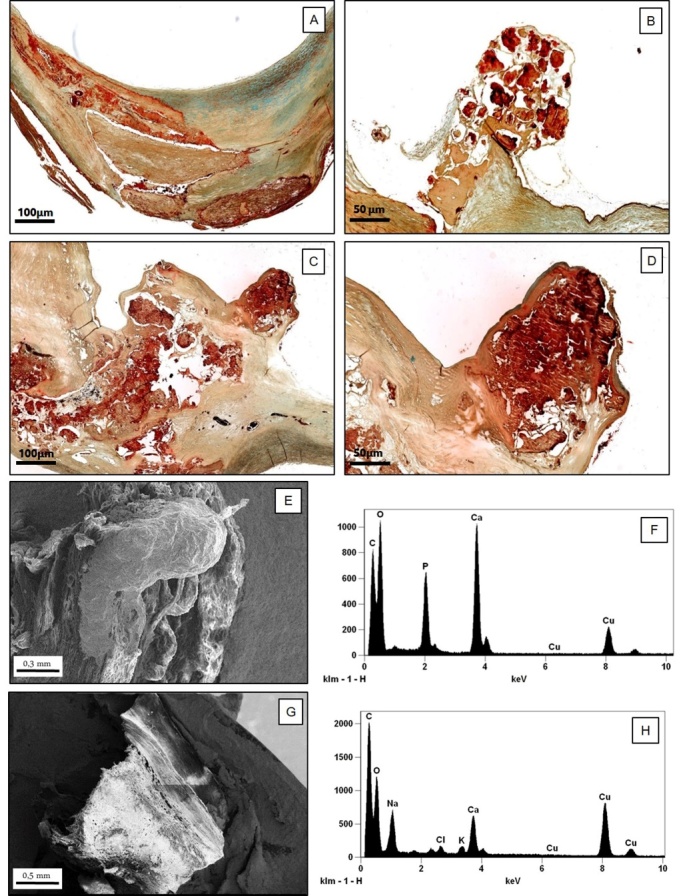
The incidence and the different type of carotid calcifications, nodular and non-nodular, and their role in the acute cerebrovascular disease has not yet been defined. Various studies have correlated the presence of specific risk factors, in particular the chronic kidney disease, with the presence of calcification, but not with the type of calcification. Since it is likely that carotid nodular calcifications rather than those with non-nodular aspect may represent a plaque at high risk of rupture, the purpose of our study was to evaluate the role of nodular calcification in the pathogenesis of cerebrovascular syndromes and their possible correlation with specific risk factors. A total of 168 carotid plaques from symptomatic and asymptomatic patients submitted to endarterectomy, whom complete clinical and laboratory assessment of major cardiovascular risk factors was available, were studied. In 21 endarterectomies (5 from symptomatic and 16 from asymptomatic patients) an eruptive calcified nodule, consisting of calcified plates associated to a small amount of fibrous tissue without extracellular lipids and inflammatory cells, was found protruding into the lumen. Nodular calcifications were significantly observed in patients affected by chronic kidney disease (with GFR<60 ml / min / 1.73 m), with a normal lipidic and glycemic profile. On the contrary, non-nodular calcification, mainly correlated to diabetes, were stable lesions. Results of our study suggest that the mechanisms and the clinical significance of carotid atherosclerotic calcification may be different. The nodular calcification could represent a type of unstable plaque, significantly related to chronic kidney disease, without inflammation, morphologically different from the classical vulnerable plaques.
颈动脉钙化的发生率、不同类型(结节状和非结节状)及其在急性脑血管疾病中的作用尚未明确。各种研究已将特定风险因素的存在,尤其是慢性肾病,与钙化的存在相关联,但未与钙化类型相关联。由于颈动脉结节状钙化而非非结节状钙化可能代表具有高破裂风险的斑块,我们研究的目的是评估结节状钙化在脑血管综合征发病机制中的作用及其与特定风险因素的可能关联。我们研究了168例接受内膜切除术的有症状和无症状患者的颈动脉斑块,这些患者可获得主要心血管风险因素的完整临床和实验室评估。在21例内膜切除术中(5例有症状患者和16例无症状患者),发现一个突出到管腔中的爆发性钙化结节,由与少量无细胞外脂质和炎症细胞的纤维组织相关的钙化板组成。在慢性肾病(肾小球滤过率<60 ml / min / 1.73 m²)且脂质和血糖谱正常的患者中,显著观察到结节状钙化。相反,主要与糖尿病相关的非结节状钙化是稳定病变。我们的研究结果表明,颈动脉粥样硬化钙化的机制和临床意义可能不同。结节状钙化可能代表一种不稳定斑块,与慢性肾病显著相关,无炎症,形态上不同于经典的易损斑块。