Max Planck Institute of Psychiatry, Research Group Sleep Endocrinology, 80804 Munich, Germany.
Centre of Mental Health, 85049 Ingolstadt, Germany.
Int J Mol Sci. 2019 Jan 31;20(3):607. doi: 10.3390/ijms20030607.
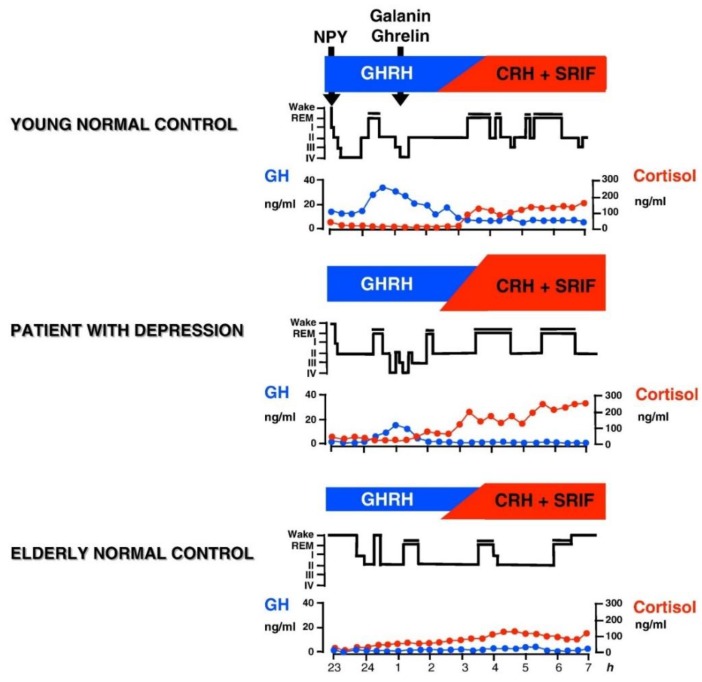
Impaired sleep is both a risk factor and a symptom of depression. Objective sleep is assessed using the sleep electroencephalogram (EEG). Characteristic sleep-EEG changes in patients with depression include disinhibition of rapid eye movement (REM) sleep, changes of sleep continuity, and impaired non-REM sleep. Most antidepressants suppress REM sleep both in healthy volunteers and depressed patients. Various sleep-EEG variables may be suitable as biomarkers for diagnosis, prognosis, and prediction of therapy response in depression. In family studies of depression, enhanced REM density, a measure for frequency of rapid eye movements, is characteristic for an endophenotype. Cordance is an EEG measure distinctly correlated with regional brain perfusion. Prefrontal theta cordance, derived from REM sleep, appears to be a biomarker of antidepressant treatment response. Some predictive sleep-EEG markers of depression appear to be related to hypothalamo-pituitary-adrenocortical system activity.
睡眠障碍既是抑郁症的一个风险因素,也是其症状之一。客观睡眠是通过睡眠脑电图 (EEG) 来评估的。抑郁症患者的特征性睡眠 EEG 变化包括快速眼动 (REM) 睡眠抑制、睡眠连续性改变和非快速眼动 (NREM) 睡眠受损。大多数抗抑郁药在健康志愿者和抑郁患者中都会抑制 REM 睡眠。各种睡眠 EEG 变量可能适合作为抑郁症诊断、预后和治疗反应预测的生物标志物。在抑郁症的家族研究中,增强的 REM 密度(快速眼球运动的频率指标)是一个表型特征。Cordance 是一种与局部脑灌注明显相关的 EEG 测量方法。来自 REM 睡眠的前额叶θ Cordance 似乎是抗抑郁治疗反应的生物标志物。一些预测抑郁症的睡眠 EEG 标志物似乎与下丘脑-垂体-肾上腺皮质系统活动有关。