Parkar Shanthi G, Kalsbeek Andries, Cheeseman James F
The New Zealand Institute for Plant & Food Research Limited, Private Bag 11600, Palmerston North 4442, New Zealand.
Department of Hypothalamic Integration Mechanisms, Netherlands Institute for Neuroscience, Royal Netherlands Academy of Arts and Sciences, Meibergdreef 47, 1105BA Amsterdam, The Netherlands.
Microorganisms. 2019 Jan 31;7(2):41. doi: 10.3390/microorganisms7020041.
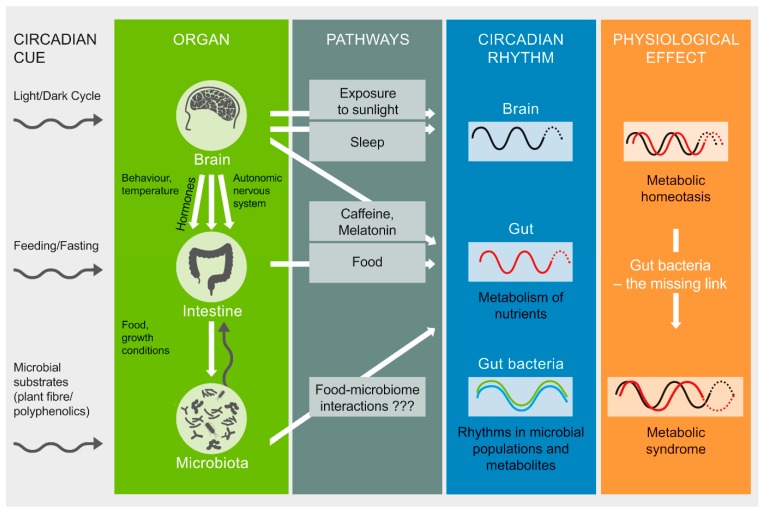
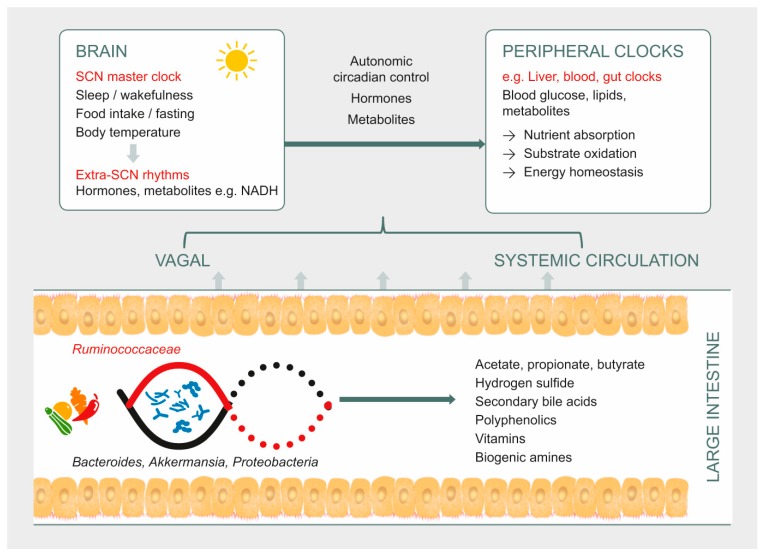
This article reviews the current evidence associating gut microbiota with factors that impact host circadian-metabolic axis, such as light/dark cycles, sleep/wake cycles, diet, and eating patterns. We examine how gut bacteria possess their own daily rhythmicity in terms of composition, their localization to intestinal niches, and functions. We review evidence that gut bacteria modulate host rhythms via microbial metabolites such as butyrate, polyphenolic derivatives, vitamins, and amines. Lifestyle stressors such as altered sleep and eating patterns that may disturb the host circadian system also influence the gut microbiome. The consequent disruptions to microbiota-mediated functions such as decreased conjugation of bile acids or increased production of hydrogen sulfide and the resultant decreased production of butyrate, in turn affect substrate oxidation and energy regulation in the host. Thus, disturbances in microbiome rhythms may at least partially contribute to an increased risk of obesity and metabolic syndrome associated with insufficient sleep and circadian misalignment. Good sleep and a healthy diet appear to be essential for maintaining gut microbial balance. Manipulating daily rhythms of gut microbial abundance and activity may therefore hold promise for a chrononutrition-based approach to consolidate host circadian rhythms and metabolic homeorhesis.
本文综述了目前关于肠道微生物群与影响宿主昼夜节律-代谢轴的因素之间关联的证据,这些因素包括光/暗周期、睡眠/觉醒周期、饮食和进食模式。我们研究了肠道细菌在组成、在肠道生态位中的定位以及功能方面如何具有自身的每日节律性。我们回顾了肠道细菌通过微生物代谢产物(如丁酸盐、多酚衍生物、维生素和胺类)调节宿主节律的证据。生活方式压力源,如改变睡眠和进食模式可能会扰乱宿主昼夜节律系统,也会影响肠道微生物群。随之而来的微生物群介导功能的破坏,如胆汁酸结合减少或硫化氢产生增加以及丁酸盐产生减少,反过来又会影响宿主的底物氧化和能量调节。因此,微生物群节律紊乱可能至少部分导致与睡眠不足和昼夜节律失调相关的肥胖和代谢综合征风险增加。良好的睡眠和健康的饮食似乎对维持肠道微生物平衡至关重要。因此,操纵肠道微生物丰度和活性的每日节律可能为基于时间营养学的方法带来希望,以巩固宿主昼夜节律和代谢动态平衡。