Bavarian Health and Food Safety Authority, 85764, Oberschleissheim, Germany.
German National Consiliary Laboratory on Diphtheria, 85764, Oberschleissheim, Germany.
BMC Microbiol. 2019 Feb 1;19(1):28. doi: 10.1186/s12866-019-1402-1.
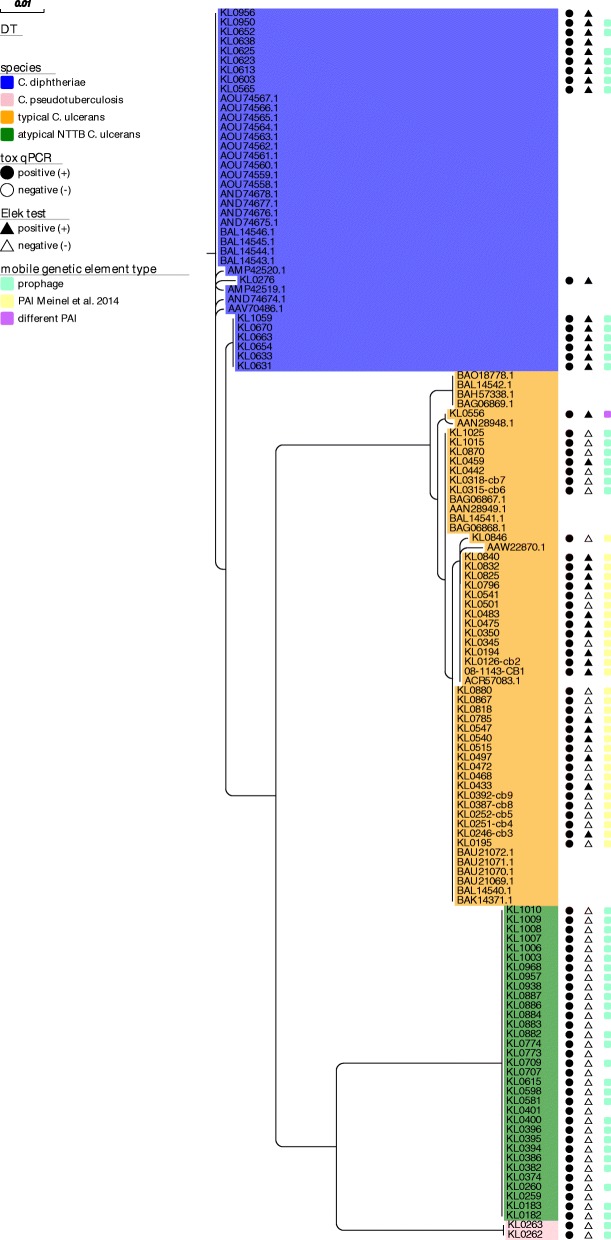
Diphtheria toxin (DT) is produced by toxigenic strains of the human pathogen Corynebacterium diphtheriae as well as zoonotic C. ulcerans and C. pseudotuberculosis. Toxigenic strains may cause severe respiratory diphtheria, myocarditis, neurological damage or cutaneous diphtheria. The DT encoding tox gene is located in a mobile genomic region and tox variability between C. diphtheriae and C. ulcerans has been postulated based on sequences of a few isolates. In contrast, species-specific sequence analysis of the diphtheria toxin repressor gene (dtxR), occurring both in toxigenic and non-toxigenic Corynebacterium species, has not been done yet. We used whole genome sequencing data from 91 toxigenic and 46 non-toxigenic isolates of different pathogenic Corynebacterium species of animal or human origin to elucidate differences in extracted DT, DtxR and tox-surrounding genetic elements by a phylogenetic analysis in a large sample set.
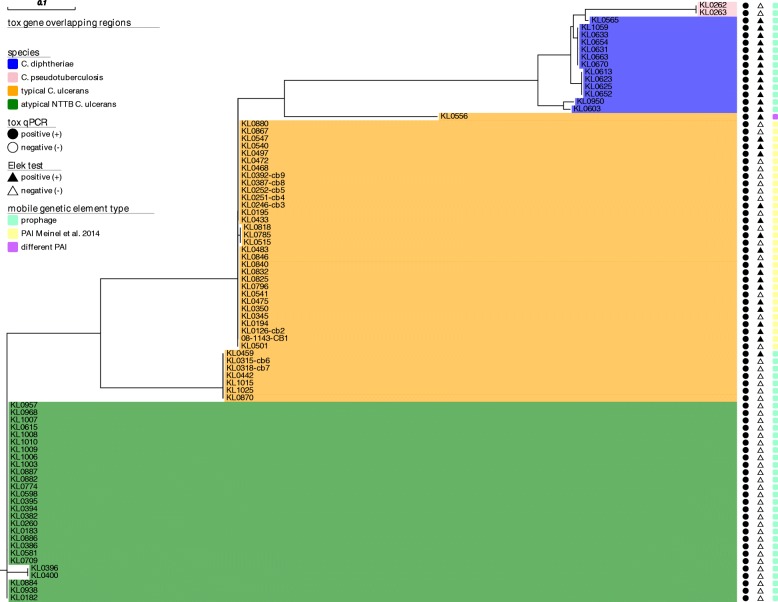
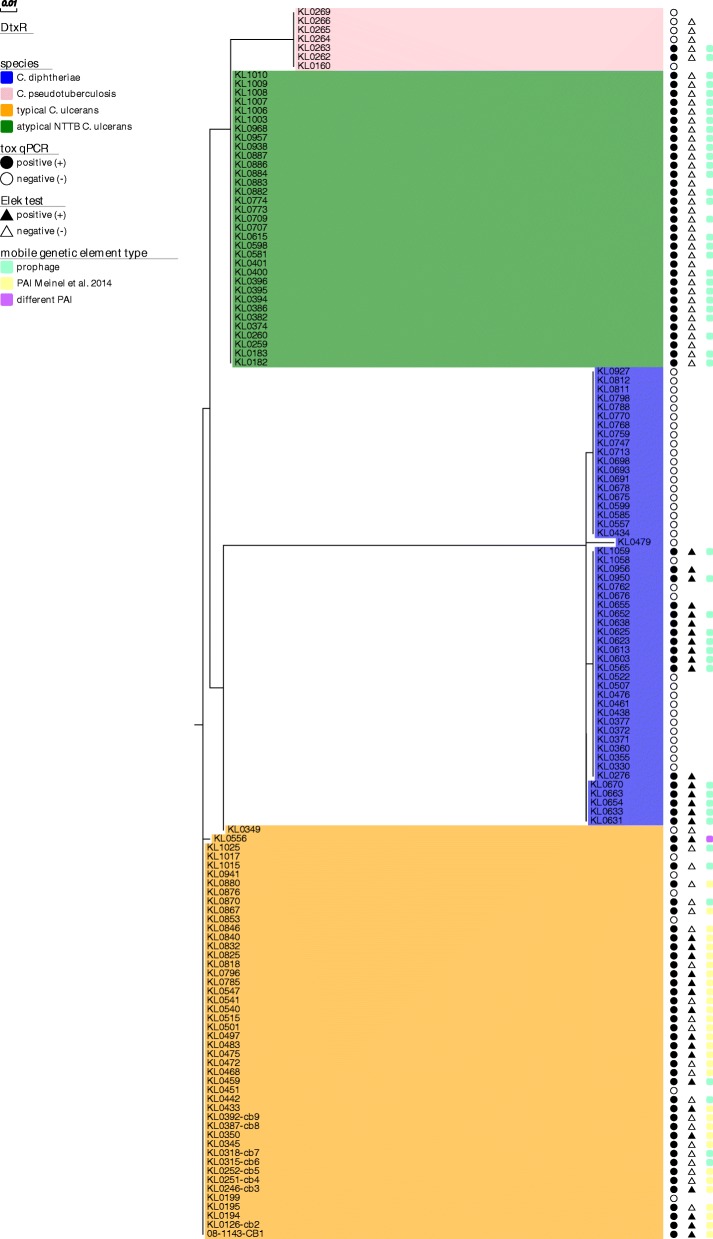
Sequences of both DT and DtxR, extracted from whole genome sequencing data, could be classified in four distinct, nearly species-specific clades, corresponding to C. diphtheriae, C. pseudotuberculosis, C. ulcerans and atypical C. ulcerans from a non-toxigenic toxin gene-bearing wildlife cluster. Average amino acid similarities were above 99% for DT and DtxR within the four groups, but lower between them. For DT, subgroups below species level could be identified, correlating with different tox-comprising mobile genetic elements. In most C. diphtheriae, tox genes were located within known prophages. In contrast, in C. ulcerans diverse tox-including mobile elements could be identified: either prophages differing from C. diphtheriae prophages or an alternative pathogenicity island (PAI) described previously. One isolate showed a different, shorter tox-comprising putative PAI. Beyond the tox-overlapping elements, most isolates harbored a variety of additional prophages.
Our NGS data from 137 isolates indicate the existence of different genetic backgrounds of DT-mediated pathogenicity in different Corynebacterium species and evolution of once acquired pathogenicity features with the strains. Different groups of pathogenicity-related elements within C. ulcerans imply that tox transmission pathways between isolates may differ in the zoonotic species and contribute to their emerging pathogenic potential.
白喉毒素(DT)由人类病原体 Corynebacterium diphtheriae 及其人畜共患的 C. ulcerans 和 C. pseudotuberculosis 的产毒菌株产生。产毒菌株可引起严重的呼吸道白喉、心肌炎、神经损伤或皮肤白喉。编码 DT 的 tox 基因位于一个可移动的基因组区域,根据少数分离株的序列,已经提出了 C. diphtheriae 和 C. ulcerans 之间 tox 的变异性。相比之下,尚未对存在于产毒和非产毒 Corynebacterium 物种中的白喉毒素阻遏基因(dtxR)进行种特异性序列分析。我们使用来自 91 株产毒和 46 株非产毒不同动物或人类来源的致病性 Corynebacterium 物种的全基因组测序数据,通过在大样本集中进行系统发育分析,阐明了提取的 DT、DtxR 和 tox 周围遗传元件的差异。
从全基因组测序数据中提取的 DT 和 DtxR 序列可分为四个截然不同的、几乎种特异性的进化枝,分别对应于 C. diphtheriae、C. pseudotuberculosis、C. ulcerans 和来自非产毒毒素基因携带野生动物群的非典型 C. ulcerans。在这四个组内,DT 和 DtxR 的平均氨基酸相似性均高于 99%,但在它们之间则较低。对于 DT,可以在种以下水平上识别亚群,与不同的 tox 组成的可移动遗传元件相关。在大多数 C. diphtheriae 中,tox 基因位于已知的原噬菌体中。相比之下,在 C. ulcerans 中,可以识别出多种包含 tox 的可移动元件:要么是与 C. diphtheriae 原噬菌体不同的原噬菌体,要么是之前描述的替代致病性岛(PAI)。一个分离株显示了不同的、较短的 tox 包含假定的 PAI。除了 tox 重叠元件外,大多数分离株还携带多种其他的原噬菌体。
我们从 137 个分离株的 NGS 数据表明,不同 Corynebacterium 物种中存在不同的 DT 介导的致病性遗传背景,并且随着菌株的进化,获得的致病性特征也在进化。C. ulcerans 内不同的致病性相关元件组表明,人畜共患病种之间的 tox 传播途径可能不同,并有助于其新出现的致病性潜力。