Social and Behavioral Sciences Branch, Eunice Kennedy Shriver National Institute of Child Health and Human Development, Bethesda, MD, 20817, USA.
Biostatistics & Bioinformatics Branch, Eunice Kennedy Shriver National Institute of Child Health and Human Development, Bethesda, USA.
Int J Behav Nutr Phys Act. 2019 Feb 1;16(1):15. doi: 10.1186/s12966-019-0774-9.
Nutrition interventions typically rely on self-reported intake that may be susceptible to differential reporting bias due to exposure to the intervention. Such differences may result from increased social desirability, increased attention to eating or improved recall accuracy, and may bias estimates of the intervention effect. This study investigated differential reporting bias of fruit and vegetable intake in youth with type 1 diabetes participating in a randomized controlled trial targeting increased whole plant food intake.
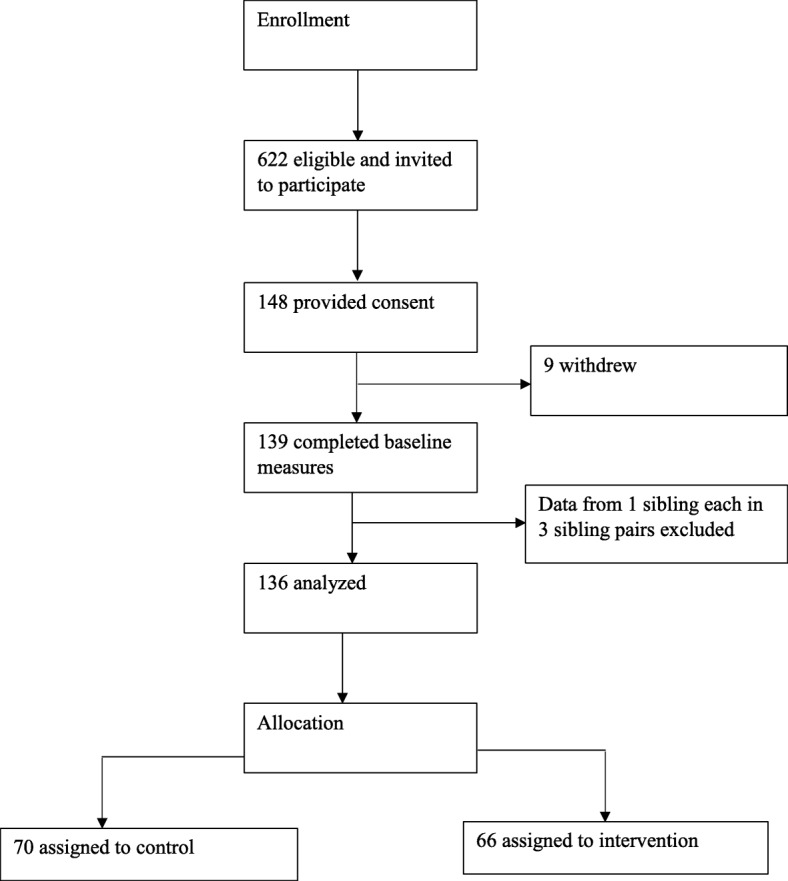
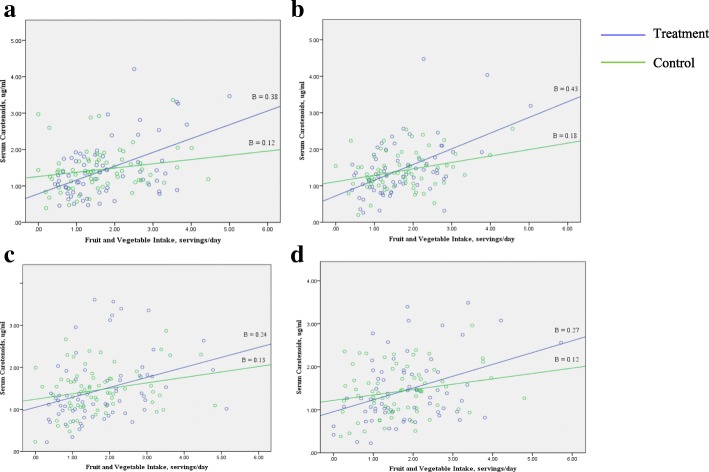
Participants (treatment n = 66, control n = 70) completed 3-day food records at baseline, 6-,12-, and 18-months, from which fruit and vegetable intake (servings/day) was calculated. Serum carotenoids were assessed at these visits using a high-performance liquid chromatography-based assay. Linear regression estimated associations of fruit and vegetable intake with serum carotenoids by treatment assignment. Multiplicative interaction terms tested the interaction of treatment assignment with fruit and vegetable intake on serum carotenoids for each visit and within each group over time.
The association of fruit and vegetable intake with serum carotenoids was significantly lower in the control versus intervention group at baseline (β = 0.22 Vs 0.46) and 6-month visits (β = 0.37 Vs 0.54), as evidenced by significant interaction effects. However, the association of fruit and vegetable intake with serum carotenoids did not significantly differ over time for either group.
While the stronger association of fruit and vegetable with carotenoids in the treatment arm suggests greater reporting accuracy, this difference was evident at baseline, and did not change significantly over time in either group. Thus, results indicate greater subject-specific bias in the control arm compared to the treatment, and lack of evidence for reactivity to the intervention by treatment assignment.
NCT00999375.
营养干预通常依赖于自我报告的摄入量,由于暴露于干预措施,这种摄入量可能容易受到差异报告偏差的影响。这种差异可能来自于社交期望的增加、对饮食的更多关注或改善了记忆准确性,并且可能会影响干预效果的估计。本研究调查了在参与以增加全植物性食物摄入量为目标的随机对照试验的 1 型糖尿病青年中,水果和蔬菜摄入量的差异报告偏差。
参与者(治疗组 n=66,对照组 n=70)在基线、6 个月、12 个月和 18 个月时完成了 3 天的食物记录,从中计算水果和蔬菜摄入量(份/天)。在这些访问中,使用高效液相色谱法评估血清类胡萝卜素。线性回归根据治疗分配估计了水果和蔬菜摄入量与血清类胡萝卜素之间的关联。乘法交互项测试了治疗分配与水果和蔬菜摄入量在每个访问和每个组内随时间变化对血清类胡萝卜素的相互作用。
与对照组相比,干预组基线(β=0.22 对 0.46)和 6 个月访视(β=0.37 对 0.54)时,水果和蔬菜摄入量与血清类胡萝卜素的关联明显较低,这表明存在显著的交互作用。然而,两组的水果和蔬菜摄入量与血清类胡萝卜素之间的关联随时间均无显著差异。
虽然治疗组中水果和蔬菜与类胡萝卜素的关联更强表明报告的准确性更高,但这种差异在基线时已经明显,而且在两组中随时间变化均不显著。因此,结果表明与治疗组相比,对照组存在更大的个体偏差,并且缺乏对治疗分配的干预反应的证据。
NCT00999375。