Wenham Clare, Katz Rebecca, Birungi Charles, Boden Lisa, Eccleston-Turner Mark, Gostin Lawrence, Guinto Renzo, Hellowell Mark, Onarheim Kristine Husøy, Hutton Joshua, Kapilashrami Anuj, Mendenhall Emily, Phelan Alexandra, Tichenor Marlee, Sridhar Devi
Department of Health Policy, London School of Economics and Political Science, London, UK.
Center for Global Health Science and Security, Georgetown University, Washington, District of Columbia, USA.
BMJ Glob Health. 2019 Jan 13;4(1):e001145. doi: 10.1136/bmjgh-2018-001145. eCollection 2019.
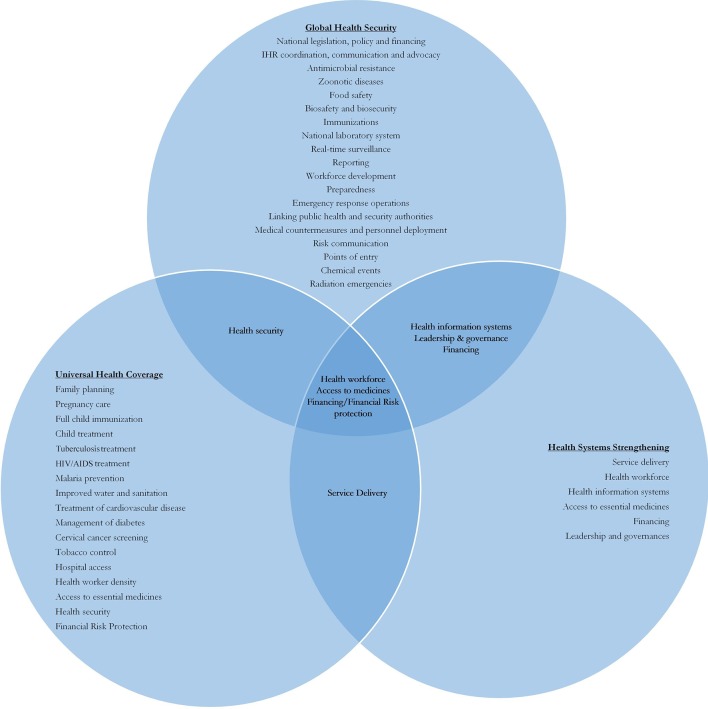
Global health security and universal health coverage have been frequently considered as "two sides of the same coin". Yet, greater analysis is required as to whether and where these two ideals converge, and what important differences exist. A consequence of ignoring their individual characteristics is to distort global and local health priorities in an effort to streamline policymaking and funding activities. This paper examines the areas of convergence and divergence between global health security and universal health coverage, both conceptually and empirically. We consider analytical concepts of risk and human rights as fundamental to both goals, but also identify differences in priorities between the two ideals. We support the argument that the process of health system strengthening provides the most promising mechanism of benefiting both goals.
全球卫生安全和全民健康覆盖常常被视为“同一枚硬币的两面”。然而,对于这两个理念是否以及在何处趋同,以及存在哪些重要差异,仍需要进行更深入的分析。忽视它们各自特点的一个后果是,为了简化政策制定和资金筹集活动而扭曲全球和地方的卫生重点。本文从概念和实证两方面研究了全球卫生安全与全民健康覆盖之间的趋同和分歧领域。我们认为,风险和人权的分析概念是这两个目标的基础,但同时也指出了这两个理念在优先事项上的差异。我们支持这样一种观点,即卫生系统加强过程为实现这两个目标提供了最有前景的机制。