Chang Chun-Yu, Chen Chu-Huang, Chen Yi-Ming, Hsieh Tsu-Yi, Li Ju-Pi, Shen Ming-Yi, Lan Joung-Liang, Chen Der-Yuan
Department of Medical Education and Research, Taichung Veterans General Hospital, Taichung 407, Taiwan.
Rheumatology and Immunology Center, China Medical University Hospital, Taichung 404, Taiwan.
J Clin Med. 2019 Feb 3;8(2):177. doi: 10.3390/jcm8020177.
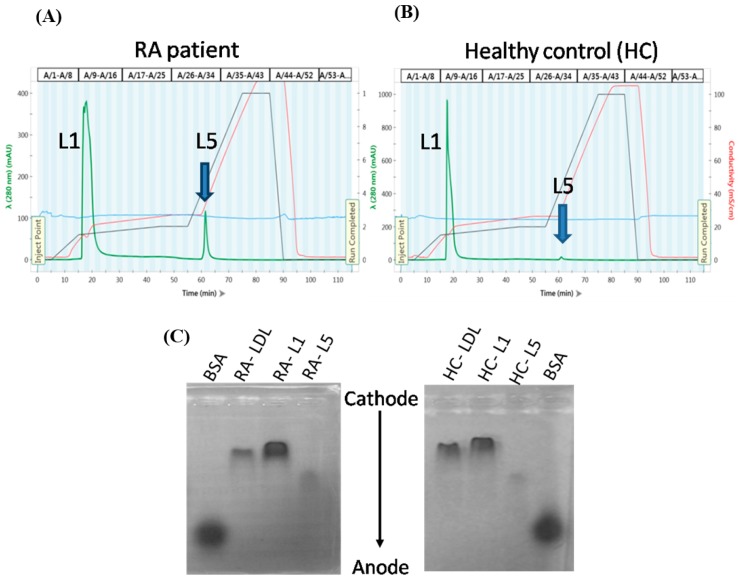
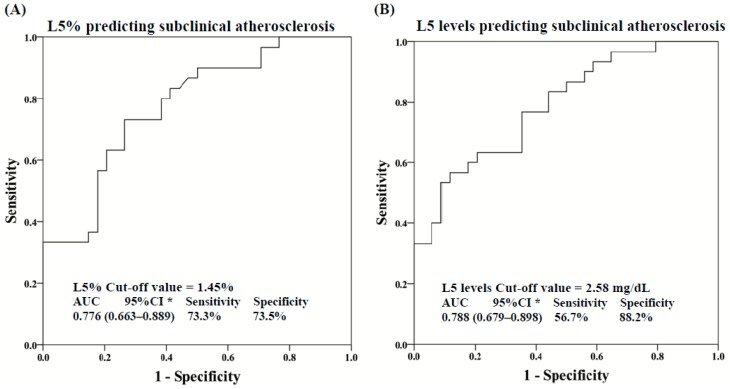
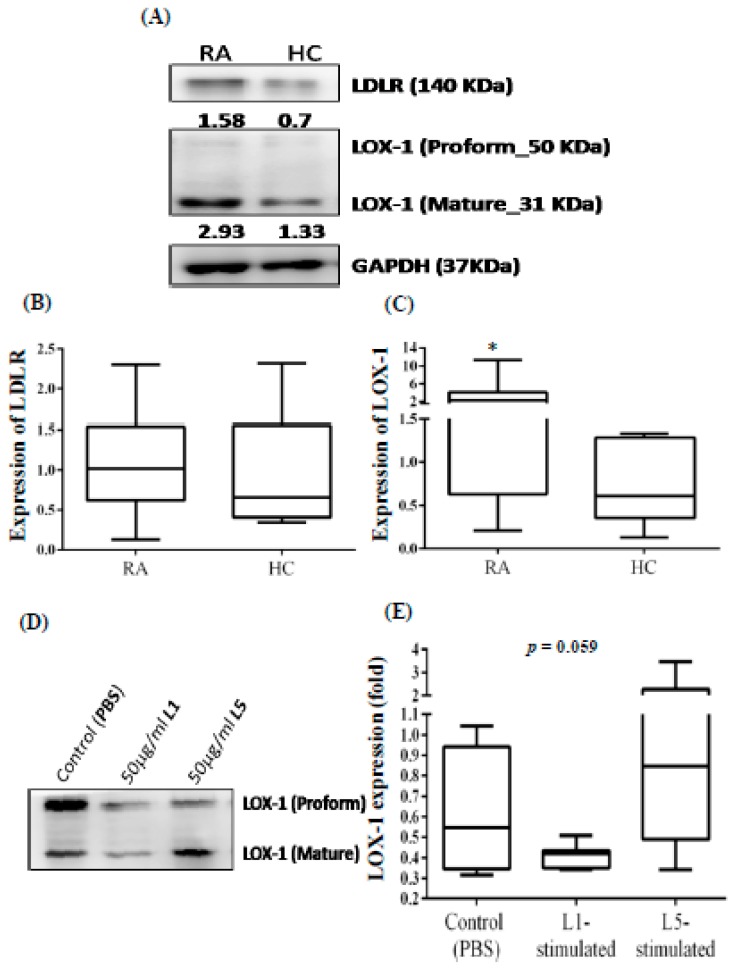
L5, the most negatively charged subfraction of low-density lipoprotein (LDL), is implicated in atherogenesis. We examined the relationship between plasma L5 levels and the occurrence of subclinical atherosclerosis in patients with rheumatoid arthritis (RA). Using anion-exchange purification with fast-protein liquid chromatography, we determined the proportion of plasma L5 of LDL (L5%) in 64 RA patients and 12 healthy controls (HC). Plasma L5% and L5 levels were significantly higher in RA patients (median, 1.4% and 1.92 mg/dL) compared with HC (0.9%, < 0.005; and 1.27 mg/dL, < 0.05) and further increased in patients with subclinical atherosclerosis (2.0% and 2.88 mg/dL). L5% and L5 levels decreased in patients after 6-months of therapy ( < 0.01). Subclinical atherosclerosis was indicated by plaque and intima-media thickness determined by carotid ultrasonography. Using multivariate analysis, L5% and L5 levels are revealed as the predictors of subclinical atherosclerosis (odds ratio, 4.94 and 1.01; both < 0.05). Receiver operating characteristic curves showed that cut-off values of L5% ≥ 1.45% and L5 levels ≥ 2.58 mg/dL could predict subclinical atherosclerosis in patients (both < 0.001). Immunoblotting showed that the expression levels of lectin-like oxidized LDL receptor-1 (LOX-1) was increased in RA patients. Together, our findings suggest that plasma L5% and L5 levels may be predictors of cardiovascular risk in RA patients.
低密度脂蛋白(LDL)中带负电荷最多的亚组分L5与动脉粥样硬化的发生有关。我们研究了类风湿关节炎(RA)患者血浆L5水平与亚临床动脉粥样硬化发生之间的关系。通过快速蛋白质液相色谱法进行阴离子交换纯化,我们测定了64例RA患者和12名健康对照者(HC)血浆中LDL的L5比例(L5%)。与HC相比,RA患者的血浆L5%和L5水平显著更高(中位数分别为1.4%和1.92mg/dL,而HC分别为0.9%,P<0.005;以及1.27mg/dL,P<0.05),并且在亚临床动脉粥样硬化患者中进一步升高(分别为2.0%和2.88mg/dL)。治疗6个月后患者的L5%和L5水平下降(P<0.01)。通过颈动脉超声检查确定的斑块和内膜中层厚度表明存在亚临床动脉粥样硬化。使用多变量分析,L5%和L5水平被揭示为亚临床动脉粥样硬化的预测指标(优势比分别为4.94和1.01;均P<0.05)。受试者工作特征曲线显示,L5%≥1.45%和L5水平≥2.58mg/dL的临界值可预测患者的亚临床动脉粥样硬化(均P<0.001)。免疫印迹显示,RA患者中凝集素样氧化LDL受体-1(LOX-1)的表达水平升高。总之,我们的研究结果表明,血浆L5%和L5水平可能是RA患者心血管风险的预测指标。