West China School of Basic Medical Sciences & Forensic Medicine, and State Key Laboratory of Biotherapy, Sichuan University, and Collaborative Innovation Center for Biotherapy, Chengdu 610041, China.
Department of Biomedical Sciences, University of North Dakota, Grand Forks, ND 58203, USA.
Cells. 2019 Feb 3;8(2):123. doi: 10.3390/cells8020123.
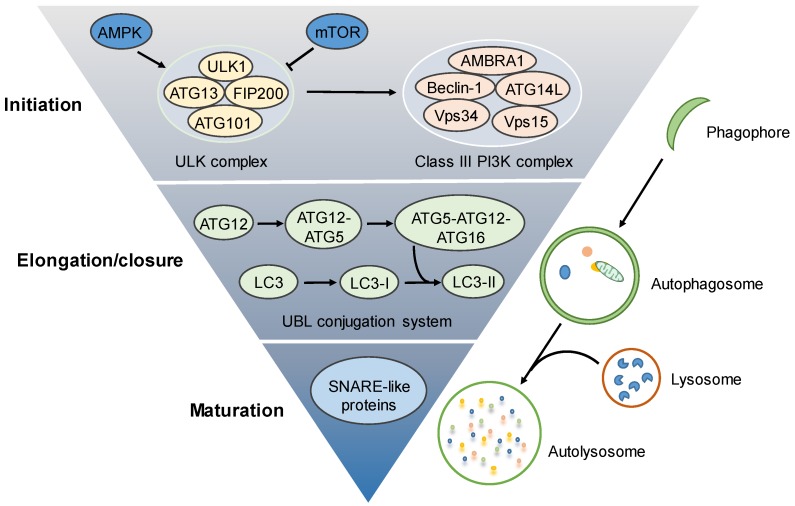
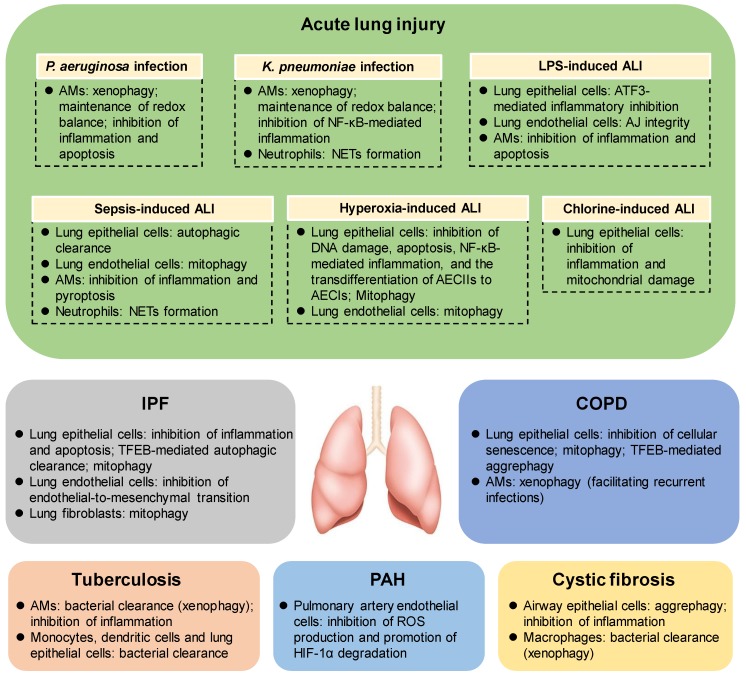
Autophagy is a highly conserved catabolic process involving autolysosomal degradation of cellular components, including protein aggregates, damaged organelles (such as mitochondria, endoplasmic reticulum, and others), as well as various pathogens. Thus, the autophagy pathway represents a major adaptive response for the maintenance of cellular and tissue homeostasis in response to numerous cellular stressors. A growing body of evidence suggests that autophagy is closely associated with diverse human diseases. Specifically, acute lung injury (ALI) and inflammatory responses caused by bacterial infection or xenobiotic inhalation (e.g., chlorine and cigarette smoke) have been reported to involve a spectrum of alterations in autophagy phenotypes. The role of autophagy in pulmonary infection and inflammatory diseases could be protective or harmful dependent on the conditions. In this review, we describe recent advances regarding the protective features of autophagy in pulmonary diseases, with a focus on ALI, idiopathic pulmonary fibrosis (IPF), chronic obstructive pulmonary disease (COPD), tuberculosis, pulmonary arterial hypertension (PAH) and cystic fibrosis.
自噬是一种高度保守的分解代谢过程,涉及细胞成分的自噬溶酶体降解,包括蛋白质聚集体、受损的细胞器(如线粒体、内质网等)以及各种病原体。因此,自噬途径是细胞对多种细胞应激反应维持细胞和组织内稳态的主要适应反应。越来越多的证据表明,自噬与多种人类疾病密切相关。具体来说,据报道,由细菌感染或吸入异源物(如氯和香烟烟雾)引起的急性肺损伤(ALI)和炎症反应涉及自噬表型的一系列改变。自噬在肺部感染和炎症性疾病中的作用可能取决于具体情况而具有保护作用或有害作用。在这篇综述中,我们描述了自噬在肺部疾病中的保护作用的最新进展,重点介绍了急性肺损伤(ALI)、特发性肺纤维化(IPF)、慢性阻塞性肺疾病(COPD)、肺结核、肺动脉高压(PAH)和囊性纤维化。