Physical and Theoretical Chemistry Laboratory, University of Oxford, OX1 3QZ Oxford, United Kingdom
Proc Natl Acad Sci U S A. 2019 Feb 19;116(8):2814-2820. doi: 10.1073/pnas.1820450116. Epub 2019 Feb 4.
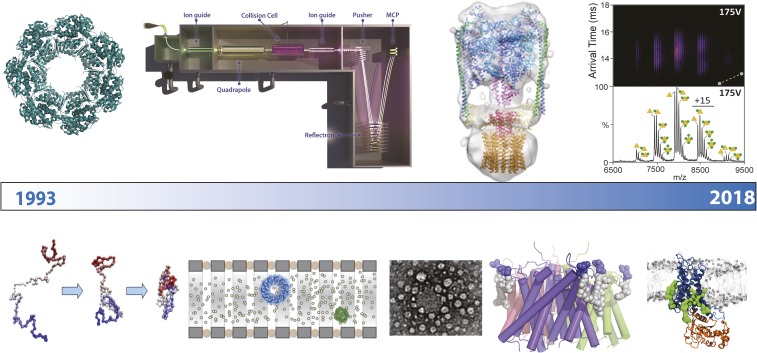
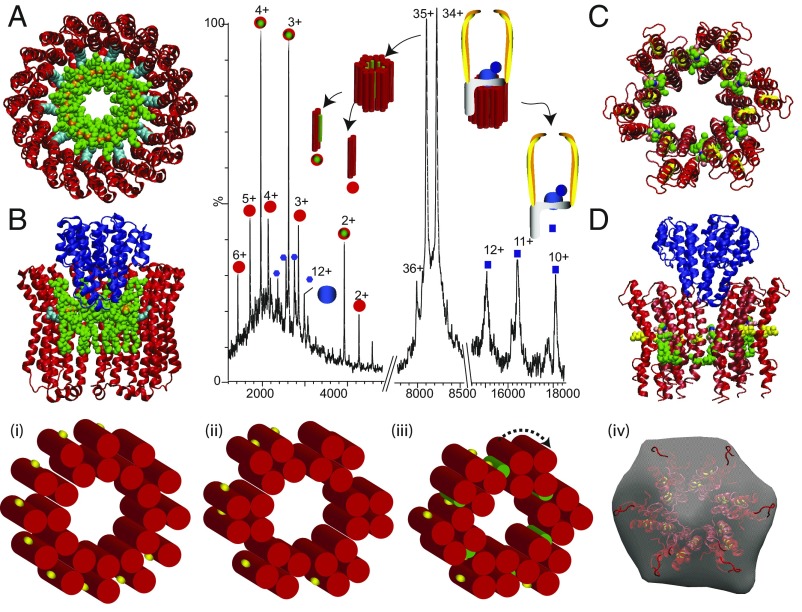
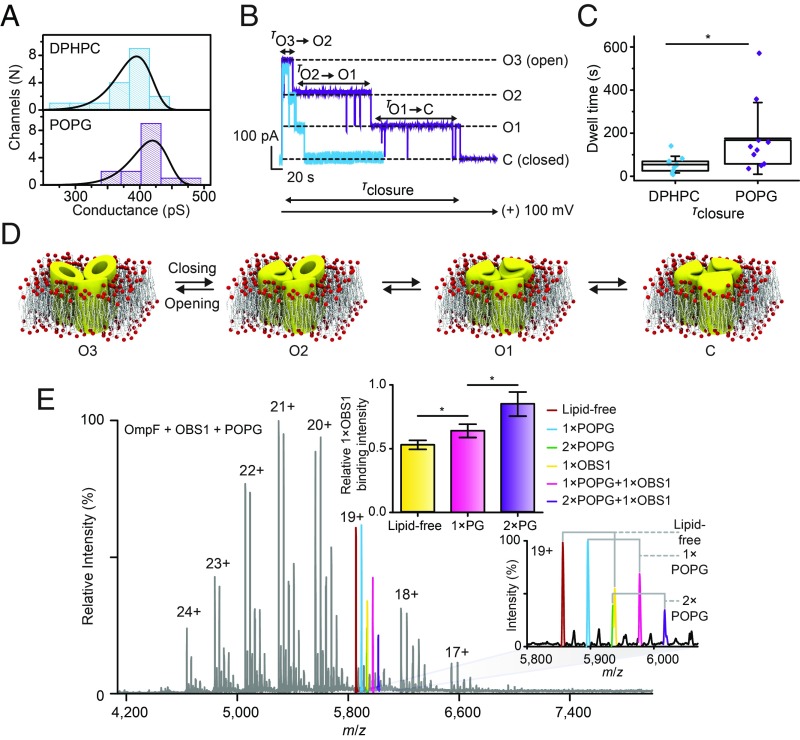
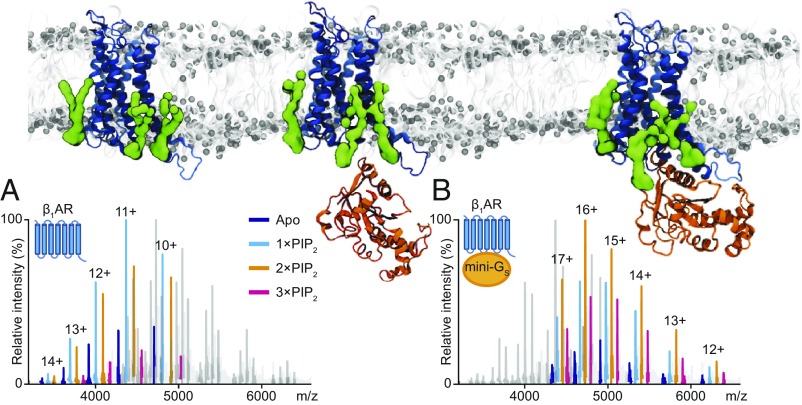
In this Inaugural Article, I trace some key steps that have enabled the development of mass spectrometry for the study of intact protein complexes from a variety of cellular environments. Beginning with the preservation of the first soluble complexes from plasma, I describe our early experiments that capitalize on the heterogeneity of subunit composition during assembly and exchange reactions. During these investigations, we observed many assemblies and intermediates with different subunit stoichiometries, and were keen to ascertain whether or not their overall topology was preserved in the mass spectrometer. Adapting ion mobility and soft-landing methodologies, we showed how ring-shaped complexes could survive the phase transition. The next logical progression from soluble complexes was to membrane protein assemblies but this was not straightforward. We encountered many pitfalls along the way, largely due to the use of detergent micelles to protect and stabilize complexes. Further obstacles presented when we attempted to distinguish lipids that copurify from those that are important for function. Developing new experimental protocols, we have subsequently defined lipids that change protein conformation, mediate oligomeric states, and facilitate downstream coupling of G protein-coupled receptors. Very recently, using a radical method-ejecting protein complexes directly from native membranes into mass spectrometers-we provided insights into associations within membranes and mitochondria. Together, these developments suggest the beginnings of mass spectrometry meeting with cell biology.
在这篇创刊文章中,我追溯了一些关键步骤,这些步骤使得从各种细胞环境中研究完整蛋白质复合物的质谱技术得以发展。从保留来自血浆的第一个可溶性复合物开始,我描述了我们的早期实验,这些实验利用了组装和交换反应过程中亚基组成的异质性。在这些研究中,我们观察到许多具有不同亚基比例的组装体和中间体,并且非常想确定它们的整体拓扑结构是否在质谱仪中得到了保留。通过适应离子淌度和软着陆方法,我们展示了环形复合物如何在相变中存活下来。从可溶性复合物下一步逻辑上的进展是膜蛋白复合物,但这并不简单。我们在这个过程中遇到了许多陷阱,主要是由于使用去污剂胶束来保护和稳定复合物。当我们试图区分与功能相关的共纯化脂质和那些不重要的脂质时,又出现了进一步的障碍。通过开发新的实验方案,我们随后确定了改变蛋白质构象、调节寡聚状态和促进 G 蛋白偶联受体下游偶联的脂质。就在最近,我们使用一种激进的方法——直接将蛋白质复合物从天然膜中弹出到质谱仪中——深入了解了膜和线粒体中的相互作用。总之,这些发展表明质谱技术开始与细胞生物学相结合。