Marine Genomics Unit, Okinawa Institute of Science and Technology Graduate University, Onna, Okinawa, 904-0495, Japan.
Instrumental Analysis Section, Okinawa Institute of Science and Technology Graduate University, Onna, Okinawa, 904-0495, Japan.
Sci Rep. 2019 Feb 4;9(1):1204. doi: 10.1038/s41598-018-37792-0.
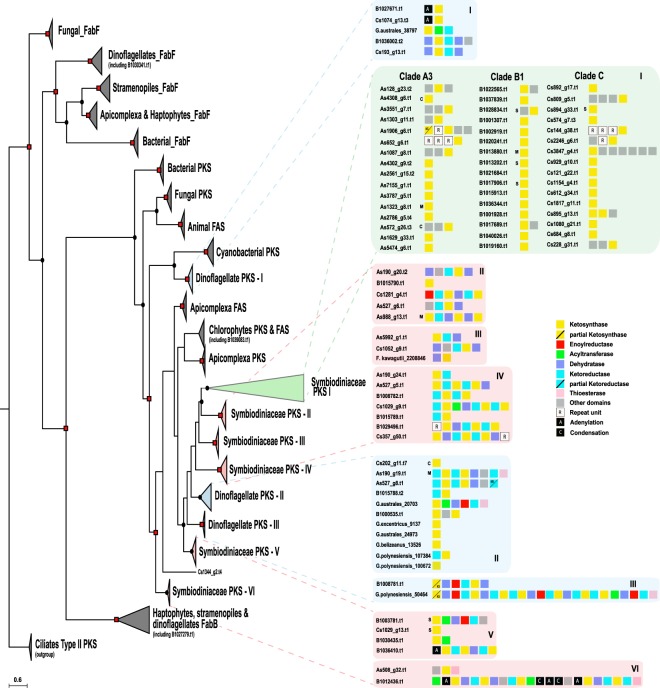
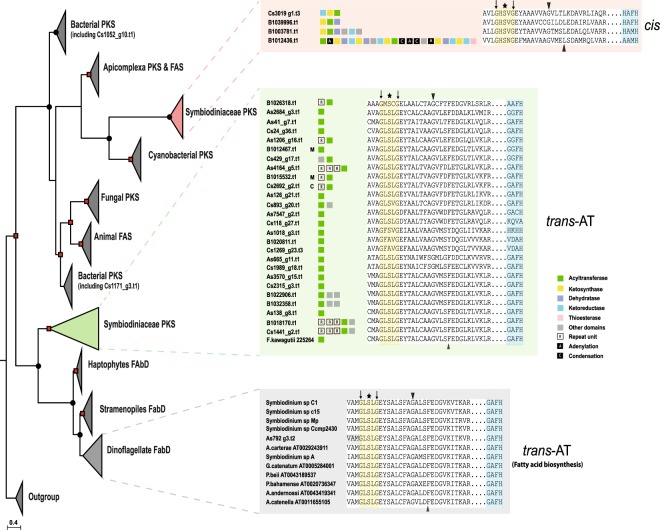
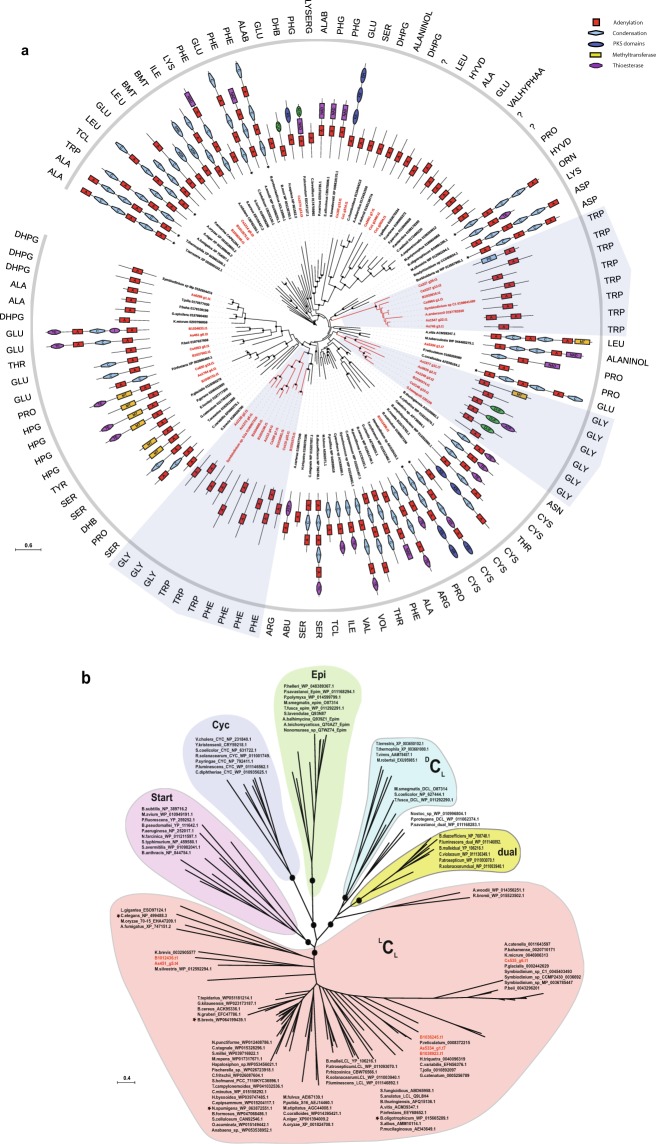
Symbiodiniaceae dinoflagellates possess smaller nuclear genomes than other dinoflagellates and produce structurally specialized, biologically active, secondary metabolites. Till date, little is known about the evolution of secondary metabolism in dinoflagellates as comparative genomic approaches have been hampered by their large genome sizes. Here, we overcome this challenge by combining genomic and metabolomics approaches to investigate how chemical diversity arises in three decoded Symbiodiniaceae genomes (clades A3, B1 and C). Our analyses identify extensive diversification of polyketide synthase and non-ribosomal peptide synthetase genes from two newly decoded genomes of Symbiodinium tridacnidorum (A3) and Cladocopium sp. (C). Phylogenetic analyses indicate that almost all the gene families are derived from lineage-specific gene duplications in all three clades, suggesting divergence for environmental adaptation. Few metabolic pathways are conserved among the three clades and we detect metabolic similarity only in the recently diverged clades, B1 and C. We establish that secondary metabolism protein architecture guides substrate specificity and that gene duplication and domain shuffling have resulted in diversification of secondary metabolism genes.
虫黄藻中的共生甲藻拥有比其他甲藻更小的核基因组,并产生结构特殊、具有生物活性的次生代谢物。迄今为止,由于比较基因组学方法受到其庞大基因组大小的阻碍,对甲藻次生代谢物进化的了解甚少。在这里,我们通过结合基因组学和代谢组学方法来研究三种已解码的共生甲藻基因组(A3、B1 和 C 类)中化学多样性是如何产生的。我们的分析确定了两种新解码的共生甲藻(三角褐指藻(A3)和 Cladocopium sp.(C))中的聚酮合酶和非核糖体肽合酶基因的广泛多样化。系统发育分析表明,几乎所有的基因家族都源自这三个类群中谱系特异性基因的重复,这表明了为适应环境而产生的分化。在这三个类群中很少有代谢途径是保守的,我们只在最近分化的 B1 和 C 类群中检测到代谢相似性。我们确定了次生代谢物蛋白结构指导底物特异性,并且基因复制和结构域改组导致了次生代谢物基因的多样化。