From the Department of Environmental Health Sciences, Mailman School of Public Health, Columbia University Medical Center, New York, NY.
Department of Environmental Medicine and Public Health, Icahn School of Medicine at Mount Sinai, New York, NY.
Epidemiology. 2019 Mar;30(2):263-273. doi: 10.1097/EDE.0000000000000962.
Trace metal concentrations may affect cardiometabolic risk, but the role of prenatal exposure is unclear. We examined (1) the relation between blood metal concentrations during pregnancy and child cardiometabolic risk factors; (2) overall effects of metals mixture (essential vs. nonessential); and (3) interactions between metals.
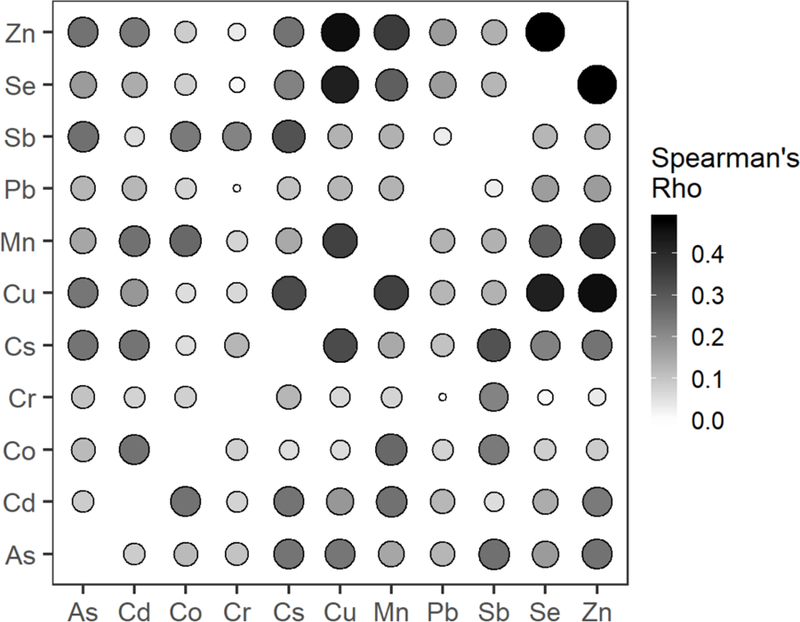
We measured 11 metals in maternal second-trimester whole blood in a prospective birth cohort in Mexico City. In children 4-6 years old, we measured body mass index (BMI), percent body fat, and blood pressure (N = 609); and plasma hemoglobin A1C (HbA1c), non-high-density lipoprotein (HDL) cholesterol, triglycerides, leptin, and adiponectin (N = 411). We constructed cardiometabolic component scores using age- and sex-adjusted z scores and averaged five scores to create a global risk score. We estimated linear associations of each metal with individual z scores and used Bayesian Kernel Machine Regression to assess metal mixtures and interactions.
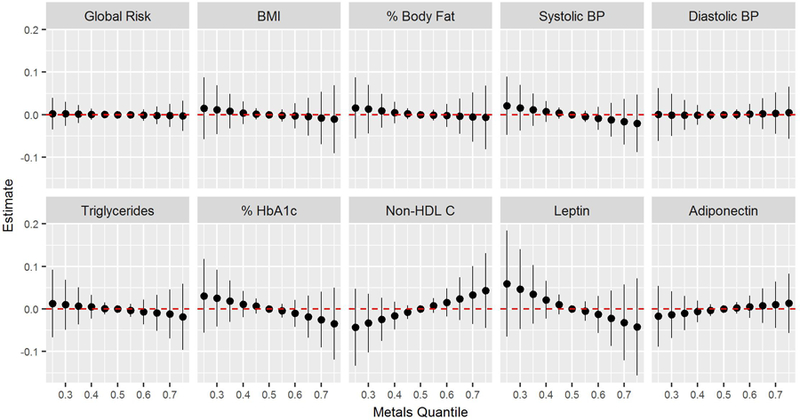
Higher total metals were associated with lower HbA1c, leptin, and systolic blood pressure, and with higher adiponectin and non-HDL cholesterol. We observed no interactions between metals. Higher selenium was associated with lower triglycerides in linear (β = -1.01 z score units per 1 unit ln(Se), 95% CI = -1.84, -0.18) and Bayesian Kernel Machine Regression models. Manganese was associated with decreased HbA1c in linear models (β = -0.32 and 95% CI = -0.61, -0.03). Antimony and arsenic were associated with lower leptin in Bayesian Kernel Machine Regression models. Essential metals were more strongly associated with cardiometabolic risk than were nonessential metals.
Low essential metals during pregnancy were associated with increased cardiometabolic risk factors in childhood.
痕量金属浓度可能会影响心脏代谢风险,但产前暴露的作用尚不清楚。我们研究了 (1) 孕妇血液中金属浓度与儿童心脏代谢危险因素之间的关系;(2) 金属混合物(必需和非必需)的整体影响;以及 (3) 金属之间的相互作用。
我们在墨西哥城的一个前瞻性出生队列中测量了孕妇妊娠中期全血中的 11 种金属。在 4-6 岁的儿童中,我们测量了体重指数 (BMI)、体脂肪百分比和血压 (N=609);以及血浆血红蛋白 A1c (HbA1c)、非高密度脂蛋白 (HDL) 胆固醇、甘油三酯、瘦素和脂联素 (N=411)。我们使用年龄和性别调整后的 z 分数构建了心脏代谢成分分数,并平均五个分数以创建一个总体风险评分。我们估计了每种金属与个体 z 分数的线性关联,并使用贝叶斯核机器回归评估了金属混合物和相互作用。
总金属浓度越高,HbA1c、瘦素和收缩压越低,而脂联素和非 HDL 胆固醇越高。我们没有观察到金属之间的相互作用。线性 (β=-1.01 z 分数单位/1 单位 ln(Se),95%CI=-1.84,-0.18) 和贝叶斯核机器回归模型均显示,硒浓度越高,甘油三酯越低。线性模型中,锰与 HbA1c 降低相关 (β=-0.32,95%CI=-0.61,-0.03)。贝叶斯核机器回归模型显示,锑和砷与瘦素降低相关。必需金属与非必需金属相比,与心脏代谢风险因素的相关性更强。
孕妇怀孕期间低水平的必需金属与儿童时期更多的心脏代谢危险因素相关。