Department of Health Information Technology, University of California, Los Angeles, California, United States.
Department of Emergency Medicine, David Geffen School of Medicine at UCLA, Los Angeles, California, United States.
Appl Clin Inform. 2019 Jan;10(1):96-102. doi: 10.1055/s-0038-1677528. Epub 2019 Feb 6.
Given the widespread electronic health record adoption, there is increasing interest to leverage patient portals to improve care.
To determine characteristics of patient portal users and the activities they accessed in the patient portal.
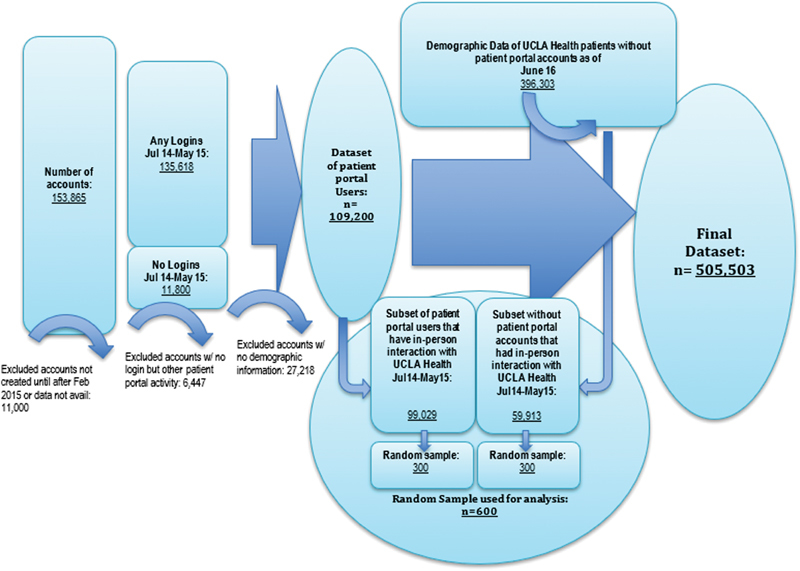
We performed a retrospective analysis of patient portal usage at University of California, Los Angeles, Health from July 2014 to May 2015. A total dataset of 505,503 patients was compiled with 396,303 patients who did not register for the patient portal and 109,200 patients who registered for a patient portal account. We compared patients who did not register for the online portal to the top 75th percentile of users based on number of logins, which was done to exclude those who only logged in to register. Finally, to avoid doing statistical analysis on too large of a sample and overpower the analysis, we performed statistical tests on a random sample of 300 patients in each of the two groups.
Patient portal users tended to be older (49.45 vs. 46.22 years in the entire sample, = 0.008 in the random sample) and more likely female (62.59 vs. 54.91% in the entire sample, = 0.035 in the random sample). Nonusers had more monthly emergency room (ER) visits on average (0.047 vs. 0.014, < 0.001). The most frequently accessed activity on the portal was viewing laboratory results (79.7% of users looked at laboratory results).
There are differences between patient portal users and nonusers, and further understanding of these differences can serve as foundation for further investigation and possible interventions to drive patient engagement and health outcomes.
鉴于电子健康记录的广泛采用,人们越来越有兴趣利用患者门户来改善医疗服务。
确定患者门户用户的特征以及他们在患者门户中访问的活动。
我们对 2014 年 7 月至 2015 年 5 月期间加州大学洛杉矶分校健康患者门户的使用情况进行了回顾性分析。我们编制了一个包含 505503 名患者的总数据集,其中 396303 名患者未注册患者门户,109200 名患者注册了患者门户账户。我们将未注册在线门户的患者与登录次数最多的前 75%的患者进行了比较,这样做是为了排除那些仅登录注册的患者。最后,为了避免对过大的样本进行统计分析并使分析过于强大,我们对两组中各 300 名患者的随机样本进行了统计检验。
患者门户用户往往年龄较大(整个样本中为 49.45 岁 vs. 46.22 岁,随机样本中为 0.008),更有可能是女性(整个样本中为 62.59% vs. 54.91%,随机样本中为 0.035)。非用户的平均每月急诊室(ER)就诊次数更多(0.047 次 vs. 0.014 次, < 0.001)。门户上最常访问的活动是查看实验室结果(79.7%的用户查看了实验室结果)。
患者门户用户和非用户之间存在差异,进一步了解这些差异可以为进一步调查和可能的干预措施提供基础,以促进患者参与和健康结果。