Aljubran Ali, Elshenawy Mahmoud A, Kandil Magdy, Zahir Muhammed N, Shaheen Ahmed, Gad Ahmed, Alshaer Omar, Alzahrani Ahmed, Eldali Abdelmonem, Bazarbashi Shouki
Medical Oncology Section, The Oncology Centre, King Faisal Specialist Hospital and Research Centre, Riyadh, Saudi Arabia.
Clinical Oncology Department, Faculty of Medicine, Menoufia University, Shibin El Kom, Egypt.
Clin Med Insights Oncol. 2019 Jan 30;13:1179554918825447. doi: 10.1177/1179554918825447. eCollection 2019.
Regorafenib is a multi-kinase inhibitor approved for treatment of refractory advanced colorectal cancer. It was found in the clinical trials to have a modest benefit and significant toxicity. Our aim was to assess the outcome in our local clinic practice.
Records of patients with confirmed colorectal cancer treated with regorafenib were reviewed. Clinical, pathological, and molecular data were collected. Efficacy and factors of possible prognostic significance were analyzed.
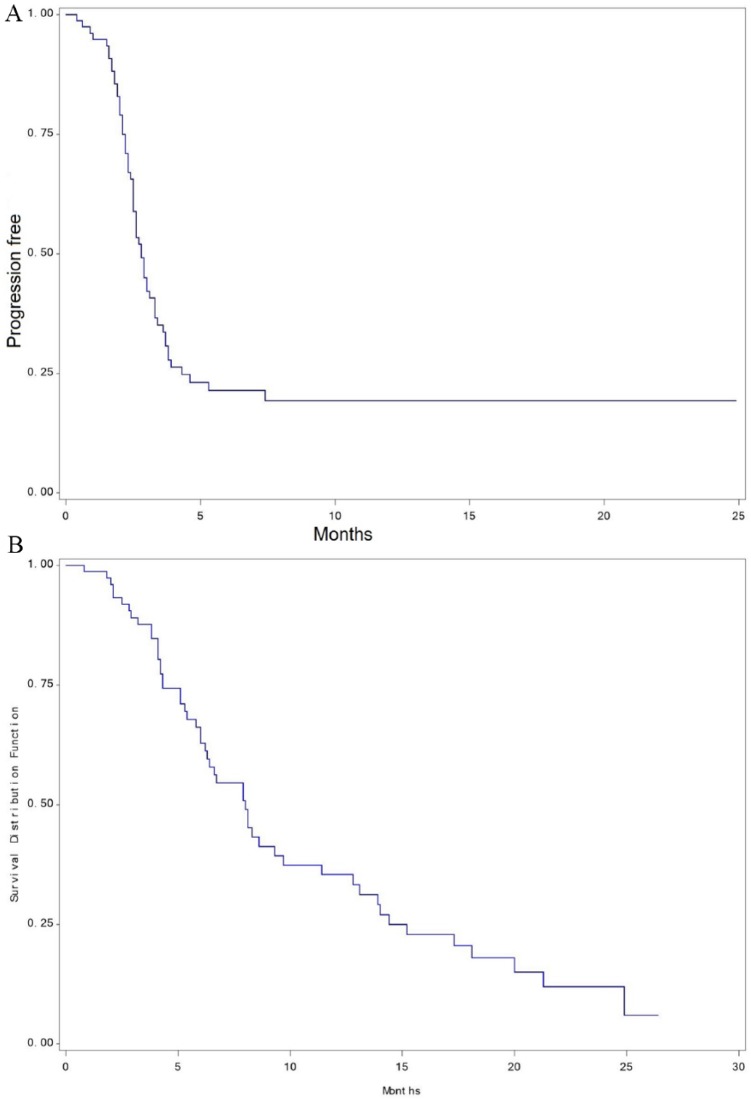
A total of 78 patients with metastatic colorectal cancer were treated with regorafenib from February 2014 to February 2016 in 4 different institutions (median age: 50.5 years; male: 40 [51.3%]; KRAS mutant: 41 [52%]; right colonic primary: 18 [23%]). A total of 52 patients (66.7%) had Eastern Cooperative Oncology Group (ECOG) Performance Status of 0 to 1, whereas in 25 patients (32.1%) it was >1. In total, 58 patients (74%) had dose reduction. No patient achieved objective response, 15 patients (19%) achieved stable disease, and 56 patients (72%) had progressive disease. With a median follow-up of 6.5 months, the median progression-free survival was 2.8 months (95% confidence interval [CI], 2.5-3.3) and overall survival was 8.0 months (95% CI, 6.2-9.7). Only performance status of ⩽1 had a statistically significant impact on progression-free survival and overall survival in both univariate and multivariate analyses.
Regorafenib in our clinical practice has equal efficacy to reported data from pivotal registration trials. Our data suggest that performance status is the most important prognostic factor in patients treated with regorafenib, suggesting a careful selection of patients.
瑞戈非尼是一种多激酶抑制剂,已被批准用于治疗难治性晚期结直肠癌。在临床试验中发现其疗效一般且毒性显著。我们的目的是评估其在本地临床实践中的治疗效果。
回顾了接受瑞戈非尼治疗的确诊结直肠癌患者的病历。收集了临床、病理和分子数据。分析了疗效及可能具有预后意义的因素。
2014年2月至2016年2月期间,4家不同机构共78例转移性结直肠癌患者接受了瑞戈非尼治疗(中位年龄:50.5岁;男性:40例[51.3%];KRAS突变型:41例[52%];右半结肠原发癌:18例[23%])。共有52例患者(66.7%)东部肿瘤协作组(ECOG)体能状态为0至1,而25例患者(32.1%)体能状态>1。总计58例患者(74%)出现剂量减少。无患者达到客观缓解,15例患者(19%)病情稳定,56例患者(72%)疾病进展。中位随访6.5个月,中位无进展生存期为2.8个月(95%置信区间[CI],2.5 - 3.3),总生存期为8.0个月(95%CI,6.2 - 9.7)。单因素和多因素分析均显示,仅体能状态⩽1对无进展生存期和总生存期有统计学显著影响。
瑞戈非尼在我们的临床实践中的疗效与关键注册试验报告的数据相当。我们的数据表明,体能状态是接受瑞戈非尼治疗患者最重要的预后因素,提示需谨慎选择患者。