Bjørnetrø Tonje, Redalen Kathrine Røe, Meltzer Sebastian, Thusyanthan Nirujah Sivarajah, Samiappan Rampradeep, Jegerschöld Caroline, Handeland Karianne Risberg, Ree Anne Hansen
Department of Oncology, Akershus University Hospital, Lørenskog, Norway.
Institute of Clinical Medicine, University of Oslo, Oslo, Norway.
J Extracell Vesicles. 2019 Jan 29;8(1):1567219. doi: 10.1080/20013078.2019.1567219. eCollection 2019.
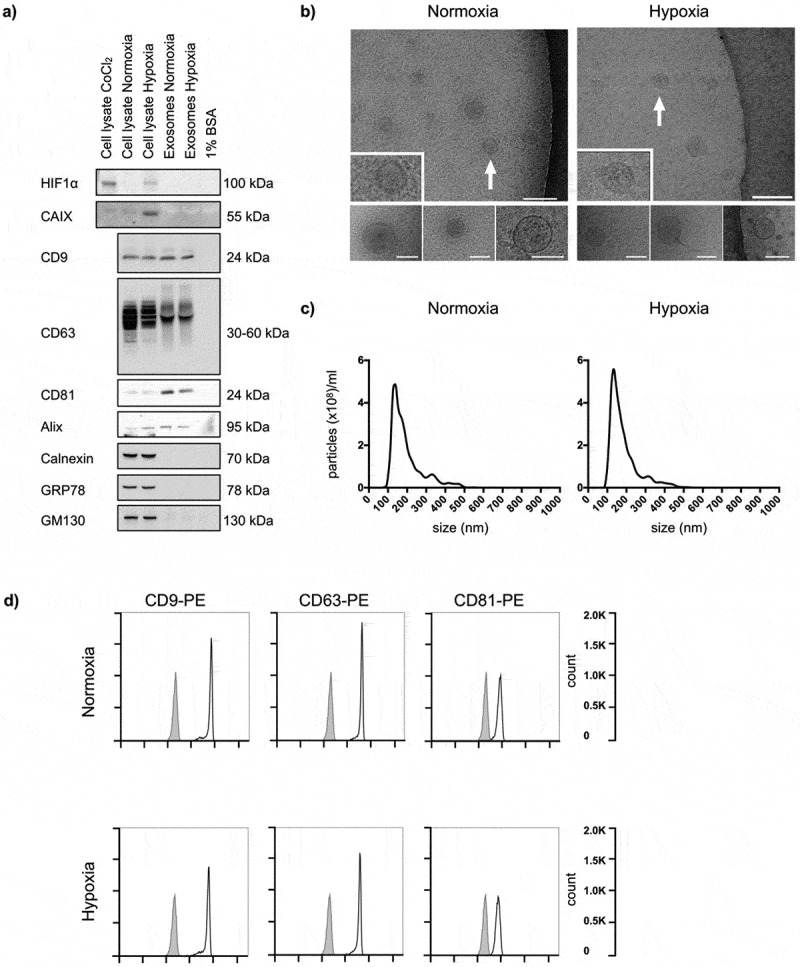
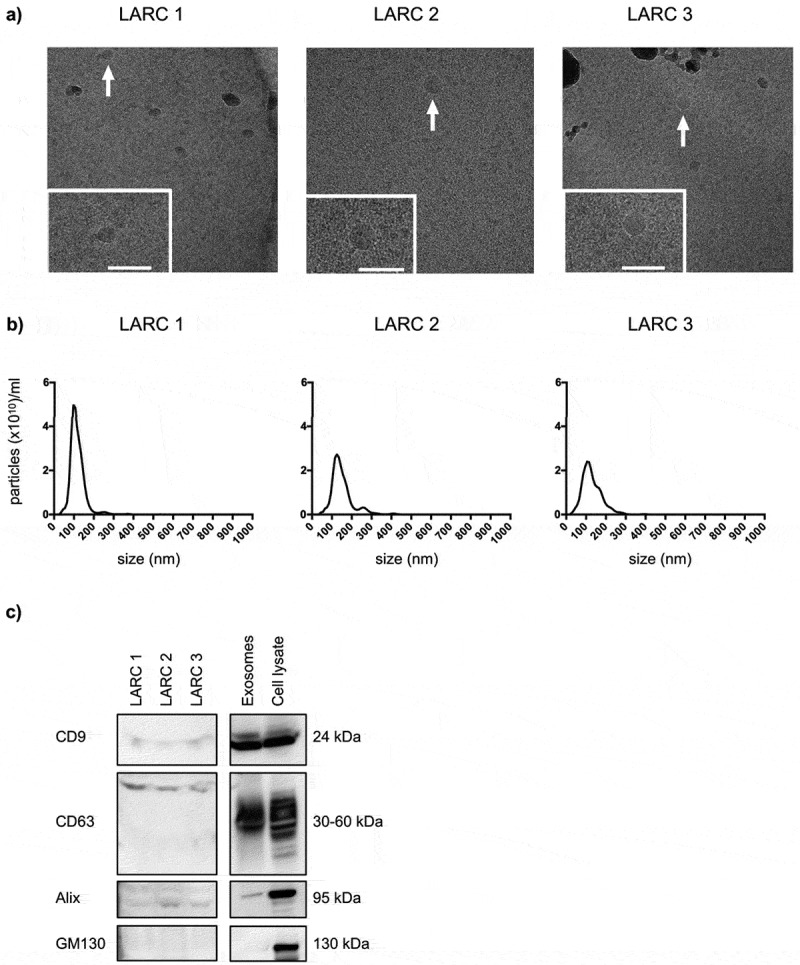
Tumour hypoxia contributes to poor treatment outcome in locally advanced rectal cancer (LARC) and circulating extracellular vesicles (EVs) as potential biomarkers of tumour hypoxia and adverse prognosis have not been fully explored. We examined EV miRNAs from hypoxic colorectal cancer cell lines as template for relevant miRNAs in LARC patients participating in a prospective biomarker study (NCT01816607). Five cell lines were cultured under normoxia (21% O) or hypoxia (0.2% O) for 24 h, and exosomes were isolated by differential ultracentrifugation. Using a commercial kit, exosomes were precipitated from 24 patient plasma samples collected at the time of diagnosis. Exosome size distribution and protein cargo were determined by cryo-electron microscopy, nanoparticle tracking analysis, immunoblotting and flow cytometry. The vesicles harboured strong cell line-specific miRNA profiles with 35 unique miRNAs differentially expressed between hypoxic and normoxic cells. Six of these miRNAs were considered candidate-circulating markers of tumour hypoxia in the patients based on the frequency or magnitude of variance in hypoxic versus normoxic cell line experiments and prevalence in patient plasma. Of these, low plasma levels of exosomal miR-486-5p and miR-181a-5p were associated with organ-invasive primary tumour ( = 0.029) and lymph node metastases ( = 0.024), respectively, both attributes of adverse LARC prognosis. In line with this, the plasma level of exosomal miR-30d-5p was elevated in patients who experienced metastatic progression ( = 0.036). Our strategy confirmed that EVs from colorectal cancer cell lines were exosomes containing the oxygen-sensitive miRNAs 486-5p, 181a-5p and 30d-5p, which were retrieved as circulating markers of high-risk LARC.
肿瘤缺氧导致局部晚期直肠癌(LARC)的治疗效果不佳,而循环细胞外囊泡(EVs)作为肿瘤缺氧和不良预后的潜在生物标志物尚未得到充分探索。我们检测了缺氧结直肠癌细胞系中的EV miRNA,作为参与一项前瞻性生物标志物研究(NCT01816607)的LARC患者相关miRNA的模板。将五种细胞系在常氧(21% O₂)或缺氧(0.2% O₂)条件下培养24小时,通过差速超速离心法分离外泌体。使用商业试剂盒,从诊断时采集的24份患者血浆样本中沉淀出外泌体。通过冷冻电子显微镜、纳米颗粒跟踪分析、免疫印迹和流式细胞术测定外泌体的大小分布和蛋白质含量。这些囊泡具有强大的细胞系特异性miRNA谱,在缺氧和常氧细胞之间有35种独特的miRNA差异表达。基于缺氧与常氧细胞系实验中的差异频率或幅度以及患者血浆中的患病率,其中六种miRNA被认为是患者肿瘤缺氧的候选循环标志物。其中,外泌体miR-486-5p和miR-181a-5p的低血浆水平分别与器官浸润性原发性肿瘤(P = 0.029)和淋巴结转移(P = 0.024)相关,这两者都是LARC不良预后的特征。与此一致,经历转移进展的患者中外泌体miR-30d-5p的血浆水平升高(P = 0.036)。我们的策略证实,结直肠癌细胞系来源的EVs是含有氧敏感miRNA 486-5p、181a-5p和30d-5p的外泌体,这些miRNA可作为高危LARC的循环标志物。