Amenu Kebede, Wieland Barbara, Szonyi Barbara, Grace Delia
Department of Microbiology, Immunology and Veterinary Public Health, College of Veterinary Medicine and Agriculture, Addis Ababa University, P. O. Box 34, Bishoftu, Ethiopia.
International Livestock Research Institute, P. O. Box 5689, Addis Ababa, Ethiopia.
J Health Popul Nutr. 2019 Feb 7;38(1):6. doi: 10.1186/s41043-019-0163-7.
Safety and wholesomeness of milk intended for human consumption are influenced by various interlinked factors. However, information on what these factors are, especially in the pastoral traditional communities of Ethiopia, is largely lacking. The objective of this study is to assess the hygienic milk production, processing and consumption practices, and behaviors of Borana pastoralists.
The study used qualitative participatory research methods. Individual semi-structured interviews, focus group discussions, informal discussions, and observations were carried out on (1) milk handling practices, (2) perceptions of quality and safety of milk, including perceived criteria for good milk, (3) awareness of milk-borne diseases, and (4) perception towards milk boiling practices. The interviews and discussions were audio recorded, transcribed, and analyzed by identifying themes.
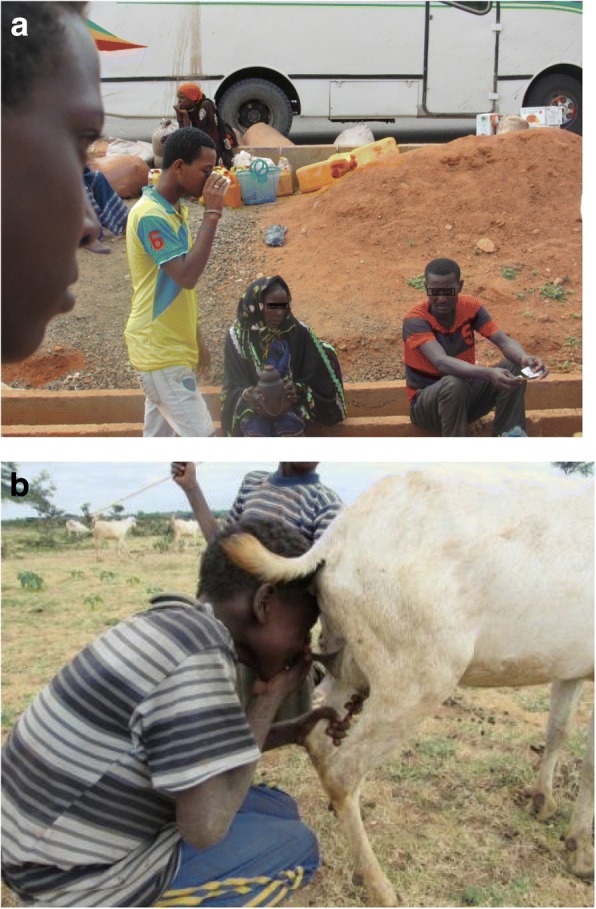
Some risky behaviors related to milk handling and consumption were identified. These include unhygienic conditions in handling milk and milk products, consumption behaviors such as consuming raw milk purchased from markets, and children directly consuming milk from the udder of animals (e.g., goats). There was a very strong reluctance to boil milk before consumption mainly because of the misconception that nutrients in the milk are destroyed when milk is boiled and "boiled milk is dead". On the other hand, potential risk mitigation practices were identified such as smoking of milk containers (which may help reduce microbial growth), processing milk through fermentation, consuming milk in boiled tea, and a recent trend towards boiling milk for babies. However, the latter was not motivated by concern over microbial hazards but the belief that raw milk could form curds in children's stomach which might then suffocate them.
The findings highlight the need to promote hygienic handling practices of milk and closely engage with local communities to improve their understanding of milk safety to facilitate change in practices. Educating pastoralists on good milk production practices should be given priority. One of the ways to do this could be by strengthening the integration of milk hygiene in research and development programs as an entry point for behavioral change towards the safe handling and consumption of milk and milk products.
供人类消费的牛奶的安全性和卫生状况受到各种相互关联的因素影响。然而,关于这些因素具体是什么的信息却极为匮乏,尤其是在埃塞俄比亚的牧区传统社区。本研究的目的是评估博拉纳牧民的牛奶生产、加工和消费卫生习惯及行为。
本研究采用定性参与式研究方法。针对以下方面开展了个人半结构化访谈、焦点小组讨论、非正式讨论及观察:(1)牛奶处理习惯;(2)对牛奶质量和安全性的认知,包括对优质牛奶的认知标准;(3)对牛奶传播疾病的认识;(4)对牛奶煮沸习惯的看法。访谈和讨论进行了录音、转录,并通过确定主题进行分析。
识别出了一些与牛奶处理和消费相关的危险行为。这些行为包括处理牛奶和奶制品时的不卫生条件、从市场购买生牛奶后直接饮用等消费行为,以及儿童直接饮用动物(如山羊)乳房中的奶。人们极不情愿在饮用前煮沸牛奶,主要原因是存在误解,认为牛奶煮沸会破坏其中的营养成分,且“煮沸的牛奶就没营养了”。另一方面,也识别出了一些潜在的风险缓解措施,如对牛奶容器进行烟熏(这可能有助于减少微生物生长)、通过发酵处理牛奶、在煮茶时饮用牛奶,以及最近出现的为婴儿煮沸牛奶的趋势。然而,后者并非出于对微生物危害的担忧,而是认为生牛奶会在儿童胃中形成凝块,进而可能导致窒息。
研究结果凸显了推广牛奶卫生处理习惯以及与当地社区密切合作以增进他们对牛奶安全的理解,从而促进习惯改变的必要性。应优先向牧民传授良好的牛奶生产习惯。实现这一目标的途径之一可能是加强将牛奶卫生纳入研发项目,以此作为促使人们改变行为以安全处理和消费牛奶及奶制品的切入点。