Oncology Group, Institute for Infection and Immunity, St. George's, University of London, London, UK.
Sci Rep. 2019 Feb 7;9(1):1544. doi: 10.1038/s41598-018-38190-2.
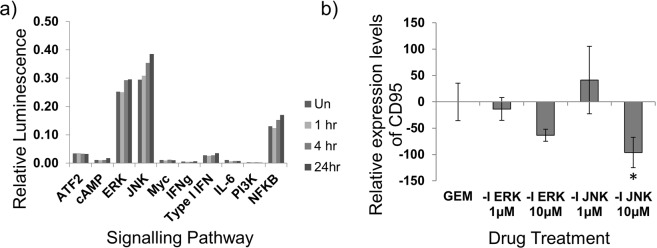
Much effort has been made to try to understand the relationship between chemotherapeutic treatment of cancer and the immune system. Whereas much of that focus has been on the direct effect of chemotherapy drugs on immune cells and the release of antigens and danger signals by malignant cells killed by chemotherapy, the effect of chemotherapy on cells surviving treatment has often been overlooked. In the present study, tumour cell lines: A549 (lung), HCT116 (colon) and MCF-7 (breast), were treated with various concentrations of the chemotherapeutic drugs cyclophosphamide, gemcitabine (GEM) and oxaliplatin (OXP) for 24 hours in vitro. In line with other reports, GEM and OXP upregulated expression of the death receptor CD95 (fas) on live cells even at sub-cytotoxic concentrations. Further investigation revealed that the increase in CD95 in response to GEM sensitised the cells to fas ligand treatment, was associated with increased phosphorylation of stress activated protein kinase/c-Jun N-terminal kinase and that other death receptors and activatory immune receptors were co-ordinately upregulated with CD95 in certain cell lines. The upregulation of death receptors and NKG2D ligands together on cells after chemotherapy suggest that although the cells have survived preliminary treatment with chemotherapy they may now be more susceptible to immune cell-mediated challenge. This re-enforces the idea that chemotherapy-immunotherapy combinations may be useful clinically and has implications for the make-up and scheduling of such treatments.
人们付出了大量努力来试图了解癌症的化疗治疗与免疫系统之间的关系。尽管其中大部分重点是化疗药物对免疫细胞的直接作用,以及化疗杀死的恶性细胞释放抗原和危险信号,但化疗对幸存细胞的影响往往被忽视。在本研究中,体外将不同浓度的化疗药物环磷酰胺、吉西他滨(GEM)和奥沙利铂(OXP)处理肿瘤细胞系 A549(肺)、HCT116(结肠)和 MCF-7(乳腺)24 小时。与其他报道一致,GEM 和 OXP 甚至在亚细胞毒性浓度下就上调了活细胞表面死亡受体 CD95(fas)的表达。进一步的研究表明,GEM 诱导的 CD95 增加使细胞对 fas 配体处理敏感,与应激激活蛋白激酶/c-Jun N-末端激酶的磷酸化增加有关,并且在某些细胞系中,其他死亡受体和激活免疫受体与 CD95 协调上调。化疗后细胞表面死亡受体和 NKG2D 配体的共同上调表明,尽管细胞已经在化疗的初步治疗中幸存下来,但它们现在可能更容易受到免疫细胞介导的挑战。这进一步证实了化疗-免疫治疗联合应用在临床上可能是有用的观点,并对这种治疗的组成和安排产生影响。