Serviço de Cirurgia de Cabeça e Pescoço, Hospital Heliópolis, São Paulo, São Paulo, Brazil.
PLoS One. 2013 Jul 19;8(7):e69024. doi: 10.1371/journal.pone.0069024. Print 2013.
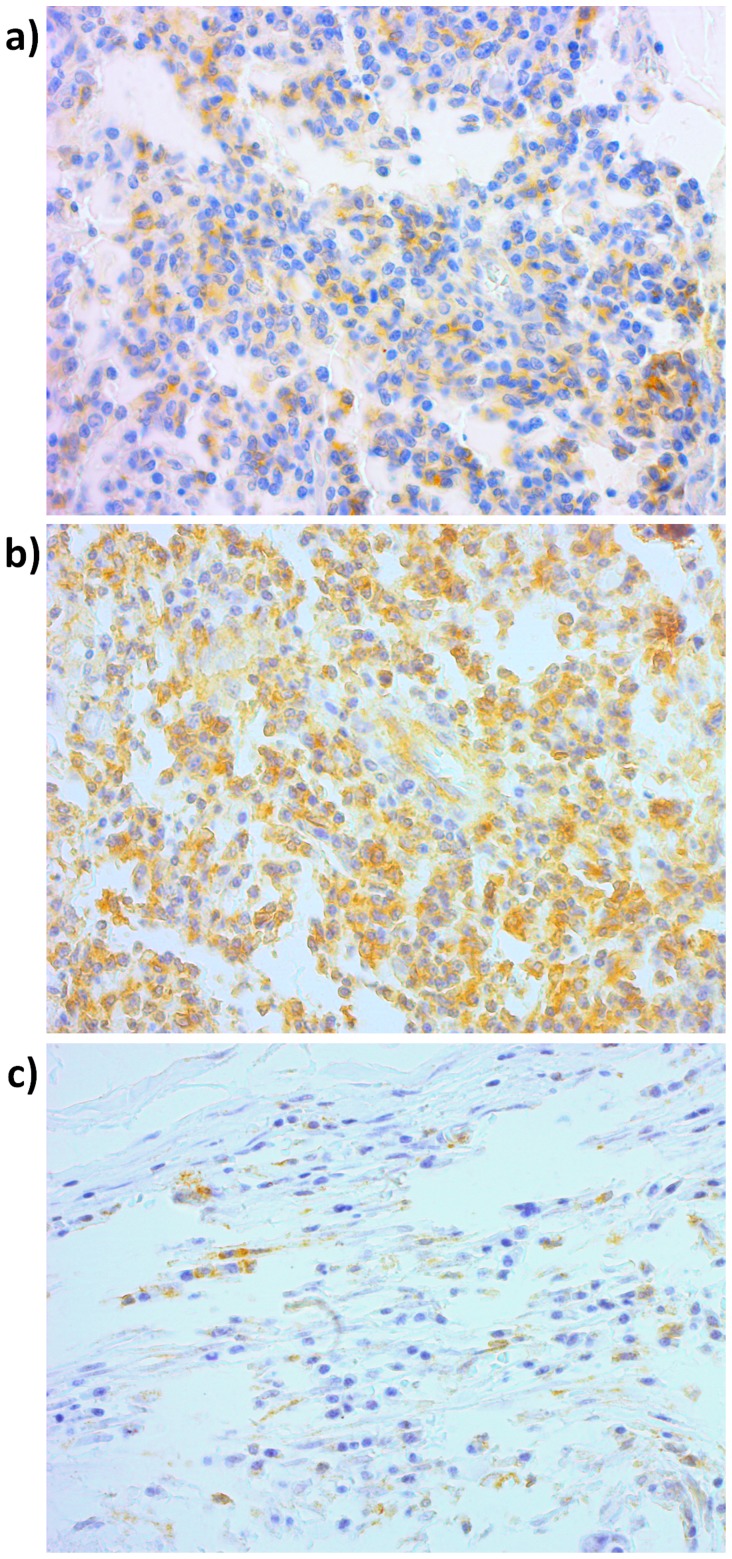
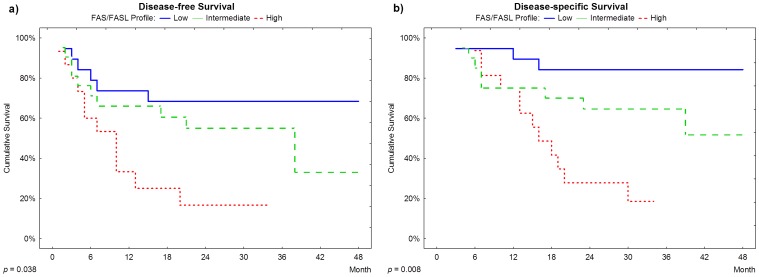
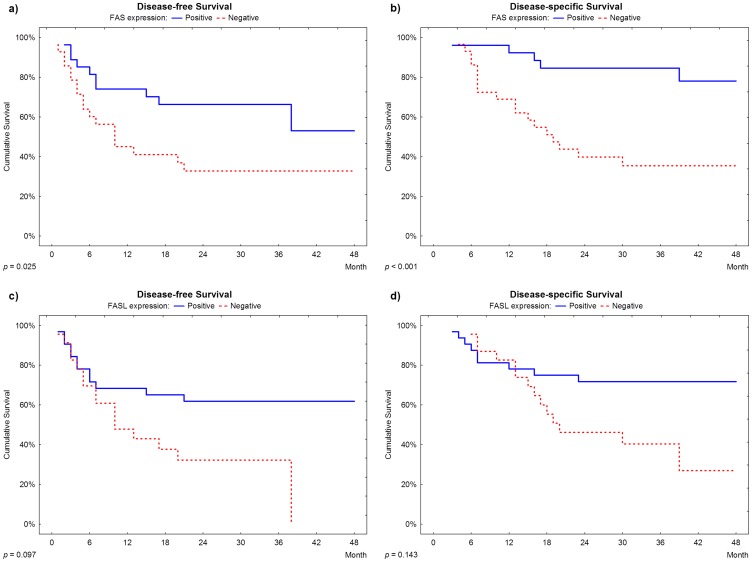
FAS/FASL altered expression may cause tumor protecting immunomodulation, with a direct impact on patient prognosis. FAS expression was studied in 60 squamous cell carcinomas of the oral cavity. FAS expression did not show a significant association with tumor histopathological characteristics, but was significantly associated with lymph node positivity. FAS expression was significantly associated with disease specific death and negative FAS expression was an independent risk factor, increasing risk 4 times when compared to positive expression. When FAS and FASL expression results were combined, we were able to define high, intermediate and low risk profiles. Disease-free and disease-specific survival were significantly correlated with FAS/FASL expression profiles. The high risk category was an independent marker for earlier disease relapse and disease-specific death, with approximately 4- and 6-fold increased risk, respectively, when compared to the low risk profile. Risk profiles based on FAS/FASL expression showed that high risk was significantly associated with increased disease relapse and death, as well as shorter disease-free or disease-specific survival. This categorization, added to patient clinical data, may facilitate the choice of therapy, minimizing treatment failure and increasing disease control.
FAS/FASL 表达改变可能导致肿瘤保护免疫调节,直接影响患者的预后。研究了 60 例口腔鳞状细胞癌中 FAS 的表达。FAS 表达与肿瘤组织病理学特征无显著相关性,但与淋巴结阳性显著相关。FAS 表达与疾病特异性死亡显著相关,阴性 FAS 表达是独立的危险因素,与阳性表达相比,风险增加 4 倍。当结合 FAS 和 FASL 表达结果时,我们能够定义高、中、低风险谱。无病生存率和疾病特异性生存率与 FAS/FASL 表达谱显著相关。高危组是疾病复发和疾病特异性死亡的独立标志物,与低危组相比,风险分别增加了约 4 倍和 6 倍。基于 FAS/FASL 表达的风险谱表明,高危与疾病复发和死亡增加以及无病或疾病特异性生存率缩短显著相关。这种分类结合患者的临床数据,可以帮助选择治疗方案,最大限度地减少治疗失败并增加疾病控制。