Lateef Shan, Holman Aubrie, Carpenter Jessica, James Jennifer
Jefferson Underclassman Multidisciplinary Laboratory (JUMP Lab), Thomas Jefferson High School for Science and Technology, Alexandria, VA, USA.
Children's National Health System and School of Medicine and Health Sciences, The George Washington University, Washington, DC, USA.
J Exp Neurosci. 2019 Jan 21;13:1179069518824852. doi: 10.1177/1179069518824852. eCollection 2019.
BACKGROUND/MAIN OBJECTIVES: No effective strategy exists to treat the well-recognized, devastating impact of traumatic brain injury (TBI) and chronic traumatic encephalopathy (CTE), which is the brain degeneration likely caused by repeated head trauma. The goals of this project were (1) to study the effects of single and recurrent TBI (rTBI) on (a) life span, (b) response to sedatives, and (c) behavioral responses to light and gravity and (2) to determine whether therapeutic hypothermia can mitigate the deleterious effects of TBI.
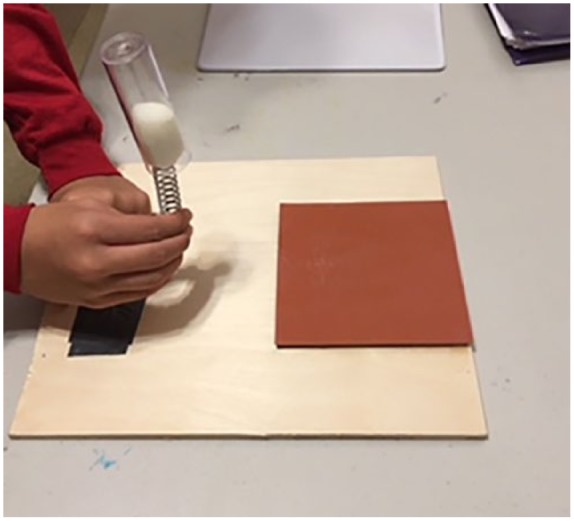
Five experimental groups were created: (1) control, (2) single TBI or concussion; (3) concussion + hypothermia, (4) rTBI, and (5) rTBI + hypothermia. A "high-impact trauma" (HIT) device was built, which used a spring-based mechanism to propel flies against the wall of a vial, causing mechanical damage to the brain. Hypothermia groups were cooled to 15°C for 3 minutes. Group differences were analyzed with chi-square tests for the categorical variables and with ANOVA tests for the continuous variables.
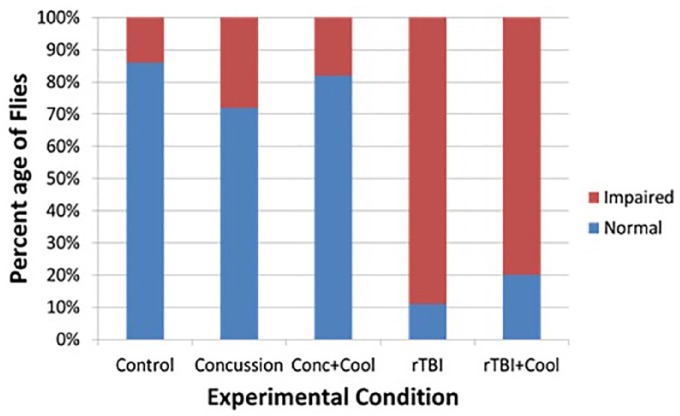
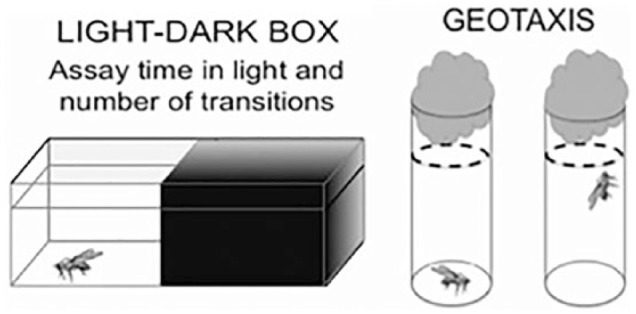
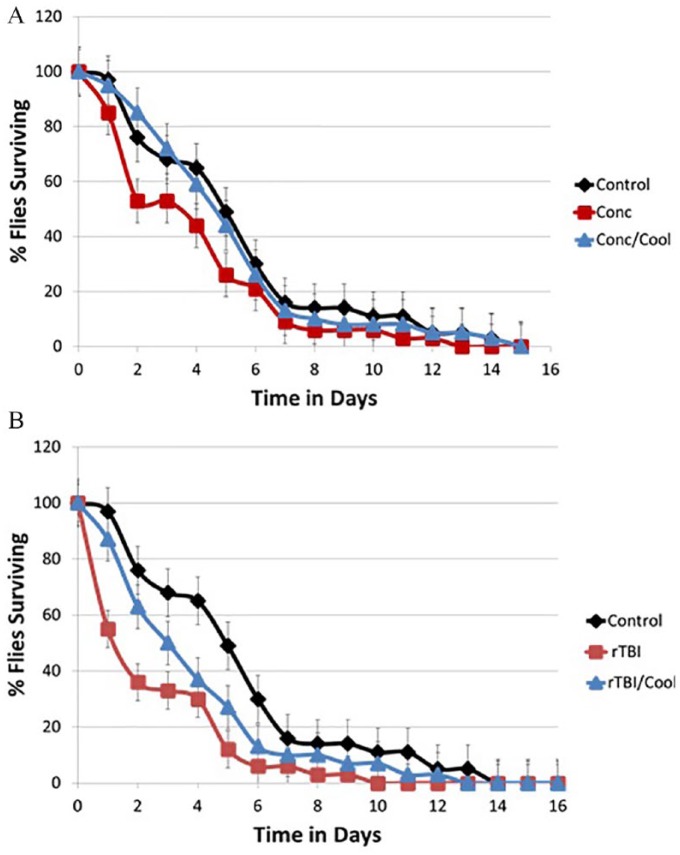
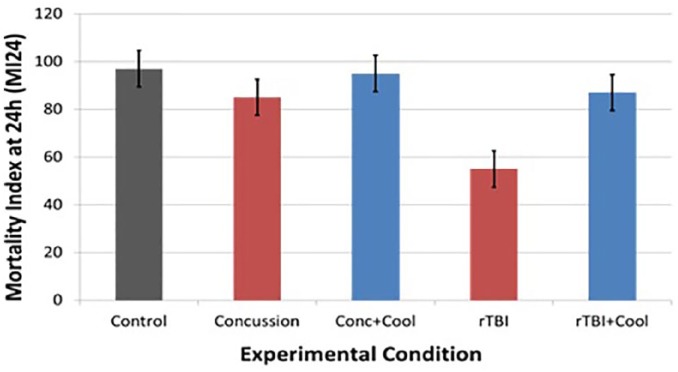
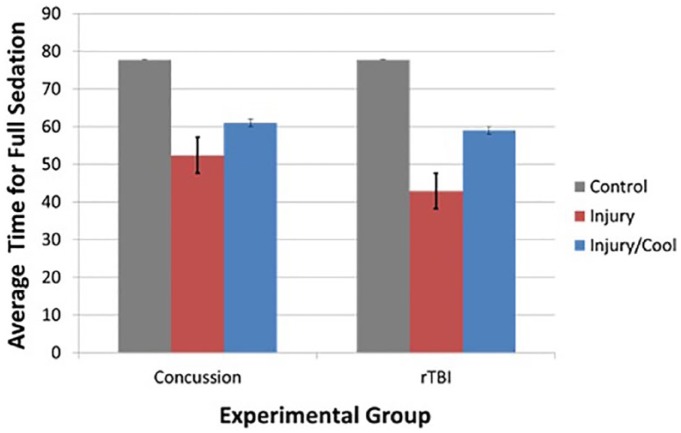
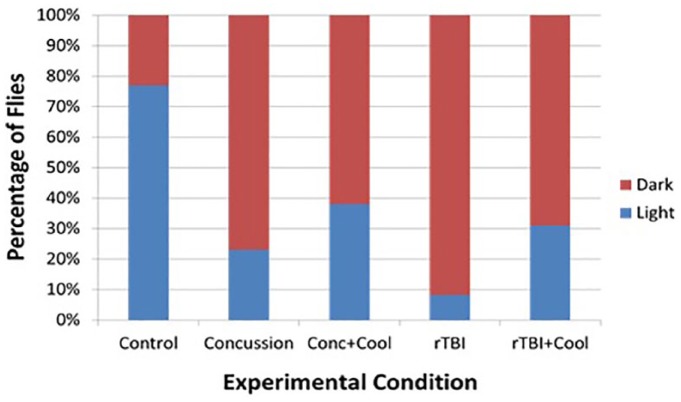
Survival curve analysis showed that rTBI can decrease lifespan and hypothermia diminished this impact. Average sedation time for control vs concussion vs concussion + hypothermia was 78 vs 52 vs 61 seconds ( < .0001). Similarly, rTBI vs rTBI/hypothermia groups took 43 vs 59 seconds ( < .0001). Concussed flies preferred dark environments compared with control flies (risk ratio 3.3, < .01) while flies who were concussed and cooled had a risk ratio of 2.7 ( < .01). Flies with rTBI were almost 4 times likely to prefer the dark environment but only 3 times as likely if they were cooled, compared with controls. Geotaxis was significantly affected by rTBI only and yet less so if rTBI flies were cooled.
Hypothermia successfully mitigated many deleterious effects of single TBI and rTBI in and may represent a promising breakthrough in the treatment of human TBI.
背景/主要目标:对于创伤性脑损伤(TBI)和慢性创伤性脑病(CTE,可能由反复头部创伤导致的脑退化)所造成的公认的毁灭性影响,目前尚无有效的治疗策略。本项目的目标是:(1)研究单次和反复创伤性脑损伤(rTBI)对(a)寿命、(b)对镇静剂的反应以及(c)对光和重力的行为反应的影响;(2)确定治疗性低温是否能减轻创伤性脑损伤的有害影响。
设立了五个实验组:(1)对照组;(2)单次创伤性脑损伤或脑震荡组;(3)脑震荡+低温治疗组;(4)反复创伤性脑损伤组;(5)反复创伤性脑损伤+低温治疗组。构建了一种“高冲击创伤”(HIT)装置,该装置利用弹簧机制将果蝇推向小瓶壁,对脑部造成机械损伤。低温治疗组被冷却至15°C持续3分钟。分类变量采用卡方检验分析组间差异,连续变量采用方差分析。
生存曲线分析表明,反复创伤性脑损伤会缩短寿命,而低温治疗可减轻这种影响。对照组、脑震荡组和脑震荡+低温治疗组的平均镇静时间分别为78秒、52秒和61秒(P<0.0001)。同样,反复创伤性脑损伤组和反复创伤性脑损伤+低温治疗组分别为43秒和59秒(P<0.0001)。与对照组相比,脑震荡果蝇更喜欢黑暗环境(风险比3.3,P<0.01),而脑震荡并接受低温治疗的果蝇风险比为2.7(P<0.01)。与对照组相比,反复创伤性脑损伤果蝇选择黑暗环境的可能性几乎是其4倍,但接受低温治疗后则仅为3倍。趋地性仅受反复创伤性脑损伤显著影响,而反复创伤性脑损伤果蝇接受低温治疗后影响较小。
低温治疗成功减轻了单次创伤性脑损伤和反复创伤性脑损伤在果蝇中的许多有害影响,可能代表了人类创伤性脑损伤治疗的一个有前景的突破。