Mukherjee Shradha, Klaus Christine, Pricop-Jeckstadt Mihaela, Miller Jeremy A, Struebing Felix L
Health Informatics Advanced Science Masters Program, Arizona State University, Tempe, AZ, United States.
Department of Neurology, University of California, Los Angeles, Los Angeles, CA, United States.
Front Neurosci. 2019 Jan 24;13:2. doi: 10.3389/fnins.2019.00002. eCollection 2019.
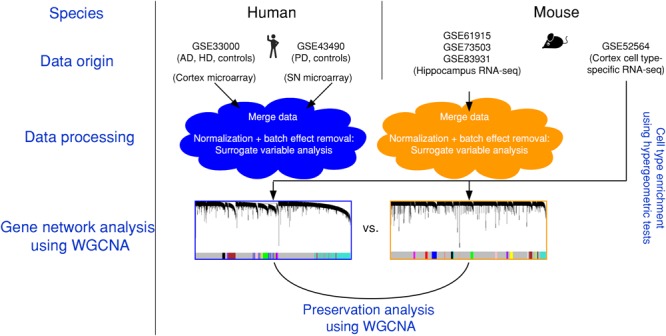
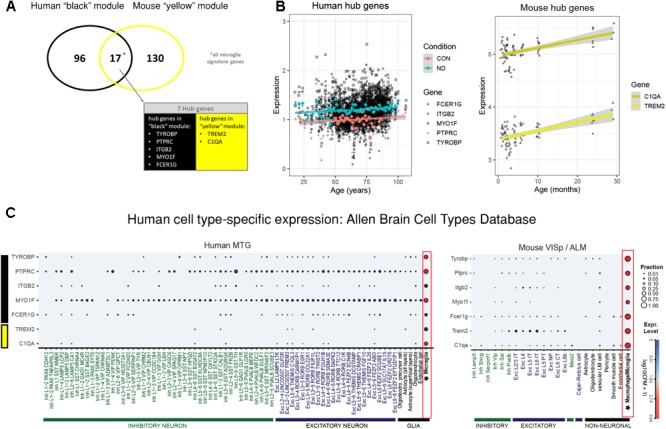
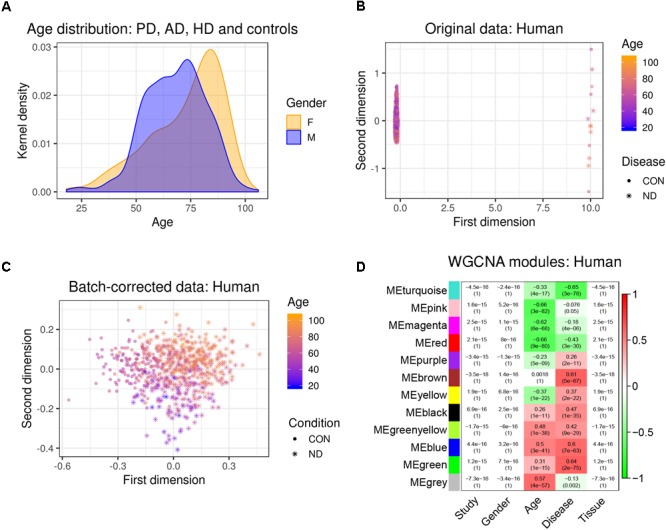
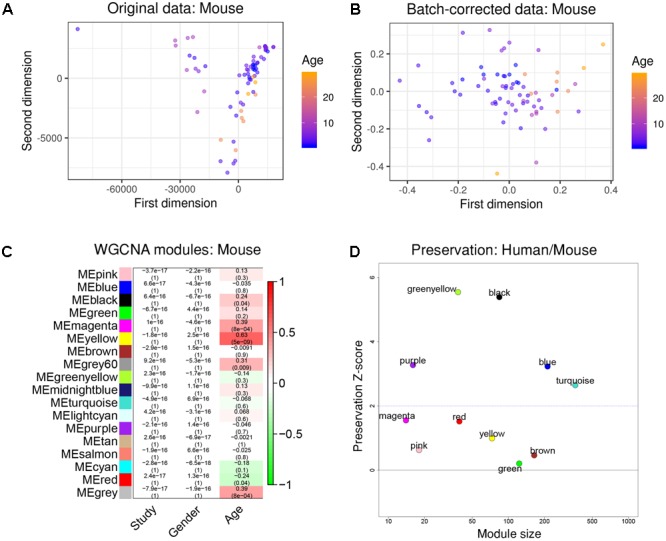
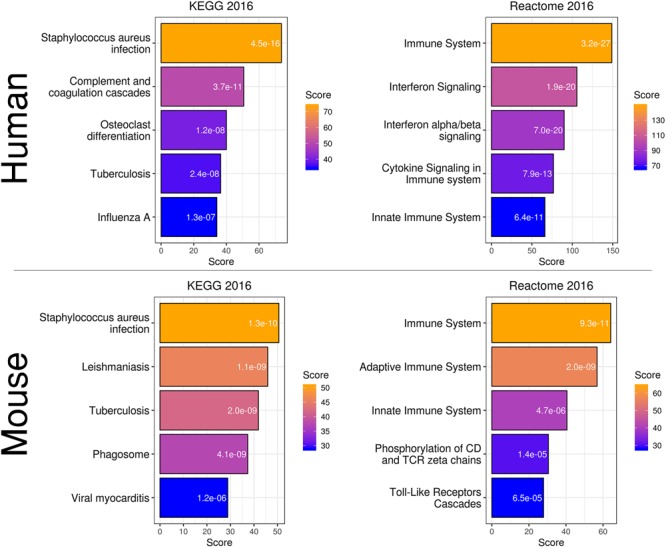
Aging is regarded as a major risk factor for neurodegenerative diseases. Thus, a better understanding of the similarities between the aging process and neurodegenerative diseases at the cellular and molecular level may reveal better understanding of this detrimental relationship. In the present study, we mined publicly available gene expression datasets from healthy individuals and patients affected by neurodegenerative diseases (Alzheimer's disease, Parkinson's disease, and Huntington's disease) across a broad age spectrum and compared those with mouse aging and mouse cell-type specific gene expression profiles. We performed weighted gene co-expression network analysis (WGCNA) and found a gene network strongly related with both aging and neurodegenerative diseases. This network was significantly enriched with a microglial signature as imputed from cell type-specific sequencing data. Since mouse models are extensively used for the study of human diseases, we further compared these human gene regulatory networks with age-specific mouse brain transcriptomes. We discovered significantly preserved networks with both human aging and human disease and identified 17 shared genes in the top-ranked immune/microglia module, among which we found five human hub genes , and two mouse hub genes and . Taken together, these results support the hypothesis that microglia are key players involved in human aging and neurodegenerative diseases, and suggest that mouse models should be appropriate for studying these microglial changes in human.
衰老被视为神经退行性疾病的主要风险因素。因此,在细胞和分子水平上更好地理解衰老过程与神经退行性疾病之间的相似性,可能有助于更深入地了解这种有害关系。在本研究中,我们挖掘了来自广泛年龄谱的健康个体和受神经退行性疾病(阿尔茨海默病、帕金森病和亨廷顿病)影响的患者的公开可用基因表达数据集,并将其与小鼠衰老和小鼠细胞类型特异性基因表达谱进行比较。我们进行了加权基因共表达网络分析(WGCNA),发现了一个与衰老和神经退行性疾病都密切相关的基因网络。根据细胞类型特异性测序数据推测,该网络显著富集了小胶质细胞特征。由于小鼠模型被广泛用于人类疾病研究,我们进一步将这些人类基因调控网络与特定年龄的小鼠脑转录组进行比较。我们发现了在人类衰老和人类疾病中都显著保留的网络,并在排名靠前的免疫/小胶质细胞模块中鉴定出17个共享基因,其中我们发现了5个人类枢纽基因,以及2个小鼠枢纽基因和。综上所述,这些结果支持了小胶质细胞是参与人类衰老和神经退行性疾病的关键因素这一假设,并表明小鼠模型适合用于研究人类这些小胶质细胞的变化。