Department of Cognitive Neuroscience, Biophysics Section, Donders Institute for Brain, Cognition and Behaviour, Radboud University Medical Centre Nijmegen, Nijmegen, The Netherlands.
Department of Biophysics, Donders Institute for Brain, Cognition and Behaviour, Radboud University Nijmegen, Nijmegen, The Netherlands.
Acta Ophthalmol. 2019 Sep;97(6):616-625. doi: 10.1111/aos.14011. Epub 2019 Feb 7.
We determined the latencies of orienting responses during a preferential looking task in children with normal vision and in children with visual impairments between 6 and 12 years old, and assessed the feasibility of scoring grating detection in these populations with video-based eye tracking.
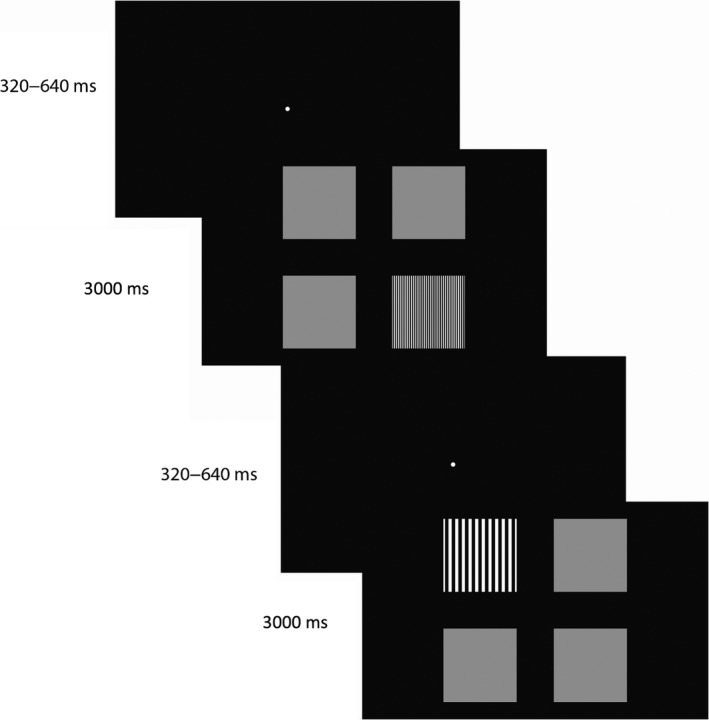
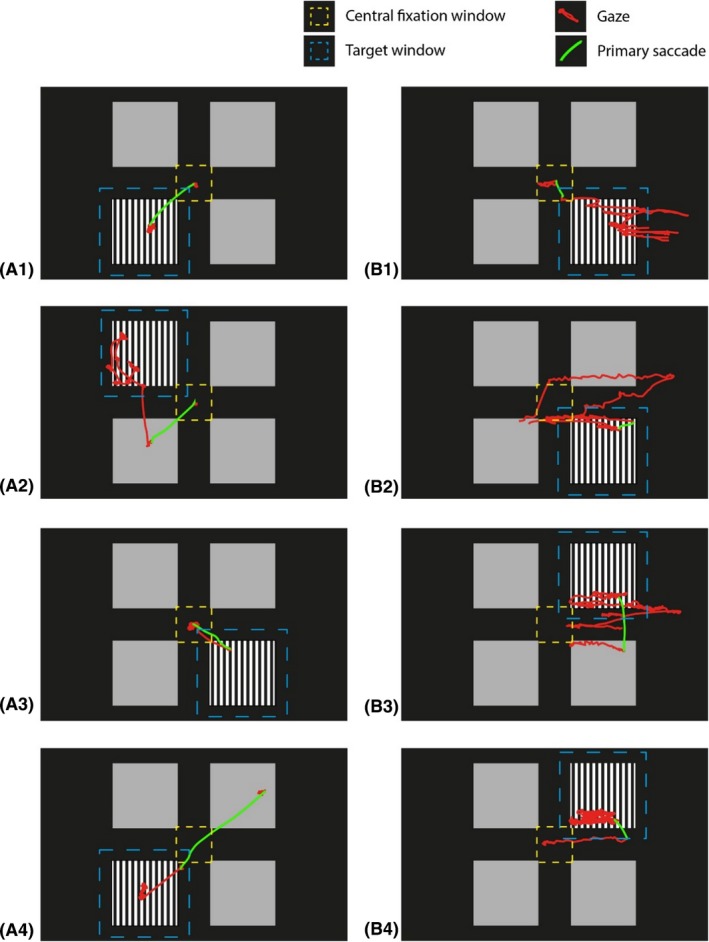
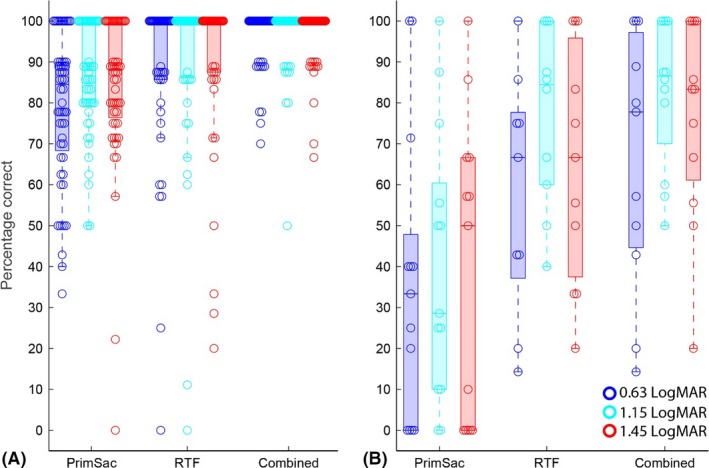
Children performed a computerized preferential looking test, while a remote eye tracker measured the children's eye movements. The stimuli consisted of a 2 × 2 grid, with three uniform grey fields and one target field consisting of a black-and-white square wave grating. The grating was presented randomly at one of the four locations. The spatial frequencies (1.05, 2.11 and 7.02 cyc/deg) were randomly interleaved, with 10 trials per spatial frequency. Three different methods were used to score the accuracy of the responses: (1) primary saccade ends on target, (1) gaze 50% of the presentation time on target, and (3) a combination of method 1 and 2 (i.e. primary saccade ends on target, and/or gaze 50% of the presentation time on target).
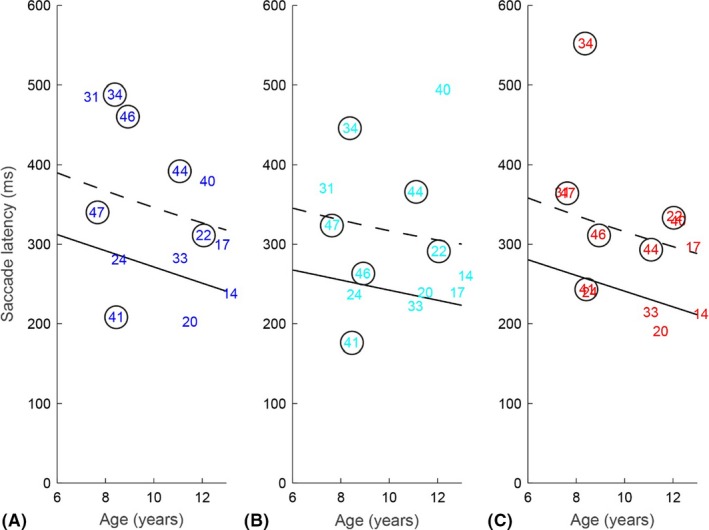
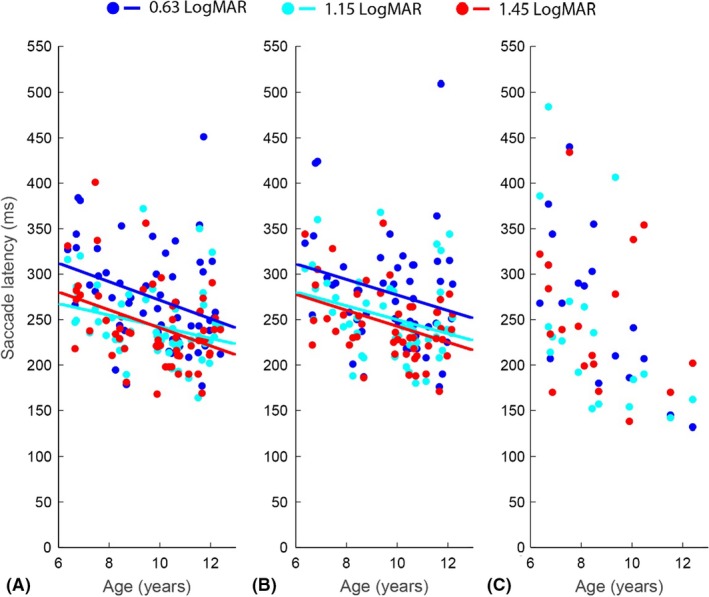
The combined scoring method was most reliable to determine whether children could resolve the gratings. Children with visual impairments had significantly lower accuracies than children with normal vision with all three scoring methods. In addition, saccade latencies decreased with age and were significantly longer (62 ± 15 ms) in children with visual impairments.
The use of eye tracking to assess grating detection with a preferential looking task in clinical populations provides valuable additional information, including objective detection measures and developmental delays in saccade latencies.
我们测定了 6 至 12 岁视力正常儿童和视力障碍儿童在偏好性注视任务中定向反应的潜伏期,并评估了基于视频的眼动追踪在这些人群中对光栅检测进行评分的可行性。
儿童在计算机化偏好性注视测试中进行操作,同时远程眼动追踪器测量儿童的眼球运动。刺激物由一个 2×2 的网格组成,其中三个均匀的灰色区域和一个目标区域由黑白方波光栅组成。光栅随机出现在四个位置之一。空间频率(1.05、2.11 和 7.02 周/度)随机交织,每个空间频率有 10 次试验。使用三种不同的方法来评分反应的准确性:(1)最初的扫视结束于目标,(2)注视目标 50%的呈现时间,以及(3)方法 1 和 2 的组合(即最初的扫视结束于目标,和/或注视目标 50%的呈现时间)。
组合评分方法最可靠,可确定儿童是否能分辨光栅。使用所有三种评分方法,视力障碍儿童的准确性明显低于视力正常儿童。此外,扫视潜伏期随年龄而降低,视力障碍儿童的潜伏期明显更长(62±15 毫秒)。
使用眼动追踪在临床人群中评估偏好性注视任务中的光栅检测,提供了有价值的额外信息,包括客观的检测指标和扫视潜伏期的发育延迟。