Valkenburg Cees, Kashmour Yasmin, Dao Angelique, Fridus Van der Weijden G A, Slot Dagmar Else
Department of Periodontology, Academic Centre for Dentistry Amsterdam (ACTA), University of Amsterdam and Vrije Universiteit Amsterdam, Amsterdam, The Netherlands.
Int J Dent Hyg. 2019 May;17(2):99-116. doi: 10.1111/idh.12390. Epub 2019 Mar 6.
To test the efficacy of a dentifrice containing baking soda (BS), compared with dentifrice without BS for controlling plaque and gingivitis.
MEDLINE-PubMed and Cochrane-CENTRAL were searched. The inclusion criteria were randomized controlled clinical trials including healthy participants aged 18 years or older. Studies were selected that compared the effect of toothbrushing with a dentifrice with and without BS on the clinical parameters of plaque and gingivitis. Data were extracted from the selected studies, and a meta-analysis was performed.
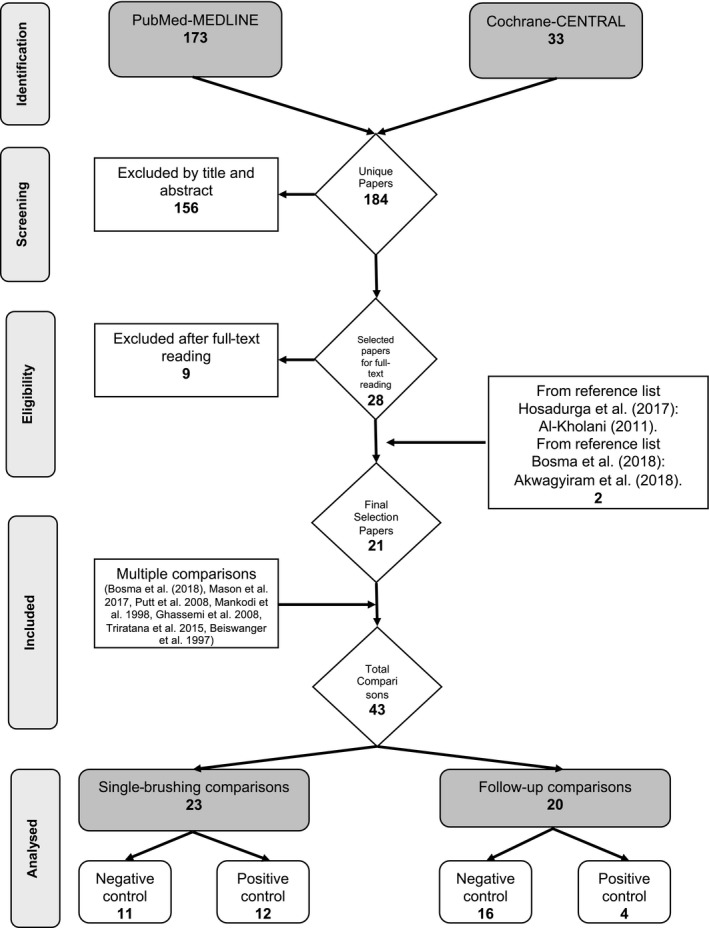
The search retrieved 21 eligible publications. Among these papers, 43 comparisons were provided, with 23 involving a single-use design and 20 being evaluations with a follow-up. Negative controls were found, or positive controls for which various active ingredients had been used. The included studies showed a moderate overall potential risk of bias and considerable heterogeneity. The meta-analysis of plaque scores from the single-brushing experiments showed that BS dentifrice (BS-DF) was associated with significantly better outcomes than the negative control dentifrices (DiffM -0.20; P < 0.0001; 95% CI: [-0.27; -0.12]) or the positive control dentifrices (DiffM -0.18; P < 0.0001; 95% CI: [-0.24; -0.12]). This finding was only confirmed in studies that used a follow-up design as compared to a negative control (DiffM -0.19; P = 0.01; 95% CI: [-0.34; -0.04]). The indices of gingival bleeding also improved when the comparison was a negative control (DiffM -0.08; P = 0.02; 95% CI: [-0.16; -0.01] and (DiffM -0.13; P < 0.001; 95% CI: [-0.18; -0.08]. However, for the gingival index scores, the meta-analysis did not reveal any significant differences.
BS-DF showed promising results with respect to plaque removal in single-use studies. However, the finding was partially substantiated in follow-up studies. Studies that assessed bleeding scores indicated that a small reduction can be expected from BS, relative to a control product.
测试含小苏打(BS)牙膏与不含BS牙膏在控制牙菌斑和牙龈炎方面的疗效。
检索MEDLINE-PubMed和Cochrane-CENTRAL数据库。纳入标准为随机对照临床试验,受试者为18岁及以上的健康参与者。选择比较使用含BS牙膏和不含BS牙膏刷牙对牙菌斑和牙龈炎临床参数影响的研究。从所选研究中提取数据,并进行荟萃分析。
检索到21篇符合条件的出版物。在这些论文中,提供了43项比较,其中23项涉及一次性设计,20项为随访评估。发现了阴性对照,或使用了各种活性成分的阳性对照。纳入的研究显示总体存在中度偏倚风险和相当大的异质性。单次刷牙实验中牙菌斑评分的荟萃分析表明,含BS牙膏(BS-DF)的效果明显优于阴性对照牙膏(差异均值-0.20;P<0.0001;95%置信区间:[-0.27;-0.12])或阳性对照牙膏(差异均值-0.18;P<0.0001;95%置信区间:[-0.24;-0.12])。与阴性对照相比,这一发现仅在采用随访设计的研究中得到证实(差异均值-0.19;P=0.01;95%置信区间:[-0.34;-0.04])。当与阴性对照比较时,牙龈出血指数也有所改善(差异均值-0.08;P=0.02;95%置信区间:[-0.16;-0.01]和差异均值-0.13;P<0.001;95%置信区间:[-0.18;-0.08])。然而,对于牙龈指数评分,荟萃分析未发现任何显著差异。
在一次性使用研究中,含BS牙膏在去除牙菌斑方面显示出有前景的结果。然而,这一发现仅在部分随访研究中得到证实。评估出血评分的研究表明,相对于对照产品,含BS牙膏可使出血略有减少。