Centre for Health Equity, School of Population and Global Health, University of Melbourne,Melbourne 3010, Australia.
Centre for Mental Health Research, Research School of Population Health, Australian National University, Canberra 2601, Australia.
Int J Environ Res Public Health. 2019 Feb 6;16(3):475. doi: 10.3390/ijerph16030475.
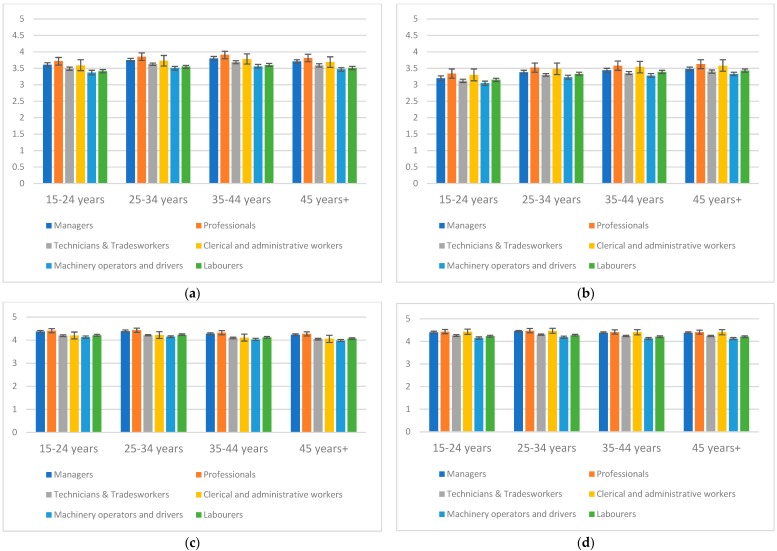
Suicide is a leading cause of death among young men. Help-seeking is known to be poor among this group, and little is known about what interventions are most successful in improving suicide prevention literacy among young men. This research aims to examine: (1) age differences in beliefs related to suicide prevention literacy and attitudes to the workplace in addressing mental health among male construction workers; (2) age differences in response to a workplace suicide prevention program. Pre- and post-training survey data of 19,917 male respondents were obtained from a workplace training program database. Linear regression models and predictive margins were computed. Mean differences in baseline beliefs, and belief change were obtained for age groups, and by occupation. Young men demonstrated poorer baseline suicide prevention literacy but were more likely to consider that mental health is a workplace health and safety issue. There was also evidence that young men employed in manual occupations had poorer suicide prevention literacy than older men, and young men employed in professional/managerial roles. The youngest respondents demonstrated the greatest intervention-associated change (higher scores indicating more favourable belief change) to (predicted mean belief change 0.47, 95% CI 0.43, 0.50 for those aged 15⁻24 years compared to 0.38, 95% CI 0.36, 0.41 for men aged 45 years and over), and to (predicted mean belief change 0.17, 95% CI 0.15, 0.20 for those aged 15⁻24 years compared to 0.12, 95% CI 0.10, 0.14 among men aged 45 years and over). Results indicate that while suicide prevention literacy may be lower among young men, this group show amenability to changing beliefs. There were some indications that young men have a greater propensity to regard the workplace as having a role in reducing suicide rates and addressing mental health, highlighting opportunity for workplace interventions.
自杀是年轻人的主要死因之一。据了解,该群体的求助意愿较低,对于哪些干预措施最能有效提高年轻人的自杀预防素养知之甚少。本研究旨在探讨:(1) 男性建筑工人在与自杀预防素养相关的信念以及对工作场所处理心理健康问题的态度方面的年龄差异;(2) 对工作场所自杀预防计划的反应的年龄差异。从工作场所培训计划数据库中获得了 19917 名男性受访者的培训前后调查数据。计算了线性回归模型和预测边际。按年龄组和职业获得了基线信念和信念变化的平均值差异。年轻男性表现出较差的自杀预防素养基础,但更倾向于认为心理健康是工作场所健康和安全问题。还有证据表明,从事体力劳动的年轻男性比年长男性和从事专业/管理职务的年轻男性的自杀预防素养较差。最年轻的受访者表现出与干预相关的最大变化(更高的分数表示更有利的信念变化),对于(预测平均信念变化 0.47,95%置信区间 0.43,0.50 对于 15-24 岁的人,与 45 岁及以上的男性相比,0.38,95%置信区间 0.36,0.41),以及对于(预测平均信念变化 0.17,95%置信区间 0.15,0.20 对于 15-24 岁的人,与 45 岁及以上的男性相比,0.12,95%置信区间 0.10,0.14)。结果表明,虽然年轻男性的自杀预防素养可能较低,但该群体表现出改变信念的能力。有一些迹象表明,年轻男性更倾向于认为工作场所可以在降低自杀率和解决心理健康问题方面发挥作用,这突显了工作场所干预的机会。