Isaacson Richard S, Seifan Alon, Haddox Candace L, Mureb Monica, Rahman Aneela, Scheyer Olivia, Hackett Katherine, Caesar Emily, Chen Jaclyn L, Isaacson Jon, McInnis Mark, Mosconi Lisa, Safdieh Joseph
Department of Neurology, Weill Cornell Medicine, New York, NY, USA.
Department of Neurology, Compass Health Systems, North Miami, FL, USA.
J Commun Healthc. 2018;11(2):106-113. doi: 10.1080/17538068.2018.1467068. Epub 2018 May 5.
The use of social media may be a valuable tool for dissemination of patient education interventions. However, in Alzheimer's disease (AD), little data exists about the effectiveness, associated cost, or conditions for utilization.
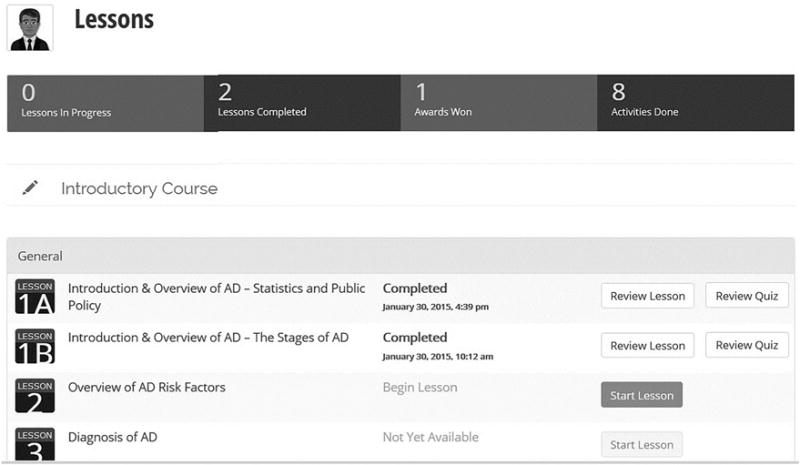
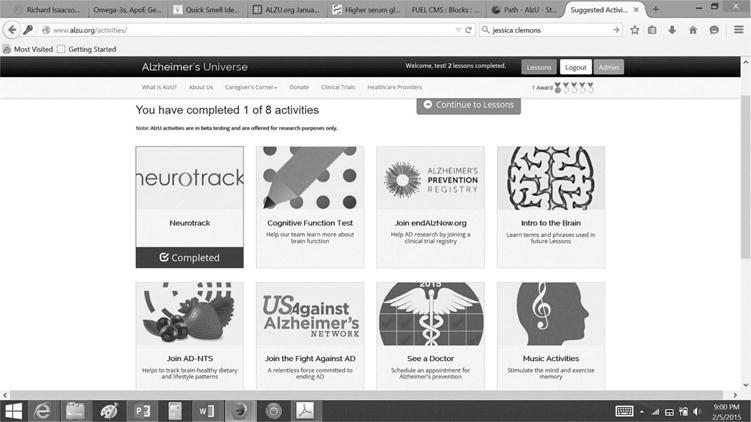
Alzheimer's Universe (www.AlzU.org) is an online educational portal that provides evidence-based educational content for the public and a variety of activities related to optimizing AD management. The primary goal of our study was to assess the effectiveness of using the social media platform Facebook.com as a tool to recruit subjects to visit AlzU.org via targeted advertising and evaluate the associated costs. Secondary outcomes included AlzU.org join rates, lesson and activity completion rates, user demographics and attitudes about the education research platform.
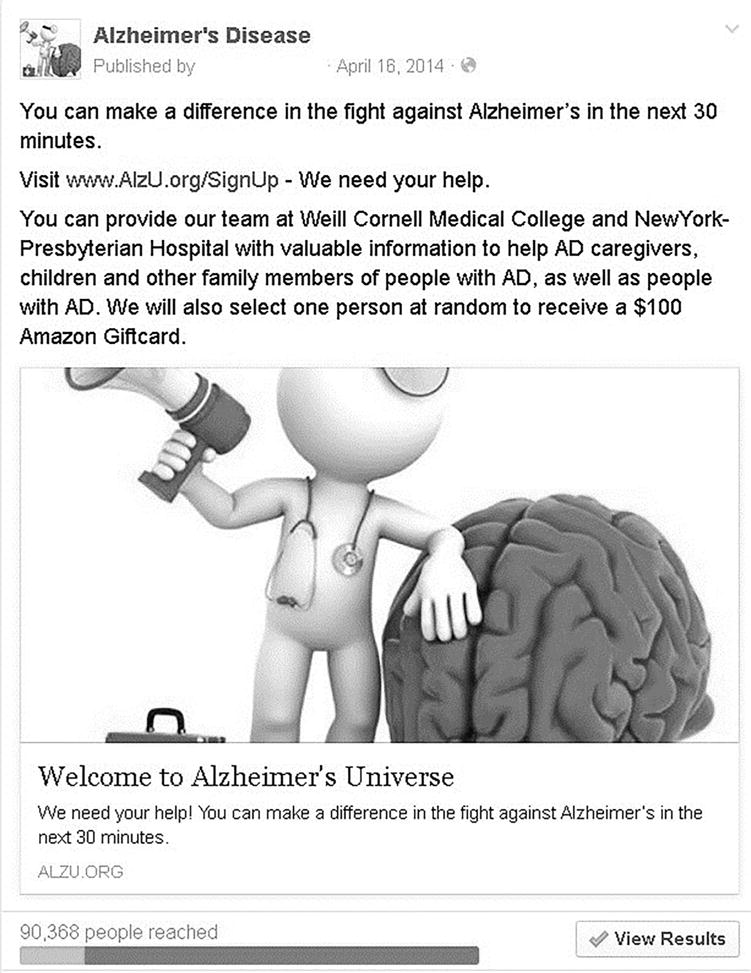
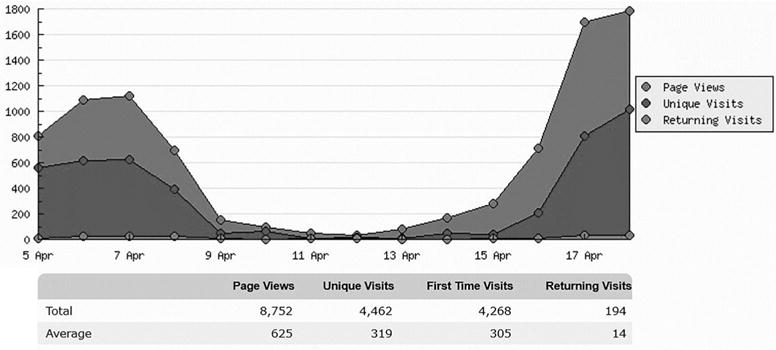
A total of $706 generated 4268 visits to AlzU.org via a series of page posts promoted with targeted advertising to individuals with previously expressed interest in 'Alzheimer's disease,' to those who had 'liked' the Alzheimer's Association page, and followers of www.facebook.com/AlzheimersDisease. Advertising used different promotional taglines in the Facebook Advertising manager tool using 'Cost Per Click' and the 'Optimized for Engagement' settings. Across all strategies combined, 503 visitors joined AlzU.org (11.8% join rate), 412 engaged with at least one lesson/activity (82%), and 100 completed all available lessons and activities (19.8%). Users were primarily women (79.8%) and the most common age group was 50's (43.3%, range 22-92). The majority joined AlzU.org to learn more about AD prevention or treatment (66.3% and 65.3%, respectively). Over 90% were satisfied with their experience.
Subjects were quickly and cost-effectively recruited to AlzU.org. Completion rates of education content and activities were adequate, and subjects were highly satisfied with their experiences. Overall, targeted advertising on Facebook.com was an effective means of disseminating AD education online.
社交媒体的使用可能是传播患者教育干预措施的一个有价值的工具。然而,在阿尔茨海默病(AD)方面,关于其有效性、相关成本或使用条件的数据很少。
通过向之前表达过对“阿尔茨海默病”感兴趣的个人、“点赞”过阿尔茨海默病协会页面的人以及www.facebook.com/AlzheimersDisease的关注者投放定向广告,发布一系列页面帖子,共花费706美元,带来了4268次对AlzU.org的访问。广告在Facebook广告管理工具中使用了不同的促销标语,采用“每次点击成本”和“优化参与度”设置。综合所有策略,503名访问者加入了AlzU.org(加入率为11.8%),412人参与了至少一项课程/活动(82%),100人完成了所有可用课程和活动(19.8%)。用户主要为女性(79.8%),最常见的年龄组是50多岁(43.3%,年龄范围22 - 92岁)。大多数人加入AlzU.org是为了了解更多关于AD预防或治疗的信息(分别为66.3%和65.3%)。超过90%的人对他们的体验感到满意。
受试者被快速且经济高效地招募到AlzU.org。教育内容和活动的完成率足够,受试者对他们的体验高度满意。总体而言,在Facebook.com上进行定向广告是在线传播AD教育的一种有效方式。