Chakraborty Poushali, Kumar Ashwani
Council of Scientific and Industrial Research, Institute of Microbial Technology, Chandigarh, India 160036.
CSIR-Academy of Scientific & Innovative Research (AcSIR), Council of Scientific & Industrial Research, New Delhi-110001.
Microb Cell. 2019 Jan 18;6(2):105-122. doi: 10.15698/mic2019.02.667.
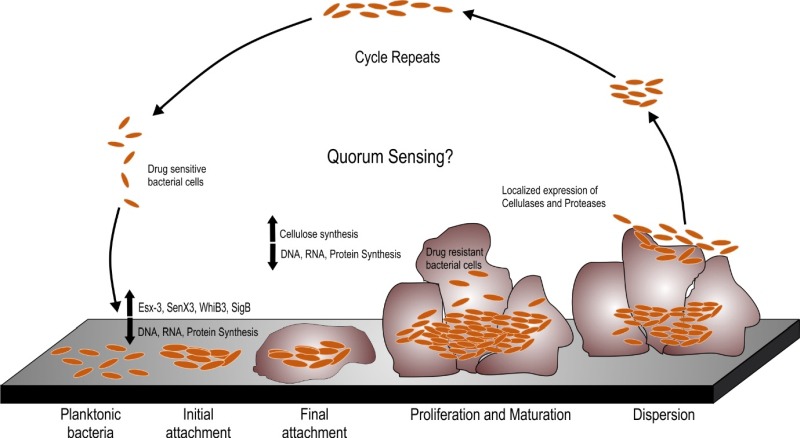
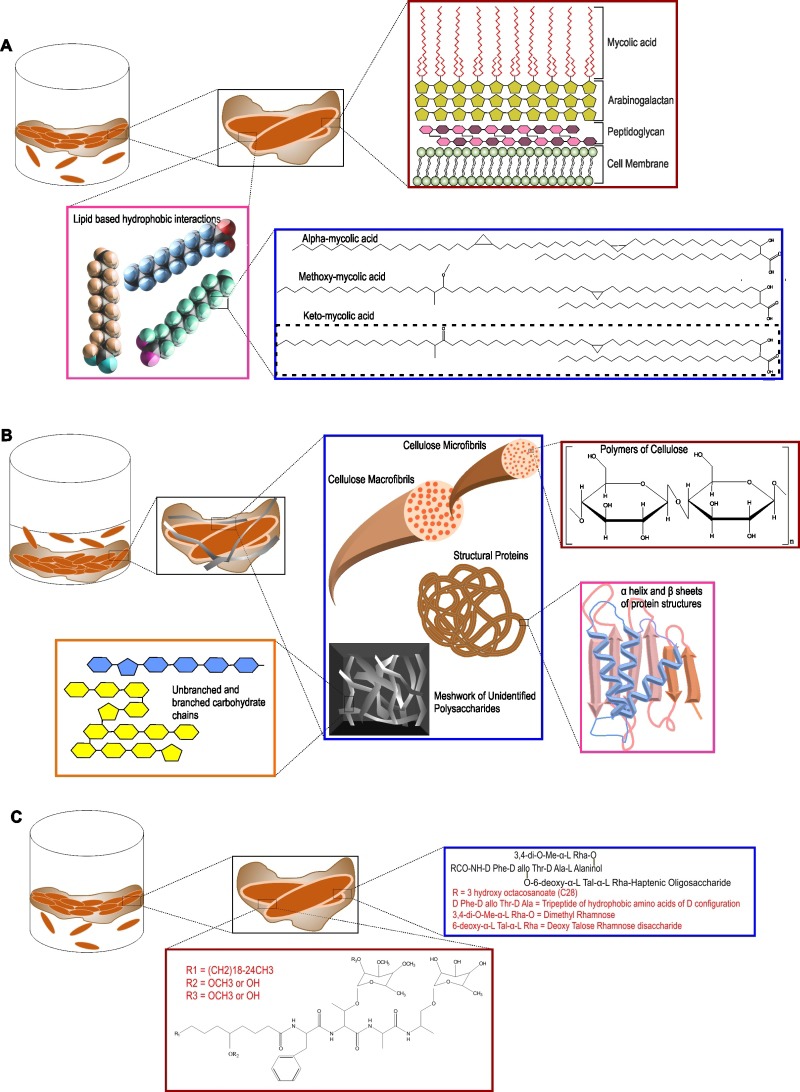
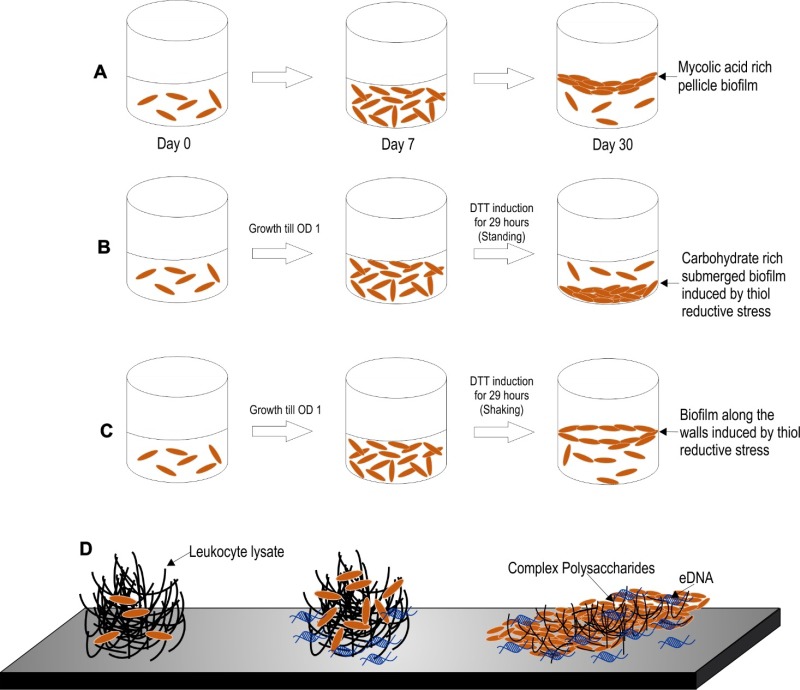
A number of non-tuberculous mycobacterium species are opportunistic pathogens and ubiquitously form biofilms. These infections are often recalcitrant to treatment and require therapy with multiple drugs for long duration. The biofilm resident bacteria also display phenotypic drug tolerance and thus it has been hypothesized that the drug unresponsiveness could be due to formation of biofilms inside the host. We have discussed the biofilms of several pathogenic non-tuberculous mycobacterium (NTM) species in context to the pathologies. Besides pathogenic NTMs, is often used as a model organism for understanding mycobacterial physiology and has been studied extensively for understanding the mycobacterial biofilms. A number of components of the mycobacterial cell wall such as glycopeptidolipids, short chain mycolic acids, monomeromycolyl diacylglycerol, etc. have been shown to play an important role in formation of pellicle biofilms. It shall be noted that these components impart a hydrophobic character to the mycobacterial cell surface that facilitates cell to cell interaction. However, these components are not necessarily the constituents of the extracellular matrix of mycobacterial biofilms. In the end, we have described the biofilms of (Mtb), the causative agent of tuberculosis. Three models of Mtb biofilm formation have been proposed to study the factors regulating biofilm formation, the physiology of the resident bacteria, and the nature of the biomaterial that holds these bacterial masses together. These models include pellicle biofilms formed at the liquid-air interface of cultures, leukocyte lysate-induced biofilms, and thiol reductive stressinduced biofilms. All the three models offer their own advantages in the study of Mtb biofilms. Interestingly, lipids (mainly keto-mycolic acids) are proposed to be the primary component of extracellular polymeric substance (EPS) in the pellicle biofilm, whereas the leukocyte lysate-induced and thiol reductive stress-induced biofilms possess polysaccharides as the primary component of EPS. Both models also contain extracellular DNA in the EPS. Interestingly, thiol reductive stressinduced Mtb biofilms are held together by cellulose and yet unidentified structural proteins. We believe that a better understanding of the EPS of Mtb biofilms and the physiology of the resident bacteria will facilitate the development of shorter regimen for TB treatment.
许多非结核分枝杆菌属物种是机会致病菌,普遍会形成生物膜。这些感染往往难以治疗,需要长期使用多种药物进行治疗。生物膜中的常驻细菌还表现出表型耐药性,因此有人推测药物无反应可能是由于宿主内生物膜的形成。我们已经结合病理学讨论了几种致病性非结核分枝杆菌(NTM)物种的生物膜。除了致病性NTM外,[具体物种名称未给出]常被用作理解分枝杆菌生理学的模式生物,并已被广泛研究以了解分枝杆菌生物膜。分枝杆菌细胞壁的许多成分,如糖肽脂、短链分枝菌酸、单分枝菌酰二酰甘油等,已被证明在菌膜生物膜的形成中起重要作用。应当指出,这些成分赋予分枝杆菌细胞表面疏水性,促进细胞间相互作用。然而,这些成分不一定是分枝杆菌生物膜细胞外基质的组成部分。最后,我们描述了结核病病原体结核分枝杆菌(Mtb)的生物膜。已经提出了三种Mtb生物膜形成模型,以研究调节生物膜形成的因素、常驻细菌的生理学以及将这些细菌团块聚集在一起的生物材料的性质。这些模型包括在培养物的液 - 气界面形成的菌膜生物膜、白细胞裂解物诱导的生物膜和硫醇还原应激诱导的生物膜。这三种模型在Mtb生物膜的研究中都有各自的优势。有趣的是,脂质(主要是酮基分枝菌酸)被认为是菌膜生物膜中细胞外聚合物(EPS)的主要成分,而白细胞裂解物诱导的和硫醇还原应激诱导的生物膜以多糖作为EPS的主要成分。这两种模型的EPS中也都含有细胞外DNA。有趣的是,硫醇还原应激诱导的Mtb生物膜由纤维素和尚未鉴定的结构蛋白聚集在一起。我们相信,更好地理解Mtb生物膜的EPS和常驻细菌的生理学将有助于开发更短疗程的结核病治疗方案。