Department of Infectious Diseases and Immunology, Faculty of Veterinary Medicine, Utrecht University, Utrecht, The Netherlands.
Department of Farm Animal Health, Faculty of Veterinary Medicine, Utrecht University, Utrecht, The Netherlands.
J Antimicrob Chemother. 2019 Jun 1;74(6):1531-1538. doi: 10.1093/jac/dkz035.
To explore the dynamics of faecal ESBL/AmpC shedding in dairy cattle and farmers, a study was conducted to examine changes in shedding by individual animals, as well as environmental exposure, and to study the association between antimicrobial use (AMU) and ESBL/AmpC shedding.
The study comprised a cross-sectional survey of 20 farms and a 1 year follow-up of 10 farms. Faecal samples were cultured by both direct inoculation on MacConkey agar + 1 mg/L cefotaxime (MC+) and enrichment in LB-broth + 1 mg/L cefotaxime with subsequent inoculation on MC+. Dust samples were collected using electrostatic dustfall collectors (EDCs). Human faecal samples were collected by the farmers. Presence of ESBL/AmpC genes was screened for by PCR and sequencing. Using mixed effects logistic regression, ORs were determined and population-attributable fractions (PAFs) calculated subsequently.
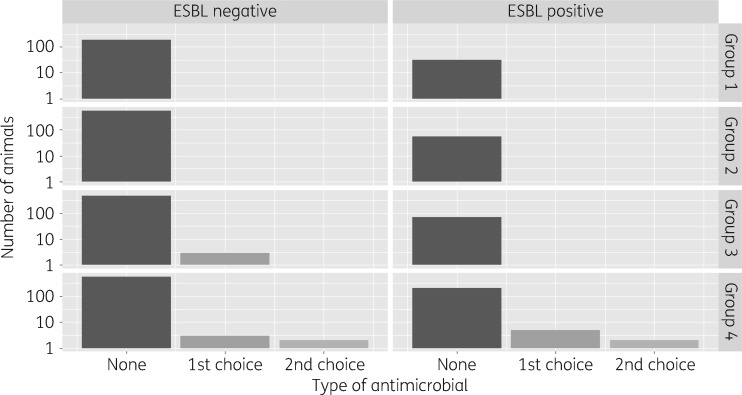
In Phase 1, 8/20 farms were positive for ESBL/AmpC and, with 2 negative farms, were selected for Phase 2. Transient shedding of dominant allele variants was observed in the animals. EDCs and human faecal samples did not reflect what was observed in the animals. AMU was related to shedding of ESBLs in the next sampling moment [OR 14.6 (95% CI 3.0-80.0)] and the PAF of AMU was 0.36 (95% CI 0.08-0.77). Calves fed with colostrum from cows on dry-off therapy was not a risk factor [OR 1.7 (95% CI 0.7-4.9, P = 0.28)].
The presence of ESBL/AmpC could only be partly explained by AMU. No link was shown between shedding in cattle and humans or the environment. Interventions should focus on prevention of introduction.
为了探究奶牛和农民粪便中产 ESBL/AmpC 菌的动态变化,本研究通过个体动物的粪便脱落变化以及环境暴露检测,来研究抗菌药物使用(AMU)与 ESBL/AmpC 菌脱落的相关性。
本研究包含 20 个农场的横断面调查和 10 个农场的 1 年随访。通过直接接种在含有 1mg/L 头孢噻肟的麦康凯琼脂(MC+)和在含有 1mg/L 头孢噻肟的 LB 肉汤中富集并随后接种在 MC+上的方法培养粪便样本。使用静电集尘器(EDC)收集灰尘样本。农民采集人粪便样本。通过 PCR 和测序筛选 ESBL/AmpC 基因。使用混合效应逻辑回归确定比值比(OR),并随后计算人群归因分数(PAF)。
在第 1 阶段,20 个农场中有 8 个为 ESBL/AmpC 阳性,其中 2 个为阴性农场,被选入第 2 阶段。在动物中观察到优势等位基因变异的一过性脱落。EDC 和人粪便样本未反映出动物中观察到的情况。AMU 与下一次采样时 ESBL 的脱落有关[OR 14.6(95%CI 3.0-80.0)],AMU 的 PAF 为 0.36(95%CI 0.08-0.77)。食用干奶疗法奶牛初乳的犊牛不是危险因素[OR 1.7(95%CI 0.7-4.9,P=0.28)]。
ESBL/AmpC 的存在只能部分通过 AMU 来解释。牛和人或环境之间的脱落没有关联。干预措施应侧重于预防引入。