School of Life and Health Sciences, Cell and Tissue Biomedical Research Group, Aston University, Aston Triangle, Birmingham, B4 7ET, UK.
Centre for Active Living, University Centre Shrewsbury, University of Chester, Guildhall, Frankwell Quay, Shrewsbury, SY3 8HQ, UK.
Syst Rev. 2019 Feb 12;8(1):51. doi: 10.1186/s13643-019-0962-3.
Typically, management of PCOS focuses on lifestyle changes (exercise and diet), aiming to alleviate symptoms, and lower the associated risk of type 2 diabetes and cardiovascular disease. Our objective was to analyse evidence on the effectiveness of exercise in the management of PCOS, when compared to (i) usual care, (ii) diet alone, and (iii) exercise combined with diet, and also exercise combined with diet, compared to (i) control or usual care and (ii) diet alone.
Relevant databases were searched (June 2017) with no time limit for trial inclusion. Eligible trials employed a randomised or quasi-randomised design to measure the chronic effects of exercise, or exercise and diet in women with PCOS.
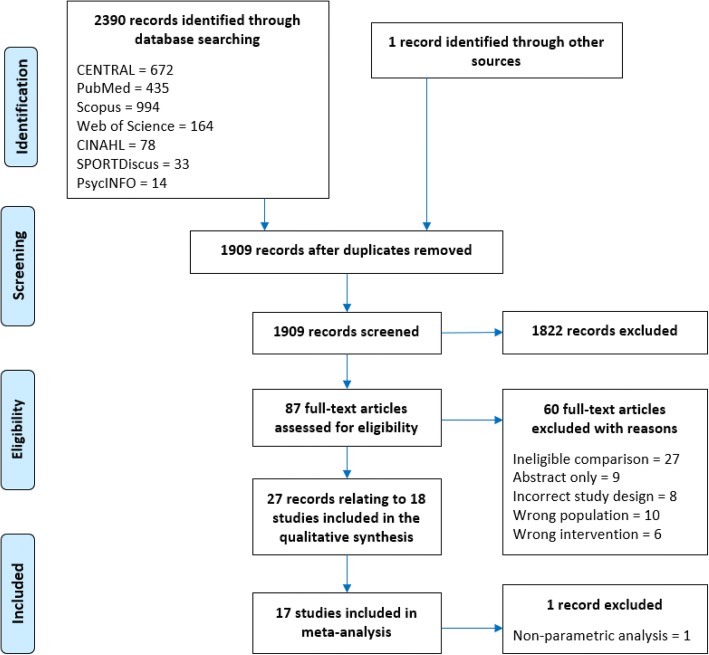
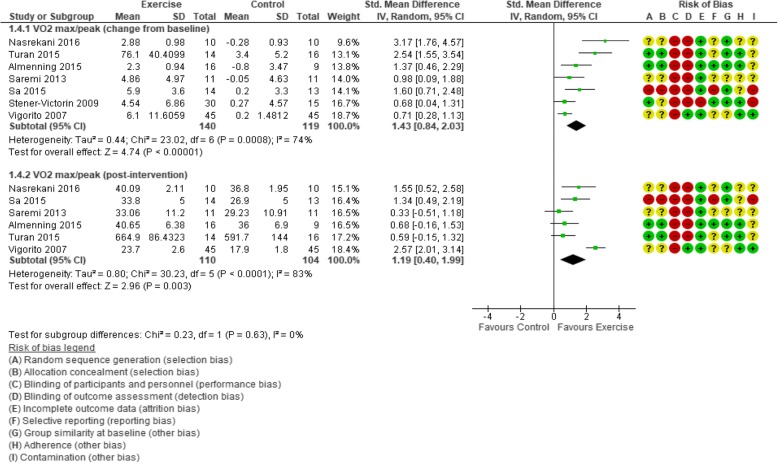
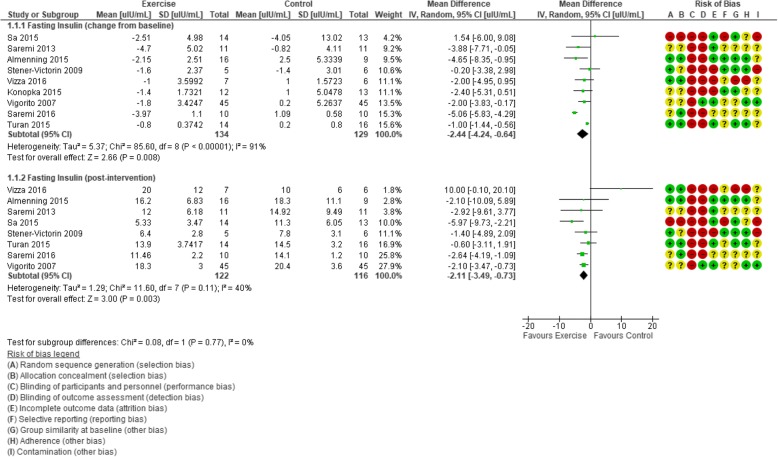
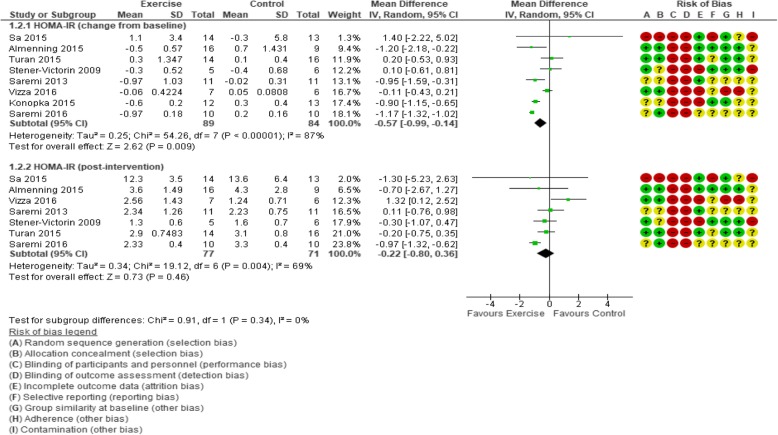
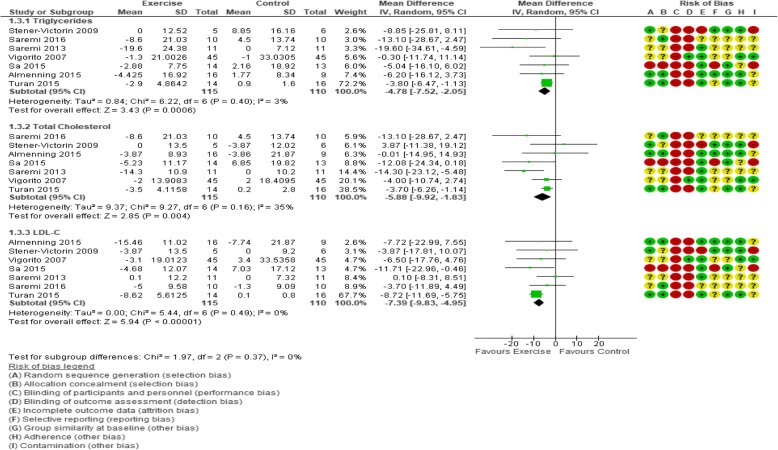
Searches returned 2390 articles; of those, 27 papers from 18 trials were included. Results are presented as mean difference (MD) and 95% confidence intervals (95% CI). Compared with control, exercise had a statistical effect on change from baseline fasting insulin (MD - 2.44 μIU/mL, 95% CIs - 4.24 to - 0.64; very low-quality evidence), HOMA-IR (- 0.57, - 0.99 to - 0.14; very low-quality evidence), total cholesterol (- 5.88 mg/dL, - 9.92 to - 1.83; low-quality evidence), LDL cholesterol (- 7.39 mg/dL, - 9.83 to - 4.95; low-quality evidence), and triglycerides (- 4.78 mg/dL, - 7.52 to - 2.05; low-quality evidence). Exercise also improved VO max (3.84 ml/kg/min, 2.87 to 4.81), waist circumference (- 2.62 cm, - 4.13 to - 1.11), and body fat percentage (- 1.39%, - 2.61 to - 0.18) when compared with usual care. No effect was found for change value systolic/diastolic blood pressure, fasting glucose, HDL cholesterol (all low-quality evidence), or waist-to-hip ratio. Many favourable change score findings were supported by post-intervention value analyses: fasting insulin (- 2.11 μIU/mL, - 3.49 to - 0.73), total cholesterol (- 6.66 mg/dL, - 11.14 to - 2.17), LDL cholesterol (- 6.91 mg/dL, - 12.02 to - 1.80), and VO max (5.01 ml/kg/min, 3.48 to 6.54). Statistically lower BMI (- 1.02 kg/m, - 1.81 to - 0.23) and resting heart rate (- 3.26 beats/min - 4.93 to - 1.59) were also revealed in post-intervention analysis. Subgroup analyses revealed the greatest improvements in overweight/obese participants, and more outcomes improved when interventions were supervised, aerobic in nature, or of a shorter duration. Based on limited data, we found no differences for any outcome between the effects of exercise and diet combined, and diet alone. It was not possible to compare exercise vs diet or exercise and diet combined vs diet.
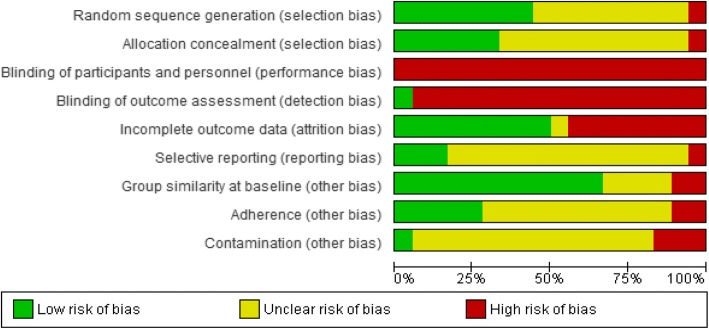
Statistically beneficial effects of exercise were found for a range of metabolic, anthropometric, and cardiorespiratory fitness-related outcomes. However, caution should be adopted when interpreting these findings since many outcomes present modest effects and wide CIs, and statistical effects in many analyses are sensitive to the addition/removal of individual trials. Future work should focus on rigorously designed, well-reported trials that make comparisons involving both exercise and diet.
This systematic review was prospectively registered on the Prospero International Prospective Register of Systematic Reviews ( CRD42017062576 ).
多囊卵巢综合征(PCOS)的治疗通常侧重于生活方式的改变(锻炼和饮食),旨在缓解症状,并降低 2 型糖尿病和心血管疾病的相关风险。我们的目的是分析锻炼在 PCOS 管理中的有效性证据,与(i)常规护理、(ii)单独饮食以及(iii)锻炼与饮食相结合进行比较,以及与(i)对照组或常规护理和(ii)单独饮食进行比较。
对相关数据库进行了检索(2017 年 6 月),没有对试验纳入的时间限制。合格的试验采用随机或半随机设计来测量女性 PCOS 患者的慢性锻炼效果,或锻炼和饮食的效果。
检索到 2390 篇文章;其中,18 项试验的 27 篇论文被纳入。结果以均数差(MD)和 95%置信区间(95%CI)表示。与对照组相比,锻炼对空腹胰岛素的变化有统计学影响(MD-2.44μIU/mL,95%CI-4.24 至-0.64;极低质量证据)、HOMA-IR(-0.57,-0.99 至-0.14;极低质量证据)、总胆固醇(-5.88mg/dL,-9.92 至-1.83;低质量证据)、LDL 胆固醇(-7.39mg/dL,-9.83 至-4.95;低质量证据)和甘油三酯(-4.78mg/dL,-7.52 至-2.05;低质量证据)。与常规护理相比,锻炼还改善了 VO2 max(3.84ml/kg/min,2.87 至 4.81)、腰围(-2.62cm,-4.13 至-1.11)和体脂肪百分比(-1.39%,-2.61 至-0.18)。收缩压/舒张压、空腹血糖、高密度脂蛋白胆固醇(均为低质量证据)或腰臀比的变化值均无统计学意义。许多有利的变化评分发现得到了干预后值分析的支持:空腹胰岛素(-2.11μIU/mL,-3.49 至-0.73)、总胆固醇(-6.66mg/dL,-11.14 至-2.17)、LDL 胆固醇(-6.91mg/dL,-12.02 至-1.80)和 VO2 max(5.01ml/kg/min,3.48 至 6.54)。干预后分析还揭示了 BMI(-1.02kg/m,-1.81 至-0.23)和静息心率(-3.26 次/分钟,-4.93 至-1.59)的统计学上较低值。亚组分析显示,超重/肥胖参与者的改善最大,当干预是监督的、有氧运动性质的或持续时间较短时,更多的结果得到改善。基于有限的数据,我们没有发现锻炼和饮食结合与饮食单独治疗之间任何结果的差异。也不可能比较锻炼与饮食或锻炼与饮食联合与饮食的比较。
锻炼对一系列代谢、人体测量和心肺功能相关的结果有统计学上的有益影响。然而,由于许多结果的效果较小且置信区间较宽,并且许多分析中的统计学效果对个别试验的增加/删除敏感,因此在解释这些发现时应谨慎。未来的工作应集中在设计严谨、报告良好的试验上,这些试验应涉及锻炼和饮食的比较。
本系统综述前瞻性地在 Prospéro 国际前瞻性注册系统评价(CRD42017062576)上进行了注册。