Hawkins-Daarud Andrea, Johnston Sandra K, Swanson Kristin R
Mayo Clinic Arizona, Phoenix, AZ.
University of Washington, Seattle, WA.
JCO Clin Cancer Inform. 2019 Feb;3:1-8. doi: 10.1200/CCI.18.00066.
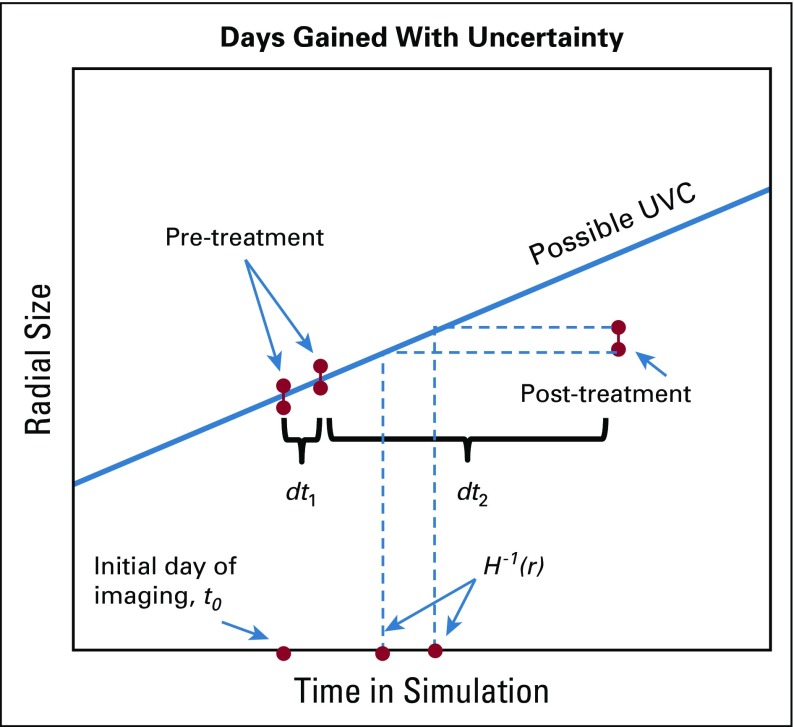
Glioblastomas, lethal primary brain tumors, are known for their heterogeneity and invasiveness. A growing body of literature has been developed demonstrating the clinical relevance of a biomathematical model, the proliferation-invasion model, of glioblastoma growth. Of interest here is the development of a treatment response metric, days gained (DG). This metric is based on individual tumor kinetics estimated through segmented volumes of hyperintense regions on T1-weighted gadolinium-enhanced and T2-weighted magnetic resonance images. This metric was shown to be prognostic of time to progression. Furthermore, it was shown to be more prognostic of outcome than standard response metrics. Although promising, the original article did not account for uncertainty in the calculation of the DG metric, leaving the robustness of this cutoff in question.
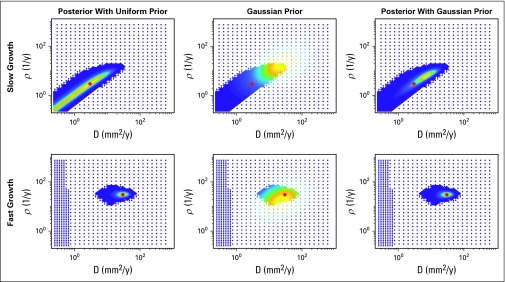
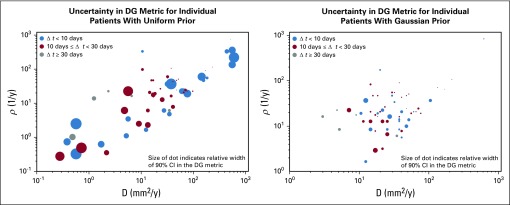
We harnessed the Bayesian framework to consider the impact of two sources of uncertainty: (1) image acquisition and (2) interobserver error in image segmentation. We first used synthetic data to characterize what nonerror variants are influencing the final uncertainty in the DG metric. We then considered the original patient cohort to investigate clinical patterns of uncertainty and to determine how robust this metric is for predicting time to progression and overall survival.
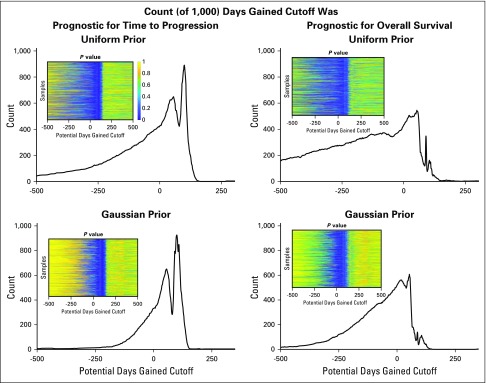
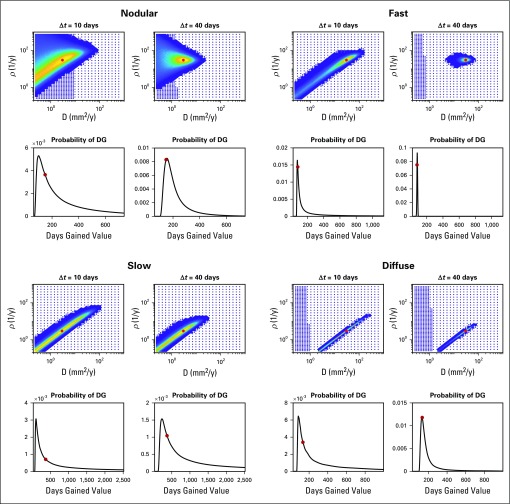
Our results indicate that the key clinical variants are the time between pretreatment images and the underlying tumor growth kinetics, matching our observations in the clinical cohort. Finally, we demonstrated that for this cohort, there was a continuous range of cutoffs between 94 and 105 for which the prediction of the time to progression was over 80% reliable.
Although additional validation must be performed, this work represents a key step in ascertaining the clinical utility of this metric.
胶质母细胞瘤是致命的原发性脑肿瘤,以其异质性和侵袭性而闻名。越来越多的文献表明了一种生物数学模型——胶质母细胞瘤生长的增殖-侵袭模型的临床相关性。这里感兴趣的是一种治疗反应指标——获得天数(DG)的发展。该指标基于通过T1加权钆增强和T2加权磁共振图像上高强度区域的分割体积估计的个体肿瘤动力学。该指标被证明可预测疾病进展时间。此外,它比标准反应指标更能预测预后。尽管很有前景,但原始文章没有考虑DG指标计算中的不确定性,使得这个临界值的稳健性受到质疑。
我们利用贝叶斯框架来考虑两个不确定性来源的影响:(1)图像采集和(2)图像分割中的观察者间误差。我们首先使用合成数据来表征哪些非误差变量正在影响DG指标的最终不确定性。然后我们考虑原始患者队列,以研究不确定性的临床模式,并确定该指标在预测疾病进展时间和总生存期方面的稳健性。
我们的结果表明,关键的临床变量是预处理图像之间的时间和潜在的肿瘤生长动力学,这与我们在临床队列中的观察结果相符。最后,我们证明,对于这个队列,在94到105之间存在一个连续的临界值范围,对于这些临界值,疾病进展时间的预测可靠性超过80%。
尽管必须进行额外的验证,但这项工作是确定该指标临床实用性的关键一步。