Benzaquen Jonathan, Boutros Jacques, Marquette Charles, Delingette Hervé, Hofman Paul
Department of Pulmonary Medicine and Oncology, Université Côte d'Azur, CHU de Nice, FHU OncoAge, Nice 06100, France.
Institute of Research on Cancer and Ageing (IRCAN), Université Côte d'Azur, FHU OncoAge, CNRS, INSERM, 06107 Nice, France.
Cancers (Basel). 2019 Feb 12;11(2):212. doi: 10.3390/cancers11020212.
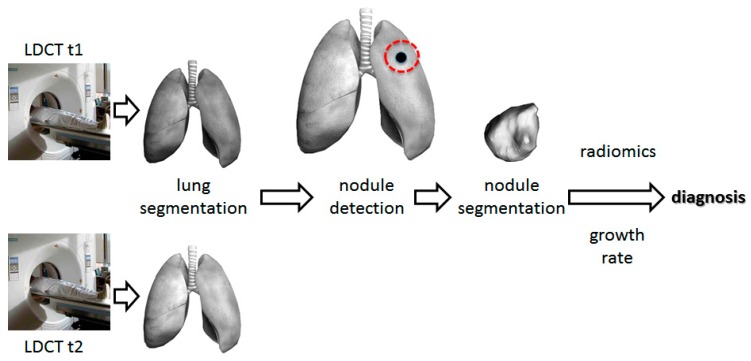
Early-stage treatment improves prognosis of lung cancer and two large randomized controlled trials have shown that early detection with low-dose computed tomography (LDCT) reduces mortality. Despite this, lung cancer screening (LCS) remains challenging. In the context of a global shortage of radiologists, the high rate of false-positive LDCT results in overloading of existing lung cancer clinics and multidisciplinary teams. Thus, to provide patients with earlier access to life-saving surgical interventions, there is an urgent need to improve LDCT-based LCS and especially to reduce the false-positive rate that plagues the current detection technology. In this context, LCS can be improved in three ways: (1) by refining selection criteria (risk factor assessment), (2) by using Computer Aided Diagnosis (CAD) to make it easier to interpret chest CTs, and (3) by using biological blood signatures for early cancer detection, to both spot the optimal target population and help classify lung nodules. These three main ways of improving LCS are discussed in this review.
早期治疗可改善肺癌的预后,两项大型随机对照试验表明,低剂量计算机断层扫描(LDCT)早期检测可降低死亡率。尽管如此,肺癌筛查(LCS)仍然具有挑战性。在全球放射科医生短缺的情况下,LDCT假阳性率高导致现有肺癌诊所和多学科团队负担过重。因此,为了让患者更早获得挽救生命的手术干预,迫切需要改进基于LDCT的LCS,尤其是降低困扰当前检测技术的假阳性率。在这种情况下,LCS可以通过三种方式得到改善:(1)完善选择标准(风险因素评估),(2)使用计算机辅助诊断(CAD)以便更轻松地解读胸部CT,(3)使用生物血液标志物进行早期癌症检测,以确定最佳目标人群并帮助对肺结节进行分类。本综述讨论了改善LCS的这三种主要方式。