Institute for Intensive Care Medicine, University Hospital of Zurich, Rämistrasse 100, 8091, Zurich, Switzerland.
Department of Physiopathology and Transplantation, Milan University and Neuro ICU Fondazione IRCCSCà Granda Ospedale Maggiore Policlinico Milan, Milan, Italy.
Crit Care. 2019 Feb 13;23(1):45. doi: 10.1186/s13054-018-2304-6.
Hyperventilation-induced hypocapnia (HV) reduces elevated intracranial pressure (ICP), a dangerous and potentially fatal complication of traumatic brain injury (TBI). HV decreases the arteriolar diameter of intracranial vessels, raising the risk of cerebral ischemia. The aim of this study was to characterize the effects of moderate short-term HV in patients with severe TBI by using concomitant monitoring of cerebral metabolism, brain tissue oxygen tension (PbrO), and cerebral hemodynamics with transcranial color-coded duplex sonography (TCCD).
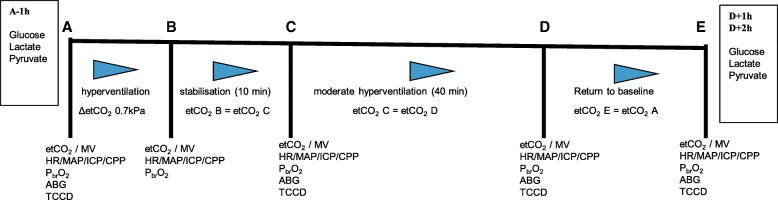
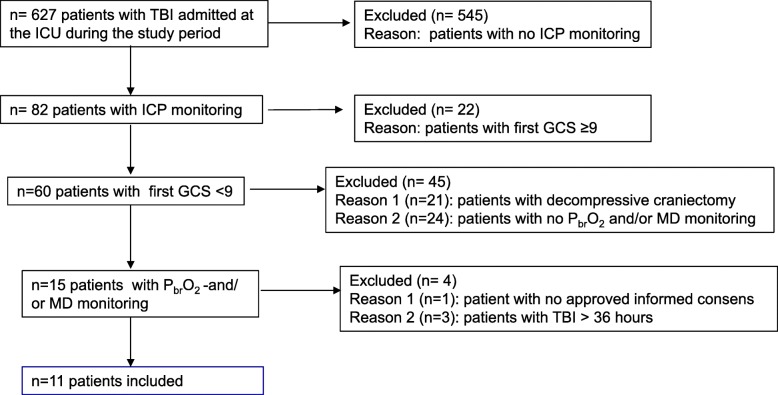
This prospective trial was conducted between May 2014 and May 2017 in the surgical intensive care unit (ICU) at the University Hospital of Zurich. Patients with nonpenetrating TBI older than 18 years of age with a Glasgow Coma Scale (GCS) score < 9 at presentation and with ICP monitoring, PbrO, and/or microdialysis (MD) probes during ICU admission within 36 h after injury were included in our study. Data collection and TCCD measurements were performed at baseline (A), at the beginning of moderate HV (C), after 50 min of moderate HV (D), and after return to baseline (E). Moderate HV was defined as arterial partial pressure of carbon dioxide 4-4.7 kPa. Repeated measures analysis of variance was used to compare variables at the different time points, followed by post hoc analysis with Bonferroni adjustment as appropriate.
Eleven patients (64% males, mean age 36 ± 14 years) with an initial median GCS score of 7 (IQR 3-8) were enrolled. During HV, ICP and mean flow velocity (CBFV) in the middle cerebral artery decreased significantly. Glucose, lactate, and pyruvate in the brain extracellular fluid did not change significantly, whereas PbrO showed a statistically significant reduction but remained within the normal range.
Moderate short-term hyperventilation has a potent effect on the cerebral blood flow, as shown by TCCD, with a concomitant ICP reduction. Under the specific conditions of this study, this degree of hyperventilation did not induce pathological alterations of brain metabolites and oxygenation.
NCT03822026 . Registered on 30 January 2019.
过度通气引起的低碳酸血症(HV)可降低外伤性脑损伤(TBI)引起的颅内压升高(ICP),这是一种危险且潜在致命的并发症。HV 会使颅内血管的动脉直径缩小,增加脑缺血的风险。本研究的目的是通过经颅彩色双功能超声(TCCD)同时监测脑代谢、脑氧张力(PbrO)和脑血流动力学,来描述严重 TBI 患者接受适度短期 HV 的影响。
这项前瞻性研究于 2014 年 5 月至 2017 年 5 月在苏黎世大学医院的外科重症监护病房(ICU)进行。纳入标准为:年龄大于 18 岁的非穿透性 TBI 患者,入院时格拉斯哥昏迷评分(GCS)<9 分,在受伤后 36 小时内有 ICP 监测、PbrO 和/或微透析(MD)探针。数据收集和 TCCD 测量在基线(A)、适度 HV 开始时(C)、适度 HV 50 分钟后(D)和返回基线时(E)进行。中度 HV 定义为动脉二氧化碳分压 4-4.7kPa。采用重复测量方差分析比较不同时间点的变量,然后进行适当的事后 Bonferroni 调整检验。
纳入了 11 名患者(64%为男性,平均年龄 36±14 岁),初始 GCS 中位数为 7(IQR 3-8)。在 HV 期间,颅内压和大脑中动脉平均血流速度(CBFV)显著降低。脑细胞外液中的葡萄糖、乳酸和丙酮酸没有明显变化,而 PbrO 则显著降低,但仍在正常范围内。
TCCD 显示,适度短期过度通气对脑血流有明显影响,同时降低 ICP。在本研究的特定条件下,这种程度的过度通气并未引起脑代谢物和氧合的病理改变。
NCT03822026。于 2019 年 1 月 30 日注册。