Brown June S L, Murphy Caroline, Kelly Joanna, Goldsmith Kimberley
Psychology Department (P077), Institute of Psychiatry, Psychology and Neuroscience, King's College London, De Crespigny Park, London, SE5 8AF, UK.
King's Clinical Trials Unit (PO64), Institute of Psychiatry, Psychology and Neuroscience, King's College London, De Crespigny Park, London, SE5 8AF, UK.
Trials. 2019 Feb 13;20(1):131. doi: 10.1186/s13063-018-3033-5.
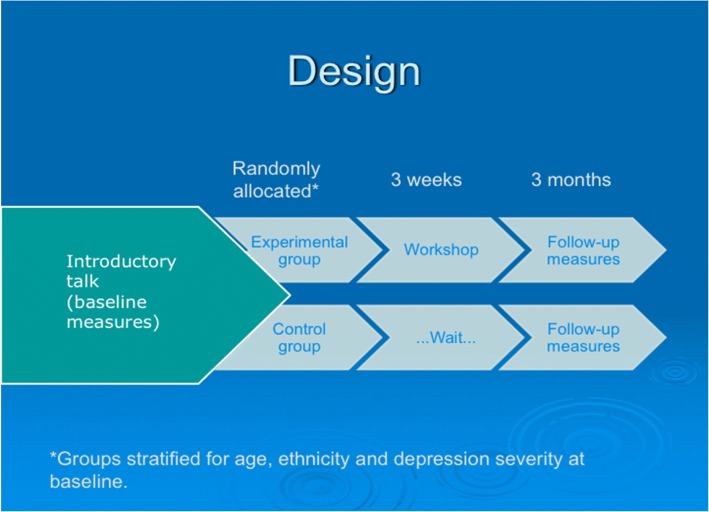
There are enormous problems in recruiting depressed people into randomised controlled trials (RCTs), with numerous studies consistently failing to recruit to target (Sully et al., Trials 14:166, 2013). Given the high prevalence of-and disability associated with-depression, it is important to find ways of effectively recruiting to RCTs evaluating interventions. This study aimed to test the feasibility of using a self-referral system to recruit to a brief intervention in a multi-site trial, the CLASSIC trial of self-confidence workshops for depression. In that trial, participants referred themselves to a depression intervention with a positive non-diagnostic title of 'self-confidence', given the close relationship of depression and self-esteem (Horrell et al., Br J Psychiatry 204:222-233, 2014).
We analysed uptake and retention rates by recruitment to the study, attendance at the workshops and follow-up rates. However, because of the rapid rate of recruitment, we decided to pause the trial and revise our original single-site research protocol in months 5-6. We report findings under three main headings: recruitment rates for the 12 months of the project before and after the pause; data regarding attendance at the workshops before and after the pause; and the follow-up rates before and after the pause.
We recruited 459 participants within 12 months, representing 38 participants recruited per month. Improved uptake of the intervention and retention after the development of multi-site research protocols are reported.
Based on previous evidence from RCT recruitment among depressed participants, our recruitment rate demonstrates that a self-referral system using a non-diagnostic title of self-confidence is a successful recruitment method. The implications of rapid recruitment using a self-referral system are described, including the impact on uptake of the intervention as well as participant retention. Because of the potential for recruiting many participants quickly, research teams need to be adequately resourced and the oversight committees prepared to meet at shorter intervals with RCTs of brief interventions.
Self-referral to a brief intervention for depression with a non-diagnostic title can be a very effective way of recruiting depressed people into trials. However, there are also some challenges.
ISRCTN, ISRCTN26634837 . Registered on 10 June 2010.
在招募抑郁症患者参与随机对照试验(RCT)时存在巨大问题,众多研究一直未能达到招募目标(萨利等人,《试验》14:166,2013年)。鉴于抑郁症的高患病率以及与之相关的残疾情况,找到有效招募参与评估干预措施的RCT的方法很重要。本研究旨在测试在一项多中心试验(针对抑郁症的自信工作坊的CLASSIC试验)中使用自我推荐系统招募参与者接受简短干预措施的可行性。在该试验中,鉴于抑郁症与自尊之间的密切关系,参与者将自己推荐至一个标题为积极且非诊断性的“自信”的抑郁症干预项目(霍雷尔等人,《英国精神病学杂志》204:222 - 233,2014年)。
我们通过研究招募情况、工作坊出勤情况和随访率来分析参与率和留存率。然而,由于招募速度很快,我们决定在第5 - 6个月暂停试验并修订我们原来的单中心研究方案。我们在三个主要标题下报告研究结果:暂停前后项目12个月的招募率;暂停前后工作坊出勤情况的数据;以及暂停前后的随访率。
我们在12个月内招募了459名参与者,每月招募38名。报告显示,在制定多中心研究方案后,干预措施的参与率和留存率有所提高。
基于之前在抑郁症患者中进行RCT招募的证据,我们的招募率表明,使用非诊断性标题“自信”的自我推荐系统是一种成功的招募方法。描述了使用自我推荐系统快速招募的影响,包括对干预措施参与率以及参与者留存率的影响。由于有可能快速招募大量参与者,研究团队需要有充足的资源,监督委员会也需准备好更频繁地与简短干预措施的RCT进行会面。
自我推荐至一个标题为非诊断性的抑郁症简短干预措施可以是一种非常有效的招募抑郁症患者参与试验的方式。然而,也存在一些挑战。
国际标准随机对照试验编号,ISRCTN26634837。于2010年6月10日注册。