Department of Social Psychology, University of Amsterdam, 1018 WT Amsterdam, The Netherlands;
Laboratory for Social and Neural Systems Research, Department of Economics, University of Zürich, 8001 Zürich, Switzerland.
Proc Natl Acad Sci U S A. 2019 Mar 5;116(10):4732-4737. doi: 10.1073/pnas.1810180116. Epub 2019 Feb 13.
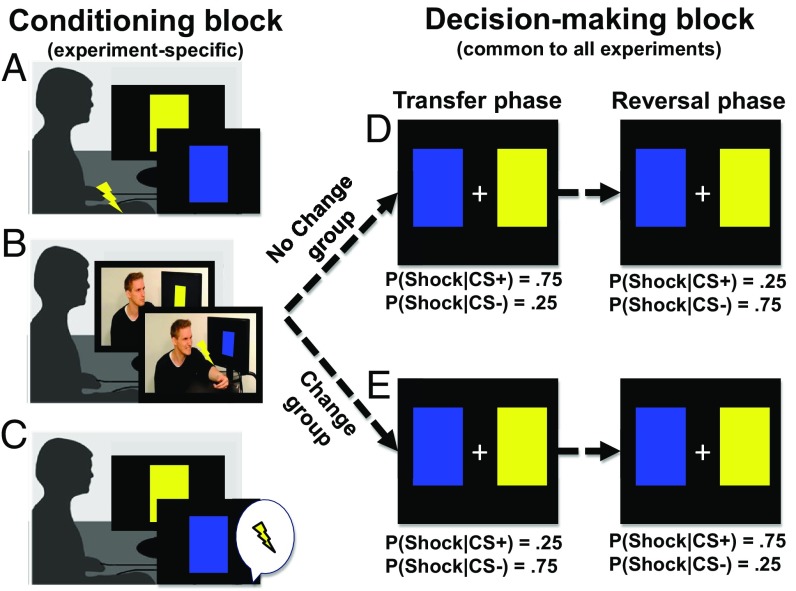
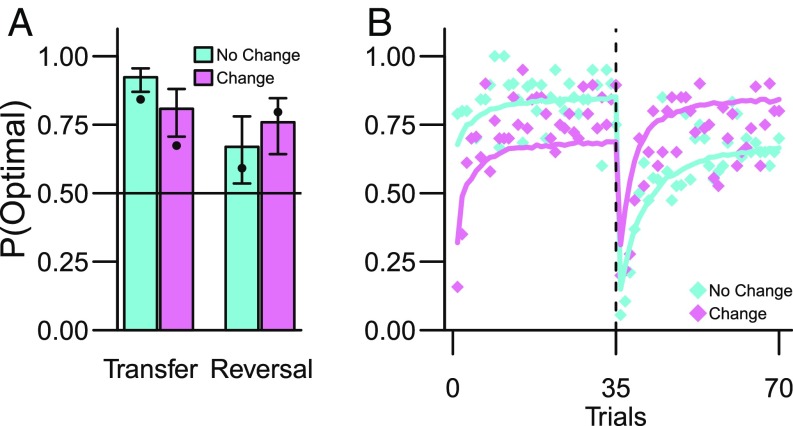
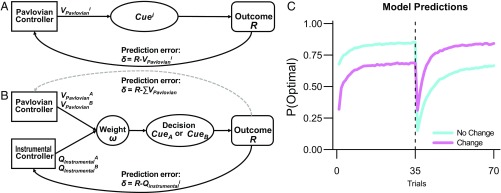
In today's world, mass-media and online social networks present us with unprecedented exposure to second-hand, vicarious experiences and thereby the chance of forming associations between previously innocuous events (e.g., being in a subway station) and aversive outcomes (e.g., footage or verbal reports from a violent terrorist attack) without direct experience. Such social threat, or fear, learning can have dramatic consequences, as manifested in acute stress symptoms and maladaptive fears. However, most research has so far focused on socially acquired threat responses that are expressed as increased arousal rather than active behavior. In three experiments ( = 120), we examined the effect of indirect experiences on behaviors by establishing a link between social threat learning and instrumental decision making. We contrasted learning from direct experience (i.e., Pavlovian conditioning) (experiment 1) against two common forms of social threat learning-social observation (experiment 2) and verbal instruction (experiment 3)-and how this learning transferred to subsequent instrumental decision making using behavioral experiments and computational modeling. We found that both types of social threat learning transfer to decision making in a strong and surprisingly inflexible manner. Notably, computational modeling indicated that the transfer of observational and instructed threat learning involved different computational mechanisms. Our results demonstrate the strong influence of others' expressions of fear on one's own decisions and have important implications for understanding both healthy and pathological human behaviors resulting from the indirect exposure to threatening events.
在当今世界,大众媒体和在线社交网络让我们前所未有地接触到二手的、间接的体验,从而有机会在没有直接经验的情况下将先前无害的事件(例如,在地铁站)与厌恶的结果(例如,来自暴力恐怖袭击的画面或口头报告)联系起来。这种社会威胁或恐惧学习可能会产生巨大的后果,表现为急性应激症状和适应不良的恐惧。然而,到目前为止,大多数研究都集中在通过社会获得的威胁反应上,这些反应表现为增加唤醒而不是主动行为。在三个实验(n=120)中,我们通过在社会威胁学习和工具性决策之间建立联系,研究了间接经验对行为的影响。我们将直接经验学习(即巴甫洛夫条件反射)(实验 1)与两种常见的社会威胁学习方式——社会观察(实验 2)和口头指导(实验 3)进行了对比,并通过行为实验和计算建模研究了这种学习如何转移到随后的工具性决策中。我们发现,这两种类型的社会威胁学习都以强烈而令人惊讶的不灵活方式转移到决策中。值得注意的是,计算建模表明,观察性和指令性威胁学习的转移涉及不同的计算机制。我们的结果表明,他人对恐惧的表达对自己的决策有很强的影响,这对理解由于间接接触威胁事件而导致的健康和病理性人类行为具有重要意义。