Biomedical Sciences Research Institute, University of Ulster, Coleraine, Northern Ireland, UK.
Avellino Lab USA, Inc., Menlo Park, CA, USA.
Eye (Lond). 2019 Jun;33(6):874-881. doi: 10.1038/s41433-019-0346-x. Epub 2019 Feb 13.
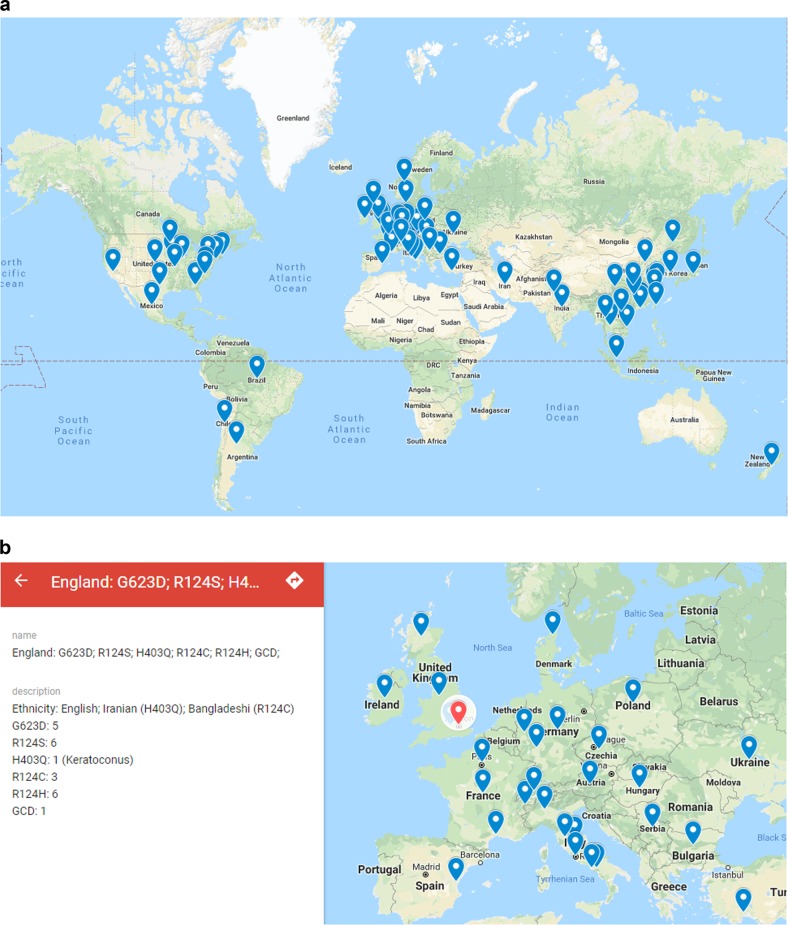
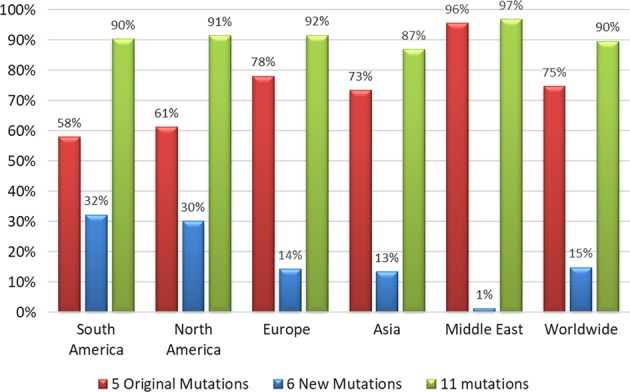
To date, 70 different TGFBI mutations that cause epithelial-stromal corneal dystrophies have been described. At present one commercially available test examines for the five most common of these mutations: R124H, R124C, R124L, R555W, and R555Q. To expand the capability of identifying the causative mutation in the remaining cases, 57 mutations would need to be added. The aim of this study was to obtain a better understanding of the worldwide distribution and population differences of TGFBI mutations and to assess which mutations could be included or excluded from any potential assay. A total of 184 published papers in Human Gene Mutation Database (HGMD) and PubMed from 34 countries worldwide reporting over 1600 corneal dystrophy cases were reviewed. Global data from 600,000 samples using the commercially available test were analyzed. Case studies by University College of London (UCL), Moorfield's Corneal Dystrophy Study data and 19 samples from patients with clinical abnormality or uncertainty for which the current test detected no mutation were used to predict an achievable detection rate. Data from the literature search showed no difference in the spectrum and frequency of each mutation in different populations or geographical locations. According to our analysis, an increase to the worldwide detection rate in all populations from 75 to 90% could be achieved by the addition of six mutations-H626R, A546D, H572R, G623D, R124S, and M502V-to the currently available test and that may be beneficial for LASIK pre-screening worldwide.
迄今为止,已经描述了 70 种不同的 TGFBI 突变,这些突变导致上皮-基质角膜营养不良。目前,一种商业上可用的测试可检测其中最常见的五种突变:R124H、R124C、R124L、R555W 和 R555Q。为了扩大确定其余病例中致病突变的能力,需要添加 57 种突变。本研究的目的是更好地了解 TGFBI 突变的全球分布和人群差异,并评估哪些突变可以包含或排除在任何潜在的检测中。对来自全球 34 个国家的 184 篇在人类基因突变数据库(HGMD)和 PubMed 上发表的论文进行了综述,共报道了超过 1600 例角膜营养不良病例。对来自全球 60 万样本的商业上可用测试的全球数据进行了分析。伦敦大学学院(UCL)的病例研究、Moorfield's Corneal Dystrophy Study 数据以及 19 份来自临床异常或不确定性患者的样本(当前测试未检测到这些患者的突变)用于预测可实现的检测率。文献检索数据显示,不同人群或地理位置的每种突变的谱和频率没有差异。根据我们的分析,通过在现有测试中添加六个突变(H626R、A546D、H572R、G623D、R124S 和 M502V),可以将所有人群的全球检测率从 75%提高到 90%,这可能有益于全球范围内的 LASIK 术前筛查。