Zhang Shen, Gu Shaohua, Ni Xinzhi, Li Xianchun
State Key Laboratory for Biology of Plant Diseases and Insect Pests, Institute of Plant Protection, Chinese Academy of Agricultural Sciences, Beijing, China.
USDA-ARS Crop Genetics and Breeding Research Unit, Tifton, GA, United States.
Front Physiol. 2019 Jan 30;10:29. doi: 10.3389/fphys.2019.00029. eCollection 2019.
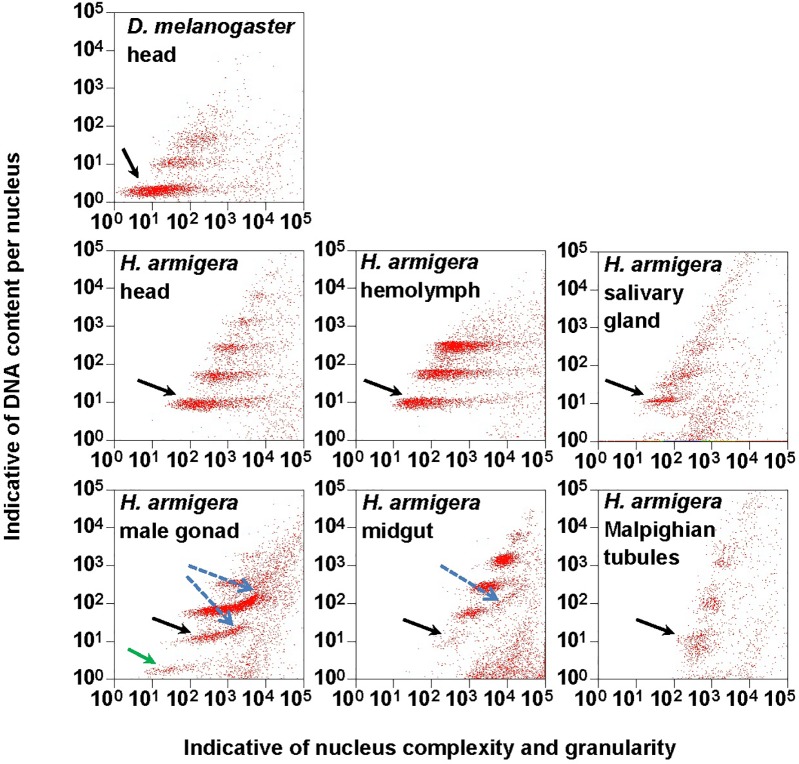
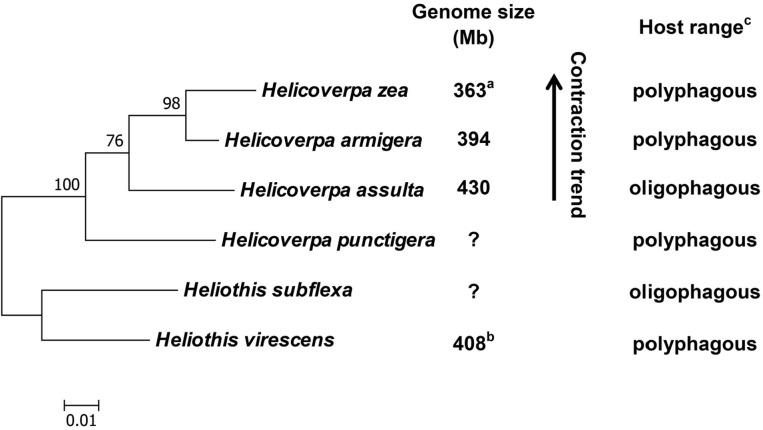
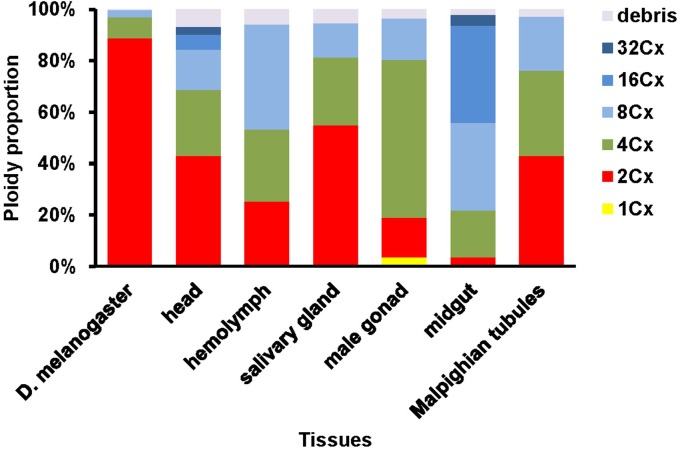
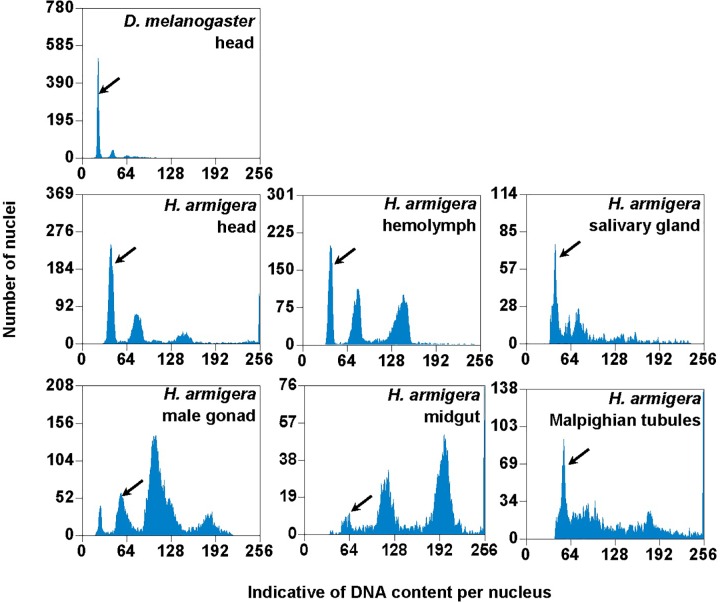
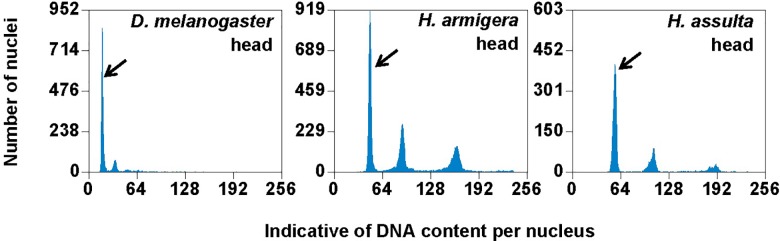
In organisms with very low percentages of transposable elements (TEs), genome size may positively or negatively correlate with host range, depending on whether host adaptation or host modification is the main route to host generalism. To test if this holds true for insect herbivores with greater percentages of TEs, we conducted flow cytometry to measure the endopolyploidy levels and C-values of the host modification (salivary gland and mandibular gland in head), host adaptation (midgut), and host use-independent tissues (male gonad, hemolymph, and Malpighian tubules) of the generalist and the head of its older specialist sister . Larval salivary gland displayed a consecutive chain of endopolyploidy particles from 8Cx to higher than 32Cx and larval head and midgut had endopolyploidy nuclei clusters of 16Cx and 32Cx, whereas larval male gonad, hemolymph, and Malpighian tubules possessed no endopolyploidy nuclei of higher than 8Cx. The estimated genome size of the Solanaceae plant specialist is 430 Mb, significantly larger than that of its older generalist sister (408 Mb) and those of its two generalist descendants (394 Mb) and (363 Mb). These data not only reveal a negative correlation between host plant range and genome size in this terminal lineage, but also imply that species appear to depend more on host modification than on host adaptation to achieve polyphagy.
在转座元件(TEs)比例极低的生物体中,基因组大小可能与宿主范围呈正相关或负相关,这取决于宿主适应或宿主修饰是否是宿主泛化的主要途径。为了测试这一规律是否适用于TEs比例更高的昆虫食草动物,我们进行了流式细胞术,以测量多食性昆虫及其较古老的专食性姐妹种头部的宿主修饰组织(头部的唾液腺和下颚腺)、宿主适应组织(中肠)以及与宿主利用无关的组织(雄性性腺、血淋巴和马氏管)的内多倍体水平和C值。幼虫唾液腺显示出从8Cx到高于32Cx的连续内多倍体颗粒链,幼虫头部和中肠有16Cx和32Cx的内多倍体细胞核簇,而幼虫雄性性腺、血淋巴和马氏管没有高于8Cx的内多倍体细胞核。茄科植物专食性昆虫的估计基因组大小为430 Mb,明显大于其较古老的多食性姐妹种(408 Mb)以及它的两个多食性后代(394 Mb)和(363 Mb)。这些数据不仅揭示了这个终端谱系中宿主植物范围与基因组大小之间的负相关,还暗示物种似乎更多地依赖宿主修饰而非宿主适应来实现多食性。