Department of Biological Engineering , Massachusetts Institute of Technology , 77 Massachusetts Avenue , Cambridge , Massachusetts 02139 , United States.
Computer Science and Artificial Intelligence Laboratory , Massachusetts Institute of Technology , 77 Massachusetts Avenue , Cambridge , Massachusetts 02139 , United States.
J Am Chem Soc. 2019 Mar 6;141(9):4108-4118. doi: 10.1021/jacs.8b13879. Epub 2019 Feb 21.
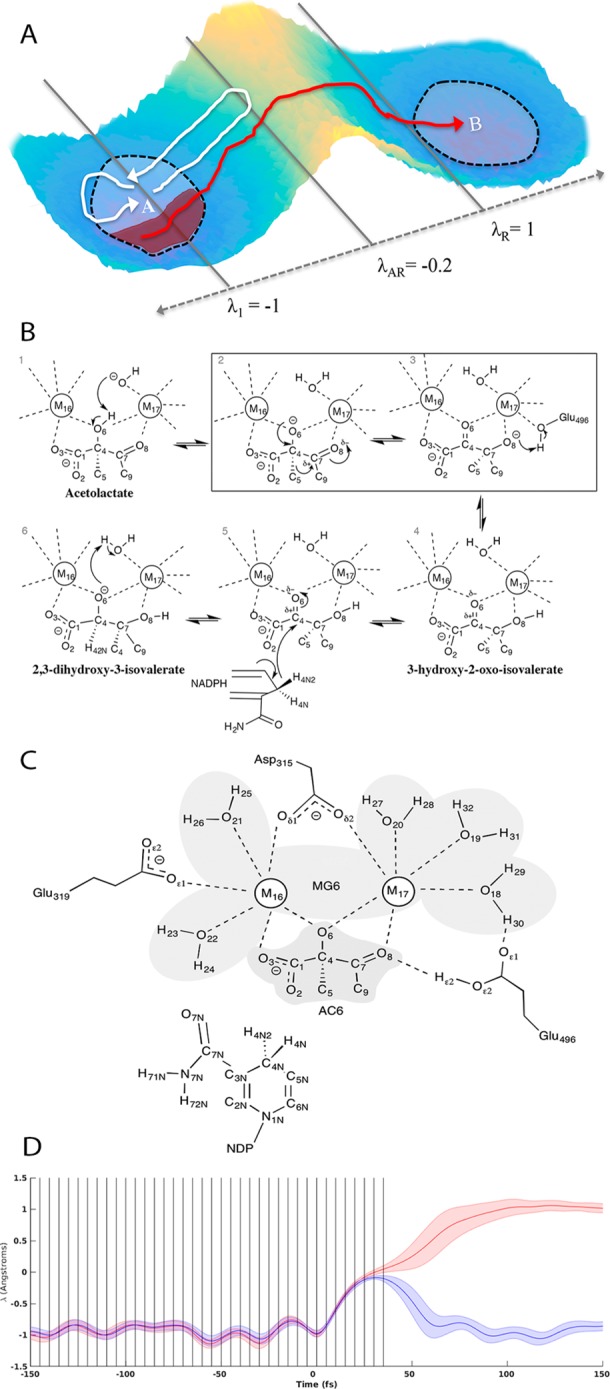
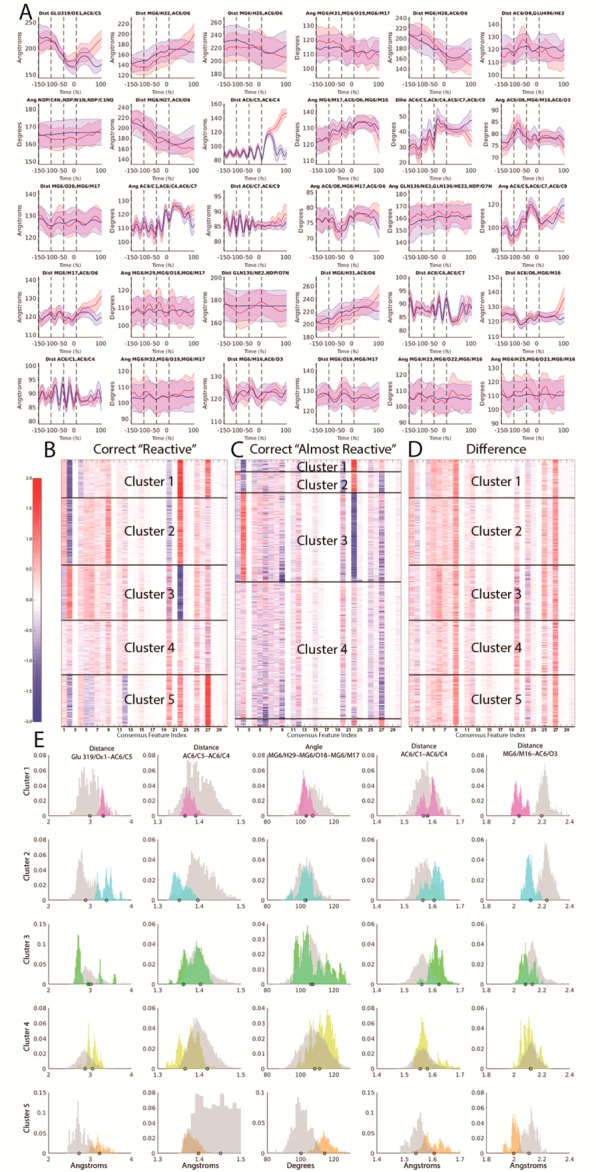
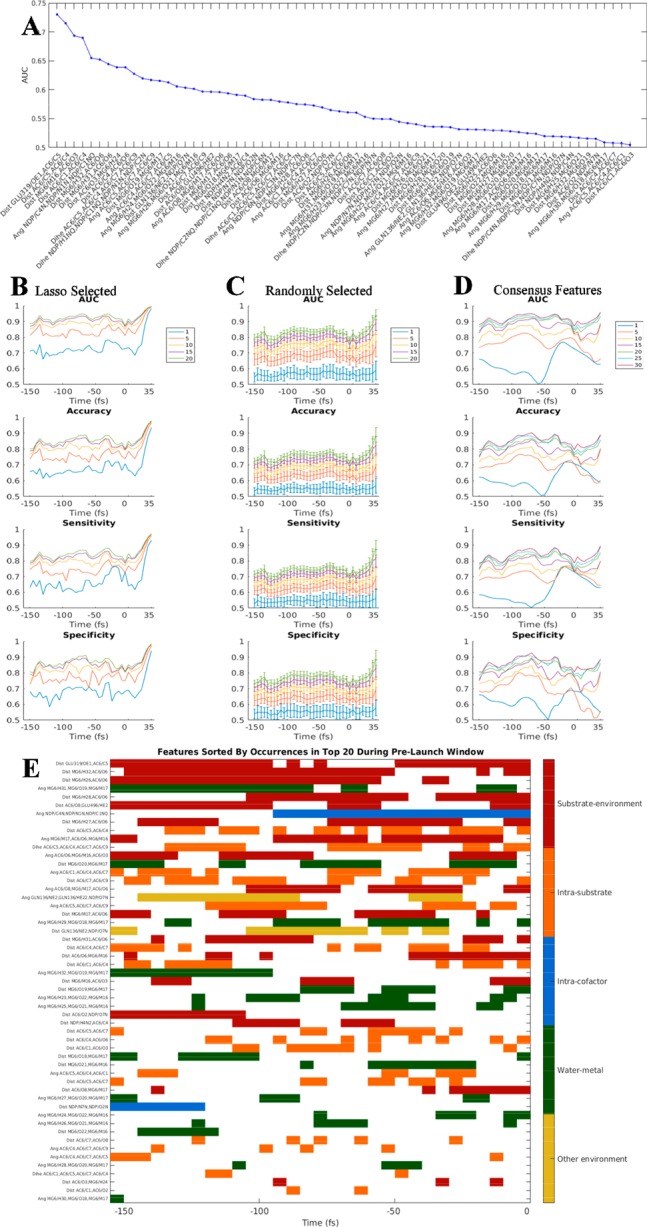
Despite tremendous progress in understanding and engineering enzymes, knowledge of how enzyme structures and their dynamics induce observed catalytic properties is incomplete, and capabilities to engineer enzymes fall far short of industrial needs. Here, we investigate the structural and dynamic drivers of enzyme catalysis for the rate-limiting step of the industrially important enzyme ketol-acid reductoisomerase (KARI) and identify a region of the conformational space of the bound enzyme-substrate complex that, when populated, leads to large increases in reactivity. We apply computational statistical mechanical methods that implement transition interface sampling to simulate the kinetics of the reaction and combine this with machine learning techniques from artificial intelligence to select features relevant to reactivity and to build predictive models for reactive trajectories. We find that conformational descriptors alone, without the need for dynamic ones, are sufficient to predict reactivity with greater than 85% accuracy (90% AUC). Key descriptors distinguishing reactive from almost-reactive trajectories quantify substrate conformation, substrate bond polarization, and metal coordination geometry and suggest their role in promoting substrate reactivity. Moreover, trajectories constrained to visit a region of the reactant well, separated from the rest by a simple hyperplane defined by ten conformational parameters, show increases in computed reactivity by many orders of magnitude. This study provides evidence for the existence of reactivity promoting regions within the conformational space of the enzyme-substrate complex and develops methodology for identifying and validating these particularly reactive regions of phase space. We suggest that identification of reactivity promoting regions and re-engineering enzymes to preferentially populate them may lead to significant rate enhancements.
尽管在理解和设计酶方面取得了巨大进展,但我们对酶结构及其动力学如何诱导观察到的催化特性的了解并不完整,而且设计酶的能力远远不能满足工业需求。在这里,我们研究了工业上重要的酶酮酸还原异构酶(KARI)限速步骤的酶催化的结构和动力学驱动因素,并确定了结合酶-底物复合物构象空间中的一个区域,当该区域被占据时,会导致反应性大大增加。我们应用了实施跃迁界面采样的计算统计力学方法来模拟反应动力学,并将其与人工智能中的机器学习技术相结合,以选择与反应性相关的特征,并构建用于反应性轨迹的预测模型。我们发现,仅使用构象描述符而无需动态描述符,就足以预测反应性,准确率超过 85%(90% AUC)。区分反应性和几乎反应性轨迹的关键描述符量化了底物构象、底物键极化和金属配位几何形状,并表明它们在促进底物反应性方面的作用。此外,受约束以访问反应物良好区域的轨迹,与由十个构象参数定义的简单超平面将其余部分隔开,计算出的反应性增加了几个数量级。这项研究为酶-底物复合物构象空间中存在促进反应性的区域提供了证据,并开发了用于识别和验证这些特殊反应性相空间区域的方法。我们建议,确定促进反应性的区域并重新设计酶以优先占据它们可能会导致显著的速率提高。