Environmental Health Investigations Branch, California Department of Public Health (CDPH), Richmond, CA 94804, USA.
Sequoia Foundation, La Jolla, CA 92037, USA.
Int J Environ Res Public Health. 2019 Feb 5;16(3):458. doi: 10.3390/ijerph16030458.
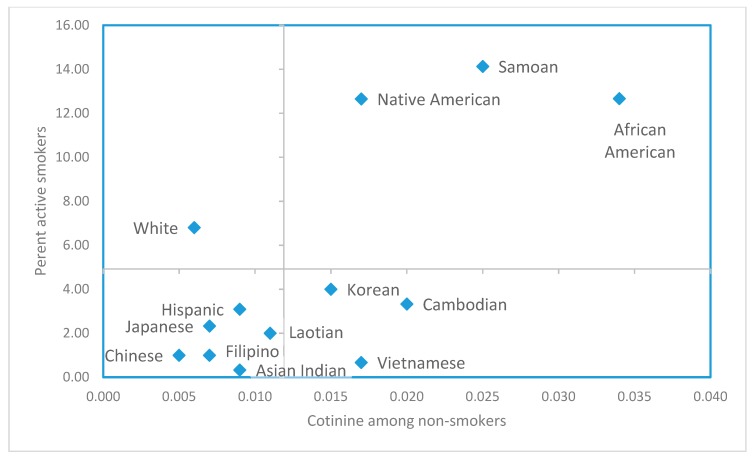
Prenatal tobacco exposure is a significant, preventable cause of childhood morbidity, yet little is known about exposure risks for many race/ethnic subpopulations. We studied active smoking and environmental tobacco smoke (ETS) exposure in a population-based cohort of 13 racially/ethnically diverse pregnant women: white, African American, Hispanic, Native American, including nine Asian/Pacific Islander subgroups: Chinese, Japanese, Korean, Filipino, Cambodian, Vietnamese, Laotian, Samoan, and Asian Indians (N = 3329). Using the major nicotine metabolite, cotinine, as an objective biomarker, we analyzed mid-pregnancy serum from prenatal screening banked in 1999⁻2002 from Southern California in an effort to understand differences in tobacco exposure patterns by race/ethnicity, as well as provide a baseline for future work to assess secular changes and longer-term health outcomes. Prevalence of active smoking (based on age- and race-specific cotinine cutpoints) was highest among African American, Samoan, Native Americans and whites (6.8⁻14.1%); and lowest among Filipinos, Chinese, Vietnamese and Asian Indians (0.3⁻1.0%). ETS exposure among non-smokers was highest among African Americans and Samoans, followed by Cambodians, Native Americans, Vietnamese and Koreans, and lowest among Filipinos, Japanese, whites, and Chinese. At least 75% of women had detectable cotinine. While for most groups, levels of active smoking corresponded with levels of ETS, divergent patterns were also found. For example, smoking prevalence among white women was among the highest, but the group's ETS exposure was low among non-smokers; while Vietnamese women were unlikely to be active smokers, they experienced relatively high ETS exposure. Knowledge of race/ethnic differences may be useful in assessing disparities in health outcomes and creating successful tobacco interventions.
产前烟草暴露是导致儿童发病的一个重要且可预防的原因,但对于许多种族/族裔亚人群的暴露风险知之甚少。我们研究了一个基于人群的 13 个不同种族/族裔的孕妇队列中的主动吸烟和环境烟草烟雾(ETS)暴露情况:白人、非裔美国人、西班牙裔、美洲原住民,包括九个亚洲/太平洋岛民亚群:中国、日本、韩国、菲律宾、柬埔寨、越南、老挝、萨摩亚和印度裔美国人(N=3329)。我们使用主要尼古丁代谢物可替宁作为客观生物标志物,分析了 1999-2002 年在南加州进行的产前筛查中储存的孕妇妊娠中期血清,以了解不同种族/族裔之间的烟草暴露模式差异,并为未来评估时间变化和长期健康结果提供基线。根据年龄和种族特异性可替宁切点,主动吸烟(基于年龄和种族特异性可替宁切点)的患病率在非裔美国人、萨摩亚人、美洲原住民和白人中最高(6.8-14.1%);而在菲律宾人、中国人、越南人和印度裔美国人中最低(0.3-1.0%)。非吸烟者的 ETS 暴露在非裔美国人和萨摩亚人中最高,其次是柬埔寨人、美洲原住民、越南人和韩国人,在菲律宾人、日本人、白人和中国人中最低。至少有 75%的女性可检测到可替宁。虽然对于大多数群体,主动吸烟的水平与 ETS 的水平相对应,但也发现了不同的模式。例如,白人女性的吸烟率是最高的,但该群体的非吸烟者 ETS 暴露水平较低;而越南女性不太可能是主动吸烟者,但她们经历了相对较高的 ETS 暴露。了解种族/族裔差异可能有助于评估健康结果的差异,并制定成功的烟草干预措施。