TNO (The Netherlands Organization for Applied Scientific Research), Leiden, Netherlands.
Dept. of Social, Health and Organizational Psychology, Utrecht University, Utrecht, Netherlands.
BMC Public Health. 2019 Feb 14;19(1):194. doi: 10.1186/s12889-019-6522-x.
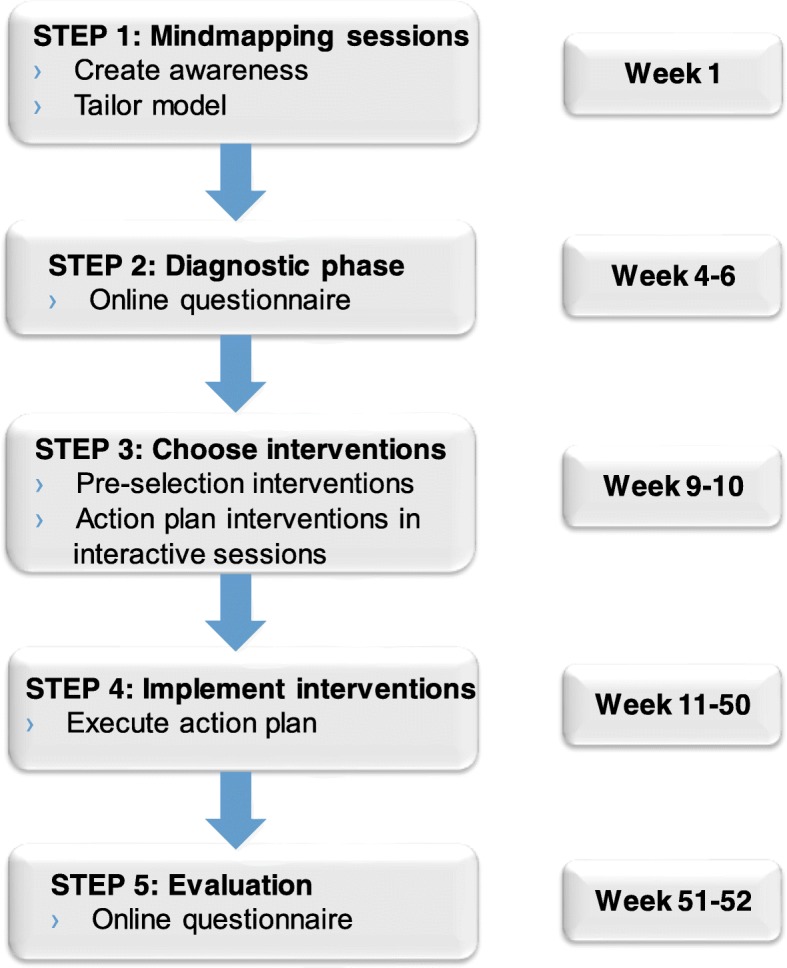
The present study aimed to investigate the effects of a stepwise, bottom-up participatory program with a tailor-made intervention process addressing the level of mental retirement in a sample of Dutch employees. Mental retirement refers to feelings of being disconnected from your work and your organization. Prevention of mental retirement is important since sustainable employability is becoming more important in today's society due to the ageing of the working population and the changes in skills demands.
This prospective cohort study with a one-year follow-up employs a sample of 683 employees of three organizations in The Netherlands, who filled out two questionnaires: at baseline and 1 year later. The dependent measure was mental retirement, which consists of three sub-concepts: developmental pro-activity, work engagement and perceived appreciation.
Multilevel analysis (N = 466) showed that employees who more actively participated in the intervention(s) had a small but statistically significant larger decrease in mental retirement at follow-up.
The stepwise, bottom-up participatory program with a tailor-made intervention process shows a tendency to decrease the level of mental retirement in Dutch employees. However, the implementation of interventions could be further improved since it turned out to be very challenging to keep up participants' commitment to the program. Future research should study the effectiveness of this program further with an improved study design (control group, multiple follow-ups, several data sources).
本研究旨在调查一项分阶段、自下而上的参与式计划对荷兰员工样本中心理退休水平的影响。心理退休是指与工作和组织脱节的感觉。预防心理退休很重要,因为随着工作人口老龄化和技能需求的变化,可持续就业能力在当今社会变得越来越重要。
这项前瞻性队列研究为期一年,采用了荷兰三家组织的 683 名员工样本,他们填写了两份问卷:基线和一年后。因变量是心理退休,它由三个子概念组成:发展积极性、工作投入和感知赞赏。
多层次分析(N=466)表明,更积极参与干预的员工在随访时心理退休程度有较小但具有统计学意义的显著下降。
分阶段、自下而上的参与式计划和定制的干预过程显示出降低荷兰员工心理退休水平的趋势。然而,由于参与者对该计划的承诺变得极具挑战性,因此干预措施的实施可以进一步改进。未来的研究应该进一步研究该计划的有效性,采用改进的研究设计(对照组、多次随访、多个数据源)。