Cinel Caterina, Valeriani Davide, Poli Riccardo
Brain Computer Interfaces and Neural Engineering Laboratory, School of Computer Science and Electronic Engineering, University of Essex, Colchester, United Kingdom.
Department of Otolaryngology, Massachusetts Eye and Ear, Harvard Medical School, Boston, MA, United States.
Front Hum Neurosci. 2019 Jan 31;13:13. doi: 10.3389/fnhum.2019.00013. eCollection 2019.
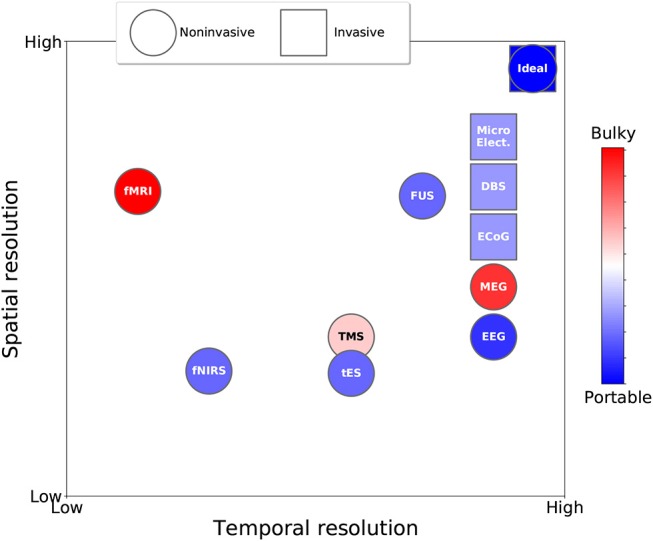
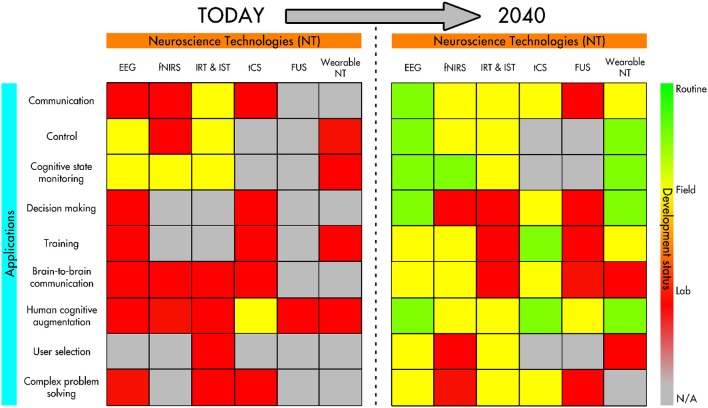
Recent advances in neuroscience have paved the way to innovative applications that cognitively augment and enhance humans in a variety of contexts. This paper aims at providing a snapshot of the current state of the art and a motivated forecast of the most likely developments in the next two decades. Firstly, we survey the main neuroscience technologies for both observing and influencing brain activity, which are necessary ingredients for human cognitive augmentation. We also compare and contrast such technologies, as their individual characteristics (e.g., spatio-temporal resolution, invasiveness, portability, energy requirements, and cost) influence their current and future role in human cognitive augmentation. Secondly, we chart the state of the art on neurotechnologies for human cognitive augmentation, keeping an eye both on the applications that already exist and those that are emerging or are likely to emerge in the next two decades. Particularly, we consider applications in the areas of communication, cognitive enhancement, memory, attention monitoring/enhancement, situation awareness and complex problem solving, and we look at what fraction of the population might benefit from such technologies and at the demands they impose in terms of user training. Thirdly, we briefly review the ethical issues associated with current neuroscience technologies. These are important because they may differentially influence both present and future research on (and adoption of) neurotechnologies for human cognitive augmentation: an inferior technology with no significant ethical issues may thrive while a superior technology causing widespread ethical concerns may end up being outlawed. Finally, based on the lessons learned in our analysis, using past trends and considering other related forecasts, we attempt to forecast the most likely future developments of neuroscience technology for human cognitive augmentation and provide informed recommendations for promising future research and exploitation avenues.
神经科学的最新进展为创新应用铺平了道路,这些应用在各种情况下对人类进行认知增强。本文旨在概述当前的技术现状,并对未来二十年最可能的发展进行有依据的预测。首先,我们调查了用于观察和影响大脑活动的主要神经科学技术,这些技术是人类认知增强的必要要素。我们还对这些技术进行了比较和对比,因为它们的个体特征(例如,时空分辨率、侵入性、便携性、能量需求和成本)会影响它们在人类认知增强中当前和未来的作用。其次,我们梳理了人类认知增强神经技术的技术现状,既关注已有的应用,也关注未来二十年可能出现或即将出现的应用。特别是,我们考虑了在通信、认知增强、记忆、注意力监测/增强、态势感知和复杂问题解决等领域的应用,并探讨了哪些人群可能从这些技术中受益,以及它们对用户培训的要求。第三,我们简要回顾了与当前神经科学技术相关的伦理问题。这些问题很重要,因为它们可能会对当前和未来关于人类认知增强神经技术的研究(以及采用)产生不同的影响:一项没有重大伦理问题的劣质技术可能会蓬勃发展,而一项引发广泛伦理担忧的优质技术最终可能会被取缔。最后,基于我们分析中吸取的教训,利用过去的趋势并考虑其他相关预测,我们试图预测人类认知增强神经科学技术最可能的未来发展,并为有前景的未来研究和开发途径提供明智的建议。