Sievert Lynnette Leidy, Huicochea-Gómez Laura, Cahuich-Campos Diana, Ko'omoa-Lange Dana-Lynn, Brown Daniel E
Department of Anthropology, Machmer Hall, 240 Hicks Way, UMass Amherst, Amherst, MA 01003-9278 USA.
2Departamento de Sociedad y Cultura, El Colegio de la Frontera, ECOSUR, Campeche, México.
Womens Midlife Health. 2018 Jun 18;4:9. doi: 10.1186/s40695-018-0038-x. eCollection 2018.
Stress has been implicated as a factor in the presence and severity of symptoms during the menopausal transition. Our primary aim was to test the hypothesis that stress-sensitive biological measures and self-reported stress would be positively associated with a greater likelihood and intensity of hot flashes. Our secondary aim was to examine measures of stress in relation to the most often reported symptoms in Campeche, Mexico. We also hypothesized ethnic differences (Maya versus non-Maya) in relation to measures of stress and symptom reports.
Participants aged 40-60 ( = 305) were drawn from multiple sites across the city of San Francisco de Campeche to achieve a generally representative sample. Measures included C-reactive protein (CRP), an indicator of inflammation; Epstein-Barr virus antibodies (EBV-Ab), an indicator of immune function; the Perceived Stress Scale (PSS); a symptom checklist; anthropometric measures; and a questionnaire that elicited symptoms, ethnicity (based on language, birthplace, and last names of the woman, her parents, and her grandparents) and ten dimensions of socioeconomic status (SES). The relationships between symptoms and stress-sensitive biological and self-reported measures were examined in bivariate analyses, and with logistic and linear regressions.
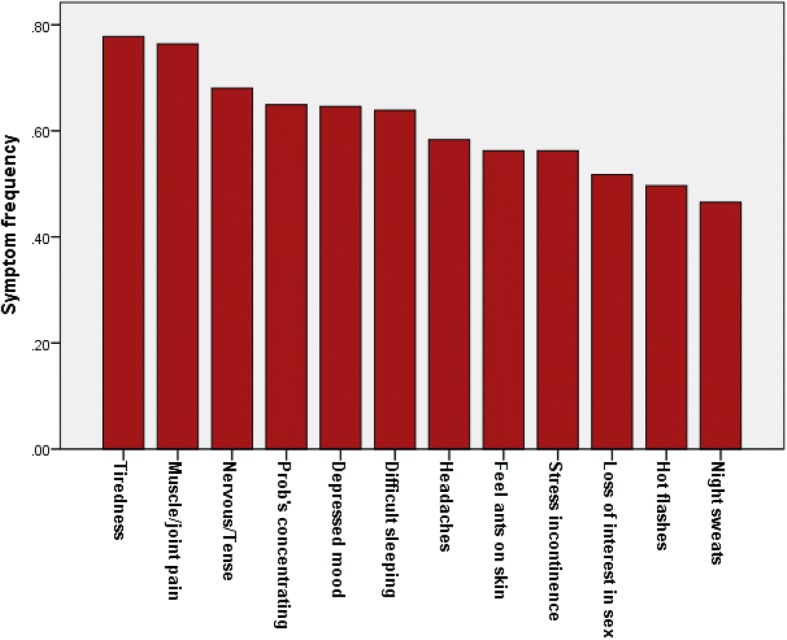
The twelve most common symptoms reported, in descending order of frequency, were tiredness, muscle and joint pain, nervous tension, problems concentrating, feeling depressed, difficulty sleeping, headaches, feeling of ants crawling on the skin, loss of interest in sex, urinary stress incontinence, hot flashes, and night sweats. PSS scores were significantly associated with the likelihood of seven symptoms (yes/no), and with the intensity of ten symptoms after controlling for ethnicity, SES, education, cohabitation status, parity, smoking, body mass index, and menopausal status. The stress-sensitive biological measures of immune function (EBV-Ab and CRP) were not significantly associated with midlife symptoms. The PSS was associated with more symptoms among the Maya (e.g., feeling nervous/tense and having difficulty concentrating) than non-Maya.
PSS scores were associated with the intensity, but not the likelihood, of hot flashes. Other symptoms were also associated with self-reported stress but not with physiological measures. Maya/non-Maya differences may indicate that either symptoms or stress were experienced and/or reported in culture-specific ways.
压力被认为是围绝经期症状出现及严重程度的一个影响因素。我们的主要目的是检验以下假设:应激敏感的生物学指标和自我报告的压力与潮热发生的可能性及强度呈正相关。我们的次要目的是研究压力指标与墨西哥坎佩切最常报告的症状之间的关系。我们还假设在压力指标和症状报告方面存在种族差异(玛雅人与非玛雅人)。
从圣弗朗西斯科 - 德坎佩切市的多个地点招募了年龄在40 - 60岁之间的参与者(n = 305),以获得具有普遍代表性的样本。测量指标包括:炎症指标C反应蛋白(CRP);免疫功能指标爱泼斯坦 - 巴尔病毒抗体(EBV - Ab);感知压力量表(PSS);症状清单;人体测量指标;以及一份问卷,该问卷涉及症状、种族(根据女性本人、其父母和祖父母的语言、出生地及姓氏)和社会经济地位(SES)的十个维度。在双变量分析以及逻辑回归和线性回归中研究症状与应激敏感的生物学指标及自我报告指标之间的关系。
报告的十二种最常见症状按频率从高到低依次为:疲劳、肌肉和关节疼痛、神经紧张、注意力不集中、情绪低落、睡眠困难、头痛、皮肤有蚁走感、对性生活失去兴趣、压力性尿失禁、潮热和盗汗。在控制了种族、SES、教育程度、同居状况、生育情况、吸烟、体重指数和绝经状态后,PSS评分与七种症状(是/否)的发生可能性以及十种症状的强度显著相关。免疫功能的应激敏感生物学指标(EBV - Ab和CRP)与中年症状无显著关联。与非玛雅人相比,PSS与玛雅人更多的症状相关(例如,感到紧张和注意力难以集中)。
PSS评分与潮热的强度相关,但与潮热的发生可能性无关。其他症状也与自我报告的压力相关,但与生理指标无关。玛雅人/非玛雅人的差异可能表明症状或压力是以特定文化方式体验和/或报告的。