Hii Aurysia, Chughtai Abrar Ahmad, Housen Tambri, Saketa Salanieta, Kunasekaran Mohana Priya, Sulaiman Feroza, Yanti Nk Semara, MacIntyre Chandini Raina
National Centre for Epidemiology & Population Health, Research School of Population Health, Australian National University, Australia.
School of Public Health and Community Medicine, University of New South Wales, Australia.
Western Pac Surveill Response J. 2018 Dec 18;9(4):28-36. doi: 10.5365/wpsar.2018.9.2.009. eCollection 2018 Oct-Dec.
To understand the global outbreak surveillance needs of stakeholders involved in epidemic response in selected countries and areas in the Asia-Pacific region to inform development of an epidemic observatory, Epi-watch.
We designed an online, semi-structured stakeholder questionnaire to collect information on global outbreak surveillance sources and limitations from participants who use epidemic intelligence and outbreak alert services in their work in government and nongovernment organizations in the Asia-Pacific region.
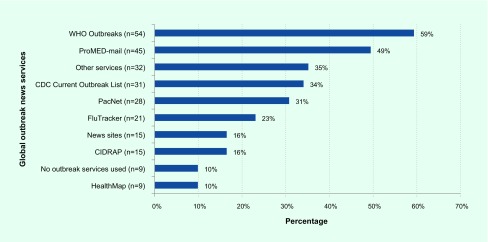
All respondents agreed that it was important to remain up to date with global outbreaks. The main reason cited for following global outbreak news was as an early warning for serious epidemics. Mainstream media and specialist Internet sources such as the World Health Organization ( = 54/91; 59%), the Program for Monitoring Emerging Diseases (ProMED)-mail ( = 45/91; 49%) and the United States Centers for Disease Control and Prevention ( = 31/91; 34%) were the most common sources for global outbreak news; rapid intelligence services such as HealthMap were less common ( = 9/91; 10%). Only 51% ( = 46/91) of respondents thought that their sources of outbreak news were timely and sufficient for their needs.
For those who work in epidemic response, epidemic intelligence is important and widely used. Stakeholders are less aware of and less frequently use rapid sources such as HealthMap and rely more on validated but less timely traditional sources of disease surveillance. Users identified a need for more timely and reliable epidemic intelligence.
了解亚太地区部分国家和地区参与疫情应对的利益相关者的全球疫情监测需求,以为疫情观测站Epi-watch的开发提供信息。
我们设计了一份在线半结构化利益相关者调查问卷,以收集亚太地区政府和非政府组织中在工作中使用疫情情报和疫情警报服务的参与者关于全球疫情监测来源和局限性的信息。
所有受访者都认为及时了解全球疫情很重要。追踪全球疫情新闻的主要原因是作为严重疫情的早期预警。主流媒体和专业互联网来源,如世界卫生组织(54/91;59%)、新兴疾病监测计划(ProMED)邮件(45/91;49%)和美国疾病控制与预防中心(31/91;34%)是全球疫情新闻最常见的来源;像HealthMap这样的快速情报服务不太常见(9/91;10%)。只有51%(46/91)的受访者认为他们的疫情新闻来源及时且满足他们的需求。
对于从事疫情应对工作的人来说,疫情情报很重要且被广泛使用。利益相关者对HealthMap等快速来源的了解较少且使用频率较低,更多地依赖经过验证但不太及时的传统疾病监测来源。用户认为需要更及时、可靠的疫情情报。