Ebana Yusuke, Furukawa Tetsushi
Life Science and Bioethics Research Center, Tokyo Medical and Dental University, Tokyo, Japan.
Department of Bioinformational Pharmacology, Tokyo Medical and Dental University, Tokyo, Japan.
Int J Cardiol Heart Vasc. 2019 Feb 2;22:150-153. doi: 10.1016/j.ijcha.2019.01.007. eCollection 2019 Mar.
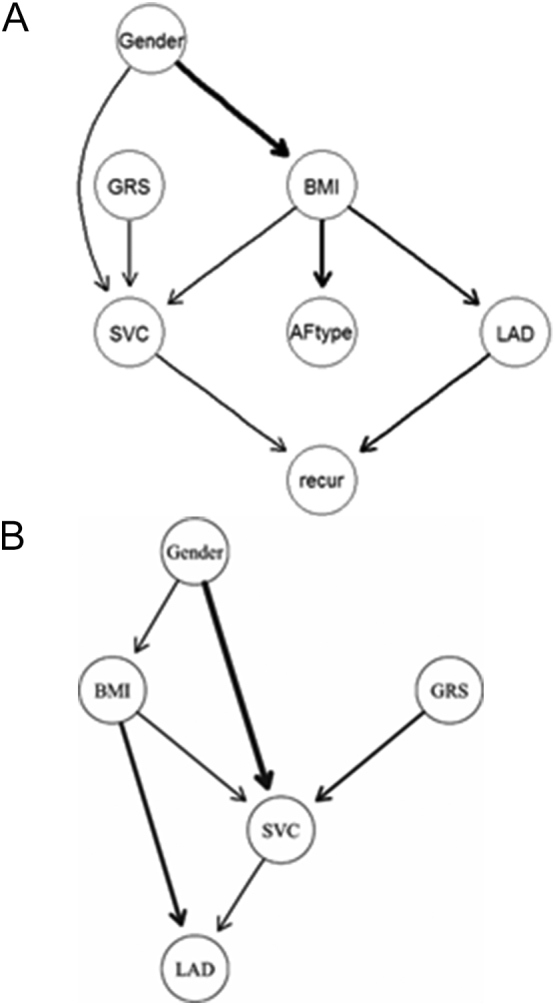
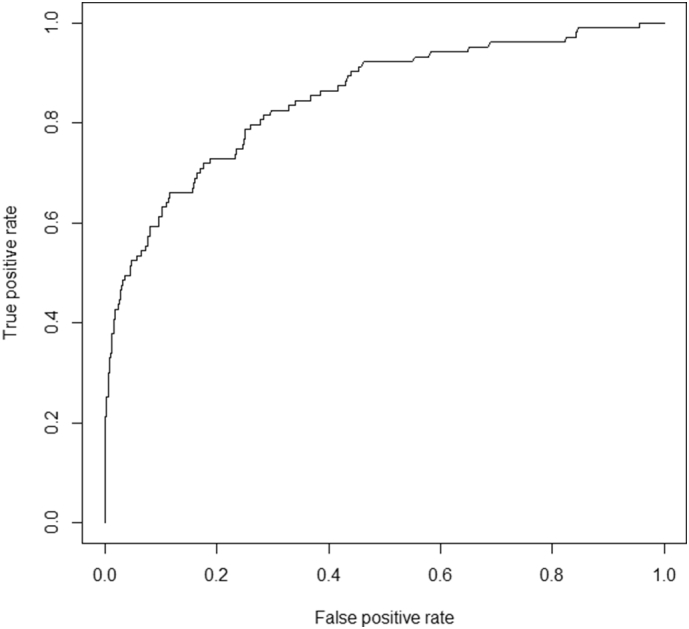
Atrial fibrillation (AF) can be initiated from arrhythmogenic foci within the muscular sleeves that extend not only into the pulmonary veins but also into both vena cavae. Patients with SVC-derived AF have the common clinical and genetic risk factors. Bayesian network analysis is a probabilistic model in which a qualitative dependency relationship among random variables is represented by a graph structure and a quantitative relationship between individual variables is expressed by a conditional probability. We used data of meta-analysis of 2170 AF patients with and without SVC arrhythmogenicity in the previous article. Bayesian Networking analysis was performed using the software "bnlearn". Using the clinical and genetic factors associated with SVC arrhythmogenicity in the previous article, we investigated a Bayesian networking structure to determine the probabilitic causation of variants to clinical parameters and found that the rate of recurrence depended on SVC arrhythmogenicity and LA diameter, and that SVC arrhythmogenicity was conditionally dependent on gender, body mass index, and genetic risk score. We found the possibility of prediction model generated from three factors. Receiver-operation characteristic analysis showed the area under the curve was 0.84. Using the clinical/genetic factors associated with SVC arrhythmogenicity through the previous meta-analysis of over 2000 patients, Bayesian networking analysis indicated the probabilistic causation of SVC arrhythmogenicity and associated clinical/genetic factors.
心房颤动(AF)可起源于肌袖内的致心律失常灶,这些肌袖不仅延伸至肺静脉,还延伸至上下腔静脉。源于上腔静脉(SVC)的AF患者具有常见的临床和遗传风险因素。贝叶斯网络分析是一种概率模型,其中随机变量之间的定性依赖关系由图结构表示,个体变量之间的定量关系由条件概率表示。我们使用了上一篇文章中对2170例有或无SVC致心律失常性的AF患者进行的荟萃分析数据。使用“bnlearn”软件进行贝叶斯网络分析。利用上一篇文章中与SVC致心律失常性相关的临床和遗传因素,我们研究了一种贝叶斯网络结构,以确定变异对临床参数的概率因果关系,发现复发率取决于SVC致心律失常性和左心房直径,并且SVC致心律失常性有条件地依赖于性别、体重指数和遗传风险评分。我们发现了由三个因素生成预测模型的可能性。受试者工作特征分析显示曲线下面积为0.84。通过对2000多名患者进行的上一篇荟萃分析,利用与SVC致心律失常性相关的临床/遗传因素,贝叶斯网络分析表明了SVC致心律失常性及相关临床/遗传因素的概率因果关系。