Joysowal Mamata, Saikia B N, Dowarah Runjun, Tamuly S, Kalita D, Choudhury K B Dev
Department of Animal Nutrition, College of Veterinary Science, Assam Agricultural University, Khanapara, Guwahati, Assam, India.
Department of Veterinary Biochemistry, College of Veterinary Science, Assam Agricultural University, Khanapara, Guwahati, Assam, India.
Vet World. 2018 Dec;11(12):1669-1676. doi: 10.14202/vetworld.2018.1669-1676. Epub 2018 Dec 14.
The experiment was conducted to evaluate the effect of swine-origin probiotic FT28 on growth, nutrient utilization, health status, meat quality and intestinal morphology in growing female pigs.
Pigs (n=27) were distributed into three groups (3 replicates of 3 each) and supplemented with basal diet either without probiotics (C) or with a probiotic of dairy-based ( NCDC-15; ) or swine based ( FT28; ). The probiotics were fed as fermented feed at 200 g/pig/day. At the end of the trial, six pigs from each group were selected for metabolism trial and then sacrificed to determine meat quality and intestinal morphology.
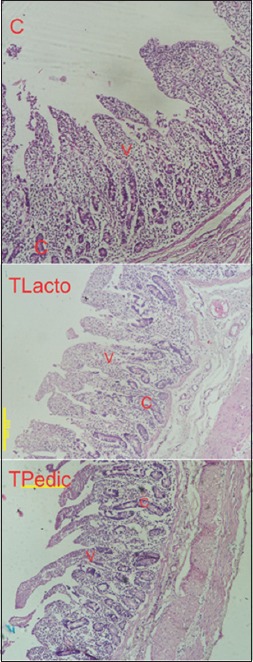
Supplementation of both probiotics improved growth performance, whereas feed intake, digestibility of CP and N retention were better (p<0.05) in FT28-fed group. However , the digestibility of dry matter (DM), organic matter (OM), ether extracts (EE), crude fiber and nitrogen free extract did not show any significant effect on probiotic supplementation. The serum A: G ratio, triglyceride, and cholesterol level were also improved (p<0.05) in group compared to other treatment groups. Both probiotic supplementations showed lower (p<0.05) serum glucose level with similar protein and albumin value, which indicated good utilization of feed as well as health status of growing pigs. Dressing percentage, vital organ weight, and EE of loin meat were higher (p<0.05) in probiotic-supplemented groups compared to control. However, FT28-fed animals showed higher (p<0.05) CP and total ash percentage of meat without affecting pH, water holding capacity, and extract release volume of loin muscle. The villi height and crypt depth were better in both supplemented groups compared to control.
Results of the present study revealed that FT28 could serve as better probiotic source in swine production for the better utilization of CP and N-retention in meat with improved health status and intestinal morphology.
本试验旨在评估猪源益生菌FT28对生长育肥母猪生长性能、养分利用率、健康状况、肉质及肠道形态的影响。
选取27头猪,分为3组(每组3个重复,每个重复3头),分别饲喂不添加益生菌的基础日粮(C组)、添加乳源益生菌(NCDC - 15)或猪源益生菌(FT28)的基础日粮。益生菌以发酵饲料形式按每头猪每天200 g的量饲喂。试验结束时,每组选取6头猪进行代谢试验,之后屠宰以测定肉质和肠道形态。
两种益生菌的添加均改善了生长性能,其中FT28组的采食量、粗蛋白消化率和氮保留率更佳(p<0.05)。然而,干物质(DM)、有机物(OM)、粗脂肪(EE)、粗纤维和无氮浸出物的消化率在益生菌添加组之间未表现出显著差异。与其他处理组相比,FT28组的血清白球比、甘油三酯和胆固醇水平也有所改善(p<0.05)。两种益生菌添加组的血清葡萄糖水平均较低(p<0.05),而蛋白质和白蛋白值相近,这表明生长猪对饲料的利用率良好且健康状况良好。与对照组相比,益生菌添加组的屠宰率、重要器官重量和腰大肌粗脂肪含量更高(p<0.05)。然而,FT28组猪的肉中粗蛋白和总灰分百分比更高(p<0.05),且未影响腰大肌的pH值、保水性和蒸煮损失。与对照组相比,两个添加组的绒毛高度和隐窝深度更佳。
本研究结果表明,FT28可作为猪生产中更好的益生菌来源,有助于提高肉中粗蛋白利用率和氮保留率,同时改善猪的健康状况和肠道形态。