Badawi David
Clinical Trials Section, Central Eye Care, Arlington Heights, IL, USA,
Clin Ophthalmol. 2019 Jan 22;13:189-198. doi: 10.2147/OPTH.S191588. eCollection 2019.
Evaluation of the safety and effectiveness of a TearCare retreatment in adult subjects with clinically significant dry eye disease (DED).
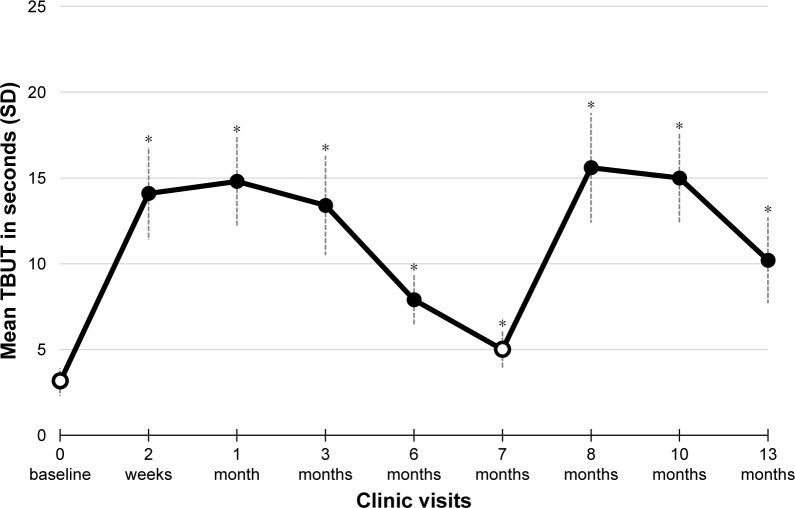
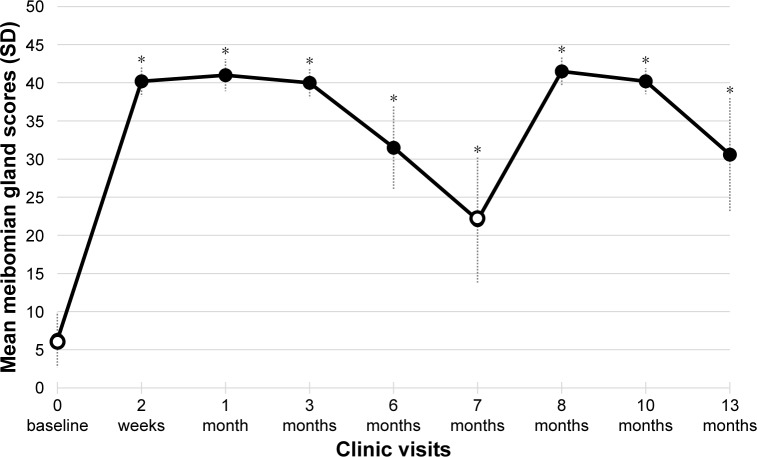
This was an extension of an initial 6-month, prospective, single-center, randomized, parallel-group pilot study. In the initial study, subjects with DED were randomized to either a single TearCare treatment or 4 weeks of daily warm compress therapy. The extension study involved retreatment of those subjects assigned to the TearCare treatment group following the initial 6-month end point. At 6 months, subjects were evaluated for the clinical signs and symptoms of DED prior to retreatment in the extension study that would measure the safety, effectiveness, and durability of a TearCare retreatment for another 6 months through a 12-month end point. The TearCare retreatment procedure consisted of 12 minutes of thermal eyelid treatment immediately followed by manual meibomian gland clearance. The primary effectiveness end point was the change in tear break-up time (TBUT) from baseline to 1-month follow-up. Secondary end points included meibomian gland scores, corneal and conjunctival staining scores, and assessment of dry eye symptoms. Safety was evaluated through monitoring intraocular pressure, best-corrected visual acuity, and device-related adverse events.
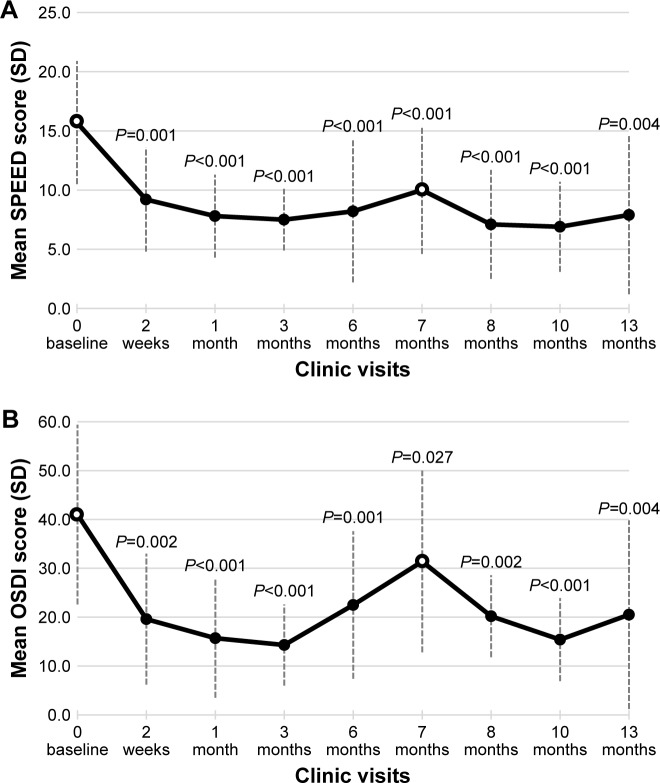
Twelve subjects participated in the 6-month extension study. At 1-month clinic visit following retreatment, a significant improvement from baseline in mean (± SD) TBUT of 12.4 (±3.3) seconds was observed (<0.001). Significant improvements in the mean change from baseline in meibomian gland scores, corneal and conjunctival staining scores, and symptoms of DED were also observed following retreatment. The second treatment was well tolerated.
The findings of the extension study through 12 months suggest that a second TearCare treatment after 6 months provides additional improvement in the signs and symptoms of DED.
评估TearCare再治疗方案对患有具有临床意义的干眼病(DED)的成年受试者的安全性和有效性。
这是一项最初为期6个月的前瞻性、单中心、随机、平行组试点研究的扩展研究。在最初的研究中,患有干眼病的受试者被随机分为接受单次TearCare治疗或为期4周的每日热敷治疗。扩展研究涉及在最初6个月的终点后,对分配到TearCare治疗组的受试者进行再治疗。在6个月时,对受试者进行干眼病的临床体征和症状评估,然后在扩展研究中进行再治疗,该研究将通过12个月的终点来测量TearCare再治疗方案在另外6个月内的安全性、有效性和持久性。TearCare再治疗程序包括12分钟的眼睑热疗,随后立即进行睑板腺手工清理。主要有效性终点是从基线到1个月随访时泪膜破裂时间(TBUT)的变化。次要终点包括睑板腺评分、角膜和结膜染色评分以及干眼症状评估。通过监测眼压、最佳矫正视力和与设备相关的不良事件来评估安全性。
12名受试者参与了为期6个月的扩展研究。再治疗后1个月的门诊随访中,观察到平均(±标准差)TBUT较基线有显著改善,为12.4(±3.3)秒(<0.001)。再治疗后,睑板腺评分、角膜和结膜染色评分以及干眼病症状的平均变化较基线也有显著改善。第二次治疗耐受性良好。
为期12个月的扩展研究结果表明,6个月后进行第二次TearCare治疗可使干眼病的体征和症状得到进一步改善。