Cummins Bree, Gedeon Tomas, Harker Shaun, Mischaikow Konstantin, Mok Kafung
Department of Mathematical Sciences, Montana State University, Bozeman, MT 59715.
Department of Mathematics, Hill Center-Busch Campus, Rutgers, The State University of New Jersey, 110 Frelinghusen Rd, Piscataway, New Jersey 08854-8019, USA.
SIAM J Appl Dyn Syst. 2016;15(4):2176-2212. doi: 10.1137/15M1052743. Epub 2016 Nov 15.
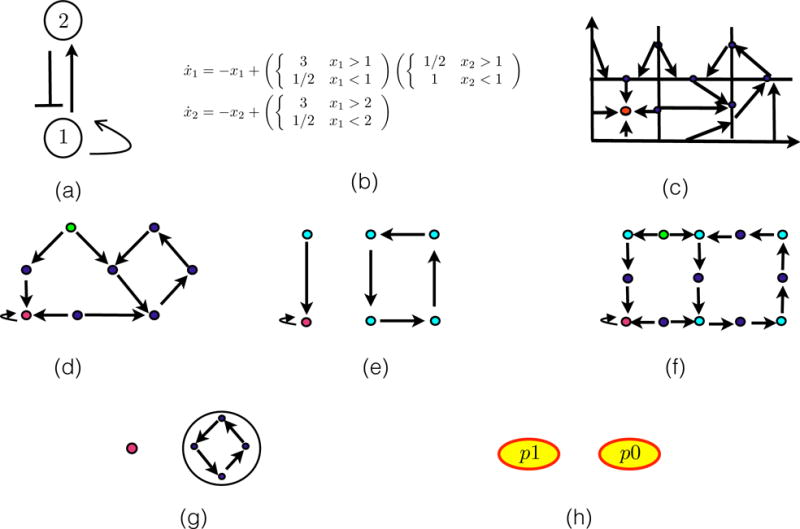
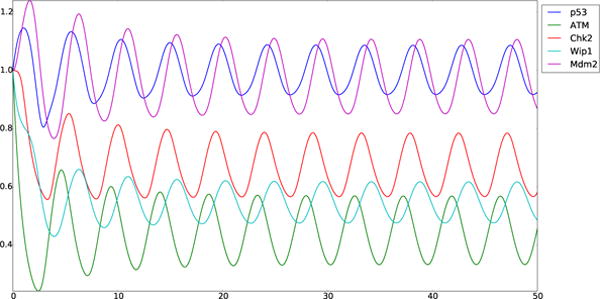
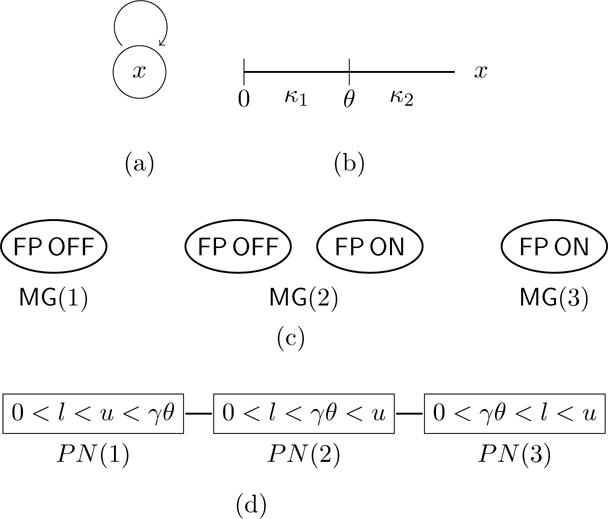
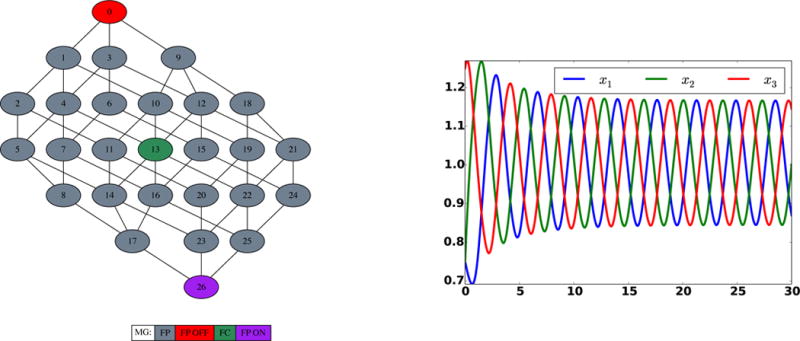
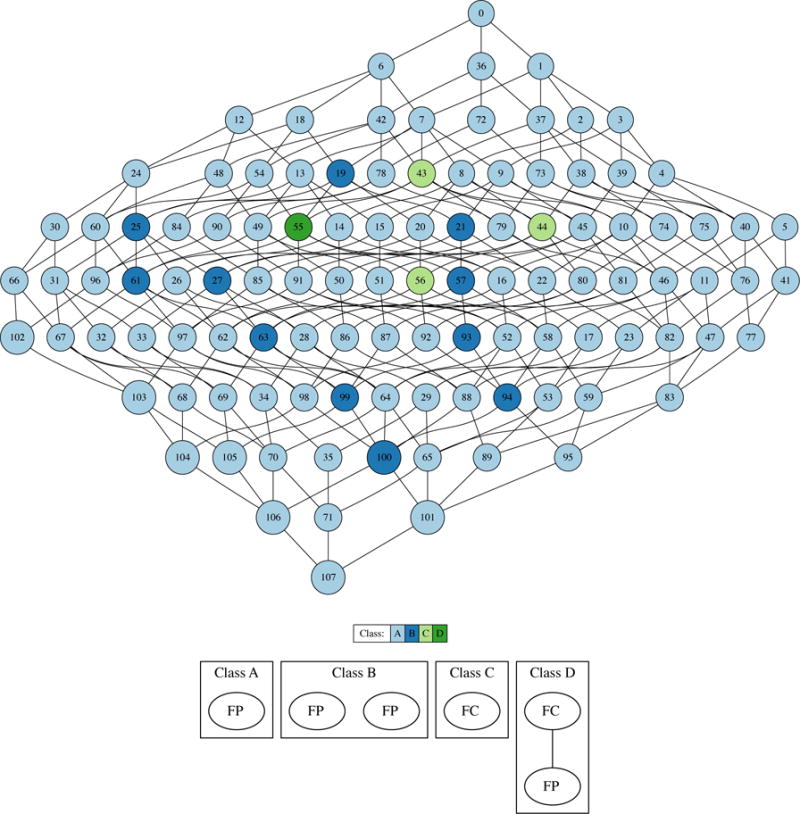
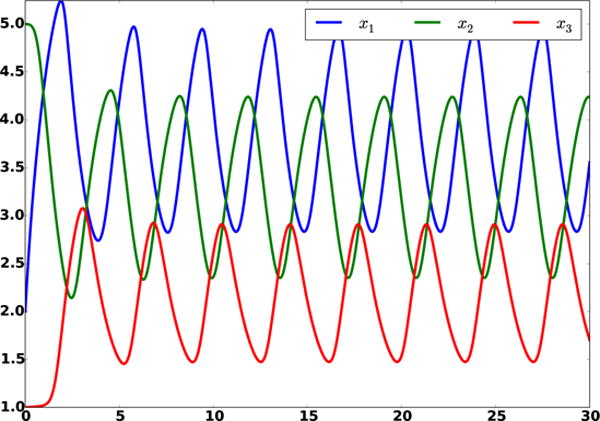
We describe the theoretical and computational framework for the Dynamic Signatures for Genetic Regulatory Network ( DSGRN) database. The motivation stems from urgent need to understand the global dynamics of biologically relevant signal transduction/gene regulatory networks that have at least 5 to 10 nodes, involve multiple interactions, and decades of parameters. The input to the database computations is a regulatory network, i.e. a directed graph with edges indicating up or down regulation. A computational model based on switching networks is generated from the regulatory network. The phase space dimension of this model equals the number of nodes and the associated parameter space consists of one parameter for each node (a decay rate), and three parameters for each edge (low level of expression, high level of expression, and threshold at which expression levels change). Since the nonlinearities of switching systems are piece-wise constant, there is a natural decomposition of phase space into cells from which the dynamics can be described combinatorially in terms of a state transition graph. This in turn leads to a compact representation of the global dynamics called an annotated Morse graph that identifies recurrent and nonrecurrent dynamics. The focus of this paper is on the construction of a natural computable finite decomposition of parameter space into domains where the annotated Morse graph description of dynamics is constant. We use this decomposition to construct an SQL database that can be effectively searched for dynamical signatures such as bistability, stable or unstable oscillations, and stable equilibria. We include two simple 3-node networks to provide small explicit examples of the type of information stored in the DSGRN database. To demonstrate the computational capabilities of this system we consider a simple network associated with p53 that involves 5 nodes and a 29-dimensional parameter space.
我们描述了基因调控网络动态签名(DSGRN)数据库的理论和计算框架。其动机源于迫切需要了解具有至少5至10个节点、涉及多种相互作用且有数十个参数的生物学相关信号转导/基因调控网络的全局动态。数据库计算的输入是一个调控网络,即一个有向图,其边表示上调或下调。基于开关网络的计算模型由调控网络生成。该模型的相空间维度等于节点数,相关的参数空间由每个节点一个参数(衰减率)以及每条边三个参数(低表达水平、高表达水平和表达水平变化的阈值)组成。由于开关系统的非线性是分段常数,相空间自然地分解为细胞,从这些细胞中可以根据状态转移图以组合方式描述动态。这进而导致了全局动态的一种紧凑表示,称为带注释的莫尔斯图,它能识别循环和非循环动态。本文的重点是构建参数空间的一种自然可计算有限分解,将其分解为动态的带注释莫尔斯图描述恒定的区域。我们利用这种分解来构建一个SQL数据库,该数据库可以有效地搜索诸如双稳态、稳定或不稳定振荡以及稳定平衡点等动态签名。我们包含两个简单的三节点网络,以提供DSGRN数据库中存储信息类型的小而明确的示例。为了展示该系统的计算能力,我们考虑一个与p53相关的简单网络,它涉及5个节点和一个29维的参数空间。