Yoo Kyung Don, Kim Hyo Jin, Kim Yunmi, Park Jae Yoon, Shin Sung Joon, Han Seung Hyeok, Kim Dong Ki, Lim Chun Soo, Kim Yon Su
Department of Internal Medicine, Dongguk University College of Medicine, Gyeongju, Korea.
Department of Internal Medicine, Dongguk University Gyeongju Hospital, Gyeongju, Korea.
Kidney Res Clin Pract. 2019 Mar 31;38(1):15-24. doi: 10.23876/j.krcp.18.0058.
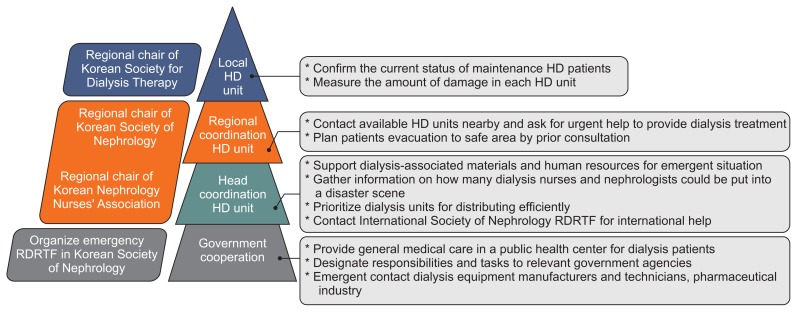
In 2016 and 2017, there were earthquakes greater than 5.0 in magnitude on the Korean Peninsula, which has previously been considered an earthquake-free zone. Patients with chronic kidney disease are particularly vulnerable to earthquakes, as the term "renal disaster" suggests. In the event of a major earthquake, patients on hemodialysis face the risk of losing maintenance dialysis due to infrastructure disruption. In this review, we share the experience of an earthquake in Pohang that posed a serious risk to patients on hemodialysis. We review the disaster response system in Japan and propose a disaster preparedness plan with respect to hemodialysis. Korean nephrologists and staff in dialysis facilities should be trained in emergency response to mitigate risk from natural disasters. Dialysis staff should be familiar with the action plan for natural disaster events that disrupt hemodialysis, such as outages and water treatment system failures caused by earthquakes. Patients on hemodialysis also need to be educated about disaster preparedness. In the event of a disaster situation that results in dialysis failure, patients need to know what to do. At the local and national government level, long-term preparations should be made to handle renal disaster and patient safety logistics. Moreover, Korean nephrologists should also be prepared to manage cardiovascular disease and diabetes in disaster situations. Further evaluation and management of social and national disaster preparedness of hemodialysis units to earthquakes in Korea are needed.
2016年和2017年,朝鲜半岛发生了震级大于5.0级的地震,而该地区此前一直被认为是无地震区。正如“肾脏灾难”一词所暗示的,慢性肾脏病患者尤其容易受到地震影响。在发生大地震时,接受血液透析的患者面临因基础设施中断而失去维持性透析的风险。在本综述中,我们分享了浦项地震给接受血液透析的患者带来严重风险的经历。我们回顾了日本的灾害应对系统,并提出了针对血液透析的灾害准备计划。韩国肾脏病学家和透析设施工作人员应接受应急培训,以降低自然灾害带来的风险。透析工作人员应熟悉应对扰乱血液透析的自然灾害事件的行动计划,如地震导致的停电和水处理系统故障。接受血液透析的患者也需要接受灾害准备教育。在发生导致透析失败的灾难情况时,患者需要知道该怎么做。在地方和国家政府层面,应做好长期准备,以应对肾脏灾难和患者安全后勤保障。此外,韩国肾脏病学家还应做好在灾难情况下管理心血管疾病和糖尿病的准备。韩国需要对血液透析单位针对地震的社会和国家灾害准备情况进行进一步评估和管理。