Department of Global Environmental Health Sciences , Tulane University School of Public Health and Tropical Medicine , New Orleans , Louisiana 70112 , United States.
Department of Pharmacology , Penn State College of Medicine , Hershey , Pennsylvania 17033 , United States.
J Proteome Res. 2019 Apr 5;18(4):1715-1724. doi: 10.1021/acs.jproteome.8b00946. Epub 2019 Mar 4.
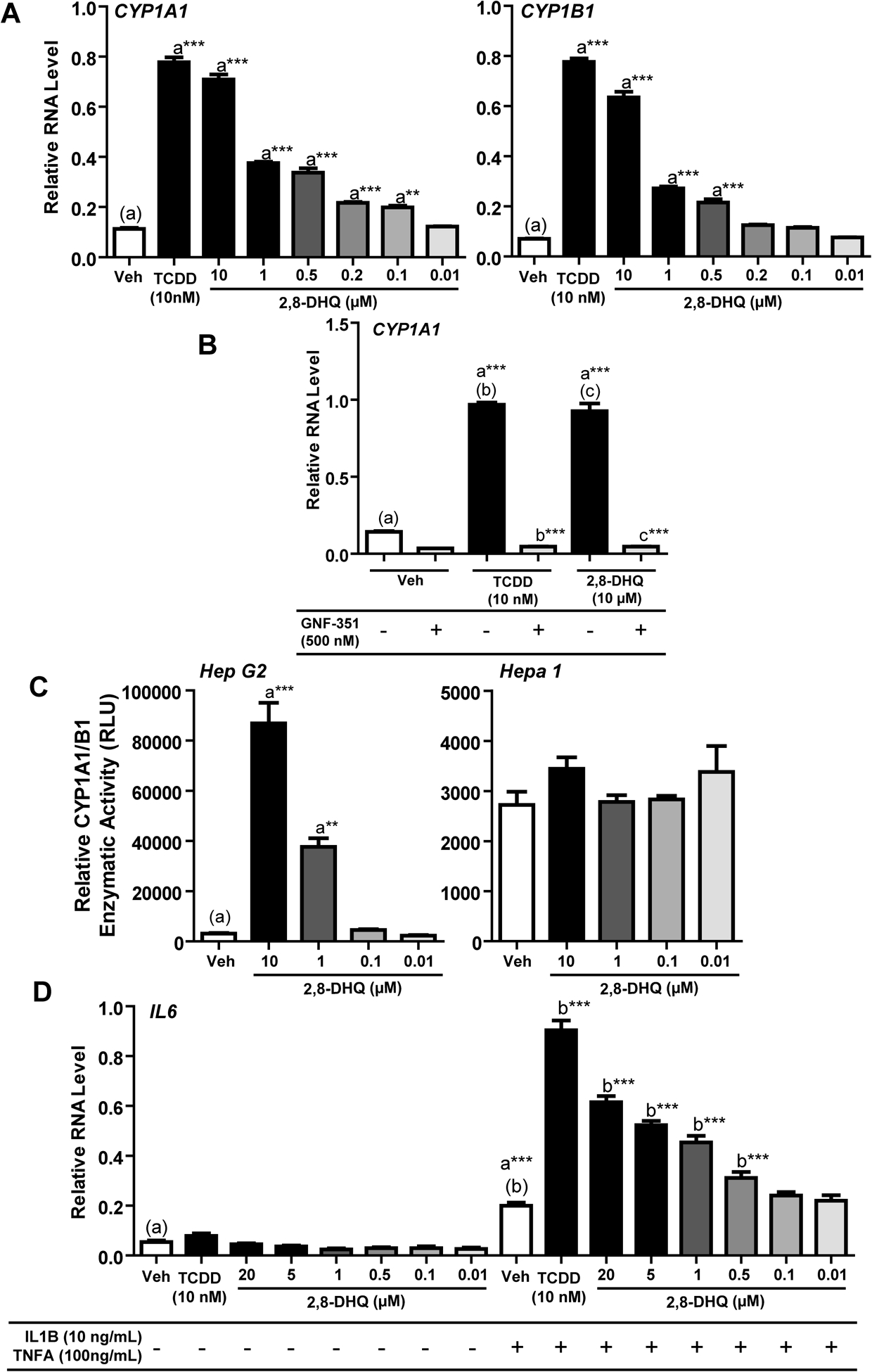
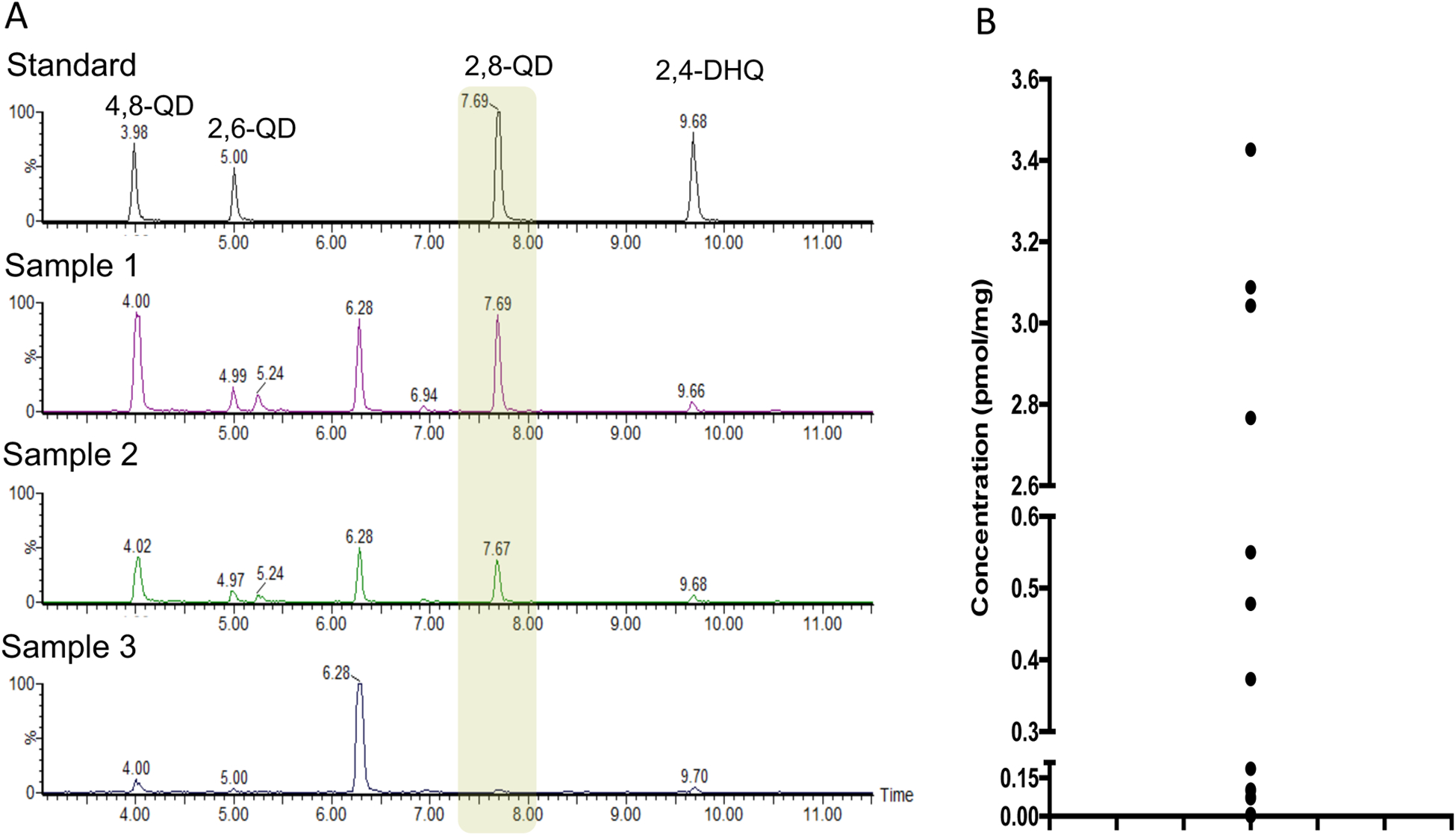
The aryl hydrocarbon receptor (AHR) is a major regulator of immune function within the gastrointestinal tract. Resident microbiota are capable of influencing AHR-dependent signaling pathways via production of an array of bioactive molecules that act as AHR agonists, such as indole or indole-3-aldehyde. Bacteria produce a number of quinoline derivatives, of which some function as quorum-sensing molecules. Thus, we screened relevant hydroxyquinoline derivatives for AHR activity using AHR responsive reporter cell lines. 2,8-Dihydroxyquinoline (2,8-DHQ) was identified as a species-specific AHR agonist that exhibits full AHR agonist activity in human cell lines, but only induces modest AHR activity in mouse cells. Additional dihydroxylated quinolines tested failed to activate the human AHR. Nanomolar concentrations of 2,8-DHQ significantly induced CYP1A1 expression and, upon cotreatment with cytokines, synergistically induced IL6 expression. Ligand binding competition studies subsequently confirmed 2,8-DHQ to be a human AHR ligand. Several dihydroxyquinolines were detected in human fecal samples, with concentrations of 2,8-DHQ ranging between 0 and 3.4 pmol/mg feces. Additionally, in mice the microbiota was necessary for the presence of DHQ in cecal contents. These results suggest that microbiota-derived 2,8-DHQ would contribute to AHR activation in the human gut, and thus participate in the protective and homeostatic effects observed with gastrointestinal AHR activation.
芳香烃受体(AHR)是胃肠道中主要的免疫功能调节剂。常驻微生物群能够通过产生一系列作为 AHR 激动剂的生物活性分子来影响 AHR 依赖性信号通路,例如吲哚或吲哚-3-醛。细菌产生许多喹啉衍生物,其中一些作为群体感应分子发挥作用。因此,我们使用 AHR 反应性报告细胞系筛选了相关的羟基喹啉衍生物的 AHR 活性。2,8-二羟基喹啉(2,8-DHQ)被鉴定为一种物种特异性的 AHR 激动剂,它在人细胞系中表现出完全的 AHR 激动剂活性,但仅在小鼠细胞中引起适度的 AHR 活性。测试的其他二羟基化喹啉未能激活人 AHR。2,8-DHQ 的纳摩尔浓度显著诱导 CYP1A1 的表达,并在与细胞因子共同处理时协同诱导 IL6 的表达。随后的配体结合竞争研究证实 2,8-DHQ 是人类 AHR 的配体。在人类粪便样本中检测到几种二羟基喹啉,2,8-DHQ 的浓度范围为 0 至 3.4 pmol/mg 粪便。此外,在小鼠中,微生物群对于盲肠内容物中 DHQ 的存在是必需的。这些结果表明,微生物群衍生的 2,8-DHQ 将有助于人类肠道中 AHR 的激活,从而参与到胃肠道 AHR 激活所观察到的保护和动态平衡效应中。