
二萘并噻吩并噻吩(DNTT)的拉曼光谱研究
Raman Spectroscopic Studies of Dinaphthothienothiophene (DNTT).
作者信息
Bhardwaj Bishwajeet Singh, Sugiyama Takeshi, Namba Naoko, Umakoshi Takayuki, Uemura Takafumi, Sekitani Tsuyoshi, Verma Prabhat
机构信息
Department of Applied Physics, Osaka University, Suita, Osaka 565-0871, Japan.
The Institute of Scientific and Industrial Research, Osaka University, Mihogaoka, Ibaraki, Osaka 567-0047, Japan.
出版信息
Materials (Basel). 2019 Feb 18;12(4):615. doi: 10.3390/ma12040615.
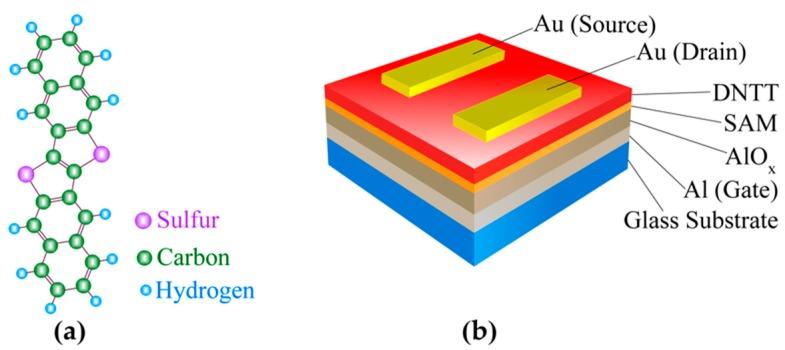
The application of dinaphthothienothiophene (DNTT) molecules, a novel organic semiconductor material, has recently increased due to its high charge carrier mobility and thermal stability. Since the structural properties of DNTT molecules, such as the molecular density distribution and molecular orientations, significantly affect their charge carrier mobility in organic field-effect transistors devices, investigating these properties would be important. Here, we report Raman spectroscopic studies on DNTT in a transistor device, which was further analyzed by the density functional theory. We also show a perspective of this technique for orientation analysis of DNTT molecules within a transistor device.
新型有机半导体材料二萘并噻吩并噻吩(DNTT)分子由于其高载流子迁移率和热稳定性,近年来其应用有所增加。由于DNTT分子的结构特性,如分子密度分布和分子取向,会显著影响其在有机场效应晶体管器件中的载流子迁移率,因此研究这些特性具有重要意义。在此,我们报告了对晶体管器件中DNTT的拉曼光谱研究,并通过密度泛函理论进行了进一步分析。我们还展示了该技术在晶体管器件内对DNTT分子进行取向分析的前景。



 Zotero 插件