Division of Nutritional Sciences, Cornell University, Ithaca, NY 14853, USA.
University of Rochester Medical Center, Rochester, NY 14642, USA.
Nutrients. 2019 Feb 13;11(2):397. doi: 10.3390/nu11020397.
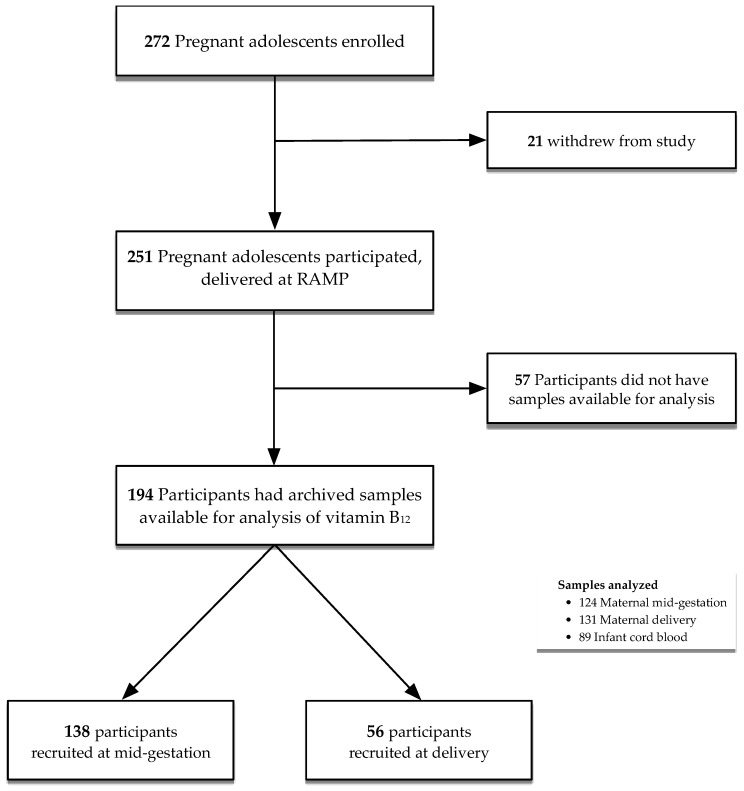
Vitamin B deficiency has been associated with increased risk of adverse pregnancy outcomes. Few prospective studies have investigated the burden or determinants of vitamin B deficiency early in life, particularly among pregnant adolescents and their children. The objectives of this study were to determine the prevalence of vitamin B deficiency and to examine associations between maternal and neonatal vitamin B status in a cohort study of healthy pregnant adolescents. Serum vitamin B and folate concentrations were measured in adolescents at mid-gestation ( = 124; 26.4 ± 3.5 weeks) and delivery ( = 131; 40.0 ± 1.3 weeks), and in neonates at birth using cord blood. Linear regression was used to examine associations between maternal and neonatal vitamin B status. Although the prevalence of vitamin B deficiency (<148.0 pmol/L; 1.6%) in adolescents was low during pregnancy, 22.6% of adolescents were vitamin B insufficient (<221.0 pmol/L; 22.6%) at mid-gestation. Maternal vitamin B concentrations significantly decreased from mid-gestation to delivery ( < 0.0001), and 53.4% had insufficient vitamin B status at delivery. Maternal vitamin B concentrations ( < 0.001) and vitamin B deficiency ( = 0.002) at delivery were significantly associated with infant vitamin B concentrations in multivariate analyses, adjusting for gestational age, maternal age, parity, smoking status, relationship status, prenatal supplement use, pre-pregnancy body mass index, race, and intake of vitamin B and folate. Maternal vitamin B concentrations significantly decreased during pregnancy and predicted neonatal vitamin B status in a cohort of healthy pregnant adolescents.
维生素 B 缺乏与不良妊娠结局的风险增加有关。很少有前瞻性研究调查生命早期维生素 B 缺乏的负担或决定因素,尤其是在孕妇青少年及其子女中。本研究的目的是确定维生素 B 缺乏的流行率,并在一项健康孕妇青少年队列研究中检查母体和新生儿维生素 B 状况之间的关联。在妊娠中期(= 124;26.4 ± 3.5 周)和分娩时(= 131;40.0 ± 1.3 周)测量青少年血清维生素 B 和叶酸浓度,在新生儿出生时使用脐血测量。线性回归用于检查母体和新生儿维生素 B 状况之间的关联。尽管青少年在妊娠期间维生素 B 缺乏(<148.0 pmol/L;1.6%)的患病率较低,但 22.6%的青少年在妊娠中期维生素 B 不足(<221.0 pmol/L;22.6%)。母体维生素 B 浓度从妊娠中期到分娩时显著下降(<0.0001),53.4%的人在分娩时维生素 B 状况不足。在多元分析中,调整了胎龄、母亲年龄、产次、吸烟状况、关系状况、产前补充剂使用、孕前体重指数、种族以及维生素 B 和叶酸的摄入量,发现母体维生素 B 浓度(<0.001)和分娩时维生素 B 缺乏(= 0.002)与婴儿维生素 B 浓度显著相关。在一项健康孕妇青少年队列研究中,母体维生素 B 浓度在妊娠期间显著下降,并预测了新生儿的维生素 B 状况。