Department of Epidemiology, Harvard T.H. Chan School of Public Health, Boston, MA 02115, USA.
Department of Global Health and Population, Harvard T.H. Chan School of Public Health, Boston, MA 02115, USA.
Nutrients. 2017 Nov 17;9(11):1258. doi: 10.3390/nu9111258.
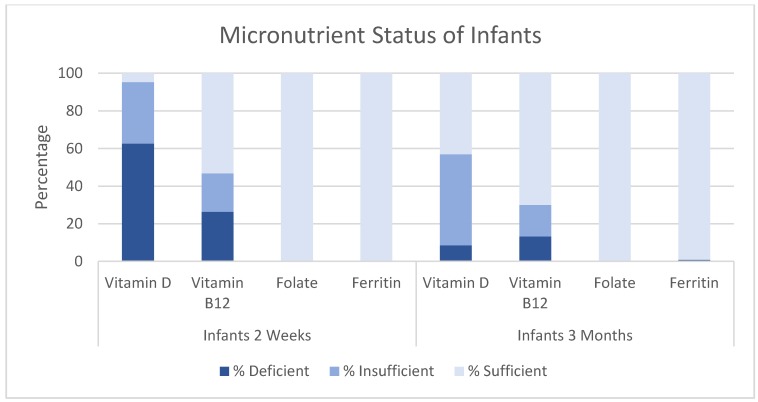
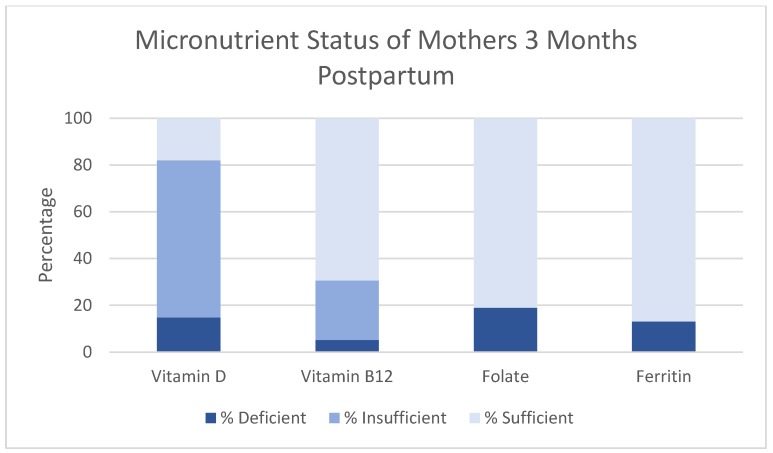
Infant mortality accounts for the majority of child deaths in Tanzania, and malnutrition is an important underlying cause. The objectives of this cross-sectional study were to describe the micronutrient status of infants in Tanzania and assess predictors of infant micronutrient deficiency. We analyzed serum vitamin D, vitamin B12, folate, and ferritin levels from 446 infants at two weeks of age, 408 infants at three months of age, and 427 mothers three months post-partum. We used log-Poisson regression to estimate relative risk of being deficient in vitamin D and vitamin B12 for infants in each age group. The prevalence of vitamin D and vitamin B12 deficiency decreased from 60% and 30% at two weeks to 9% and 13% at three months respectively. Yet, the prevalence of insufficiency at three months was 49% for vitamin D and 17% for vitamin B12. Predictors of infant vitamin D deficiency were low birthweight, urban residence, maternal education, and maternal vitamin D status. Maternal vitamin B12 status was the main predictor for infant vitamin B12 deficiency. The majority of infants had sufficient levels of folate or ferritin. Further research is necessary to examine the potential benefits of improving infants' nutritional status through vitamin D and B12 supplements.
婴儿死亡率在坦桑尼亚占儿童死亡的大部分,而营养不良是一个重要的潜在原因。本横断面研究的目的是描述坦桑尼亚婴儿的微量营养素状况,并评估婴儿微量营养素缺乏的预测因素。我们分析了 446 名两周大、408 名三个月大和 427 名产后三个月的婴儿的血清维生素 D、维生素 B12、叶酸和铁蛋白水平。我们使用对数泊松回归来估计每个年龄组婴儿维生素 D 和维生素 B12 缺乏的相对风险。维生素 D 和维生素 B12 缺乏的患病率从两周时的 60%和 30%分别下降到三个月时的 9%和 13%。然而,三个月时维生素 D 和维生素 B12 的不足率分别为 49%和 17%。婴儿维生素 D 缺乏的预测因素包括低出生体重、城市居住、母亲教育和母亲维生素 D 状况。母亲的维生素 B12 状况是婴儿维生素 B12 缺乏的主要预测因素。大多数婴儿的叶酸或铁蛋白水平充足。需要进一步研究,以检验通过维生素 D 和 B12 补充改善婴儿营养状况的潜在益处。