Department of Psychiatry, University of Arkansas for Medical Sciences, Little Rock, Arkansas, USA.
Faculty Centre, University of Arkansas for Medical Sciences, Little Rock, Arkansas, USA.
BMJ Open. 2019 Feb 19;9(2):e023506. doi: 10.1136/bmjopen-2018-023506.
To determine the prevalence and associated factors for personal, work-related and patient/client-related burnout in clinical professionals and biomedical scientists in academic medicine.
Prevalence survey using the Copenhagen Burnout Inventory.
Mid-size academic health centre.
Clinical providers (n=6489) and biomedical scientists (n=248) were invited to complete the survey. 1646 completed responses (response rate 24.4%) were analysed.
Prevalence estimates and adjusted ORs (AOR) were stratified for gender, age and professional category.
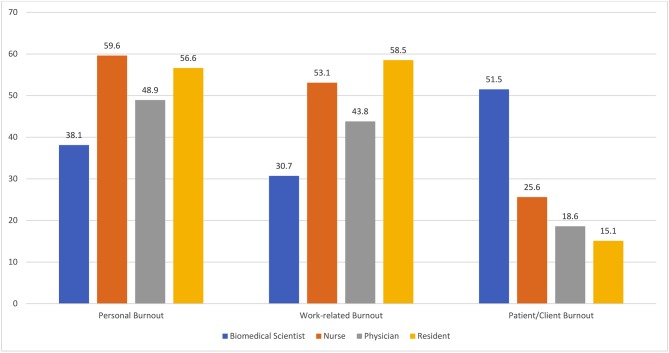
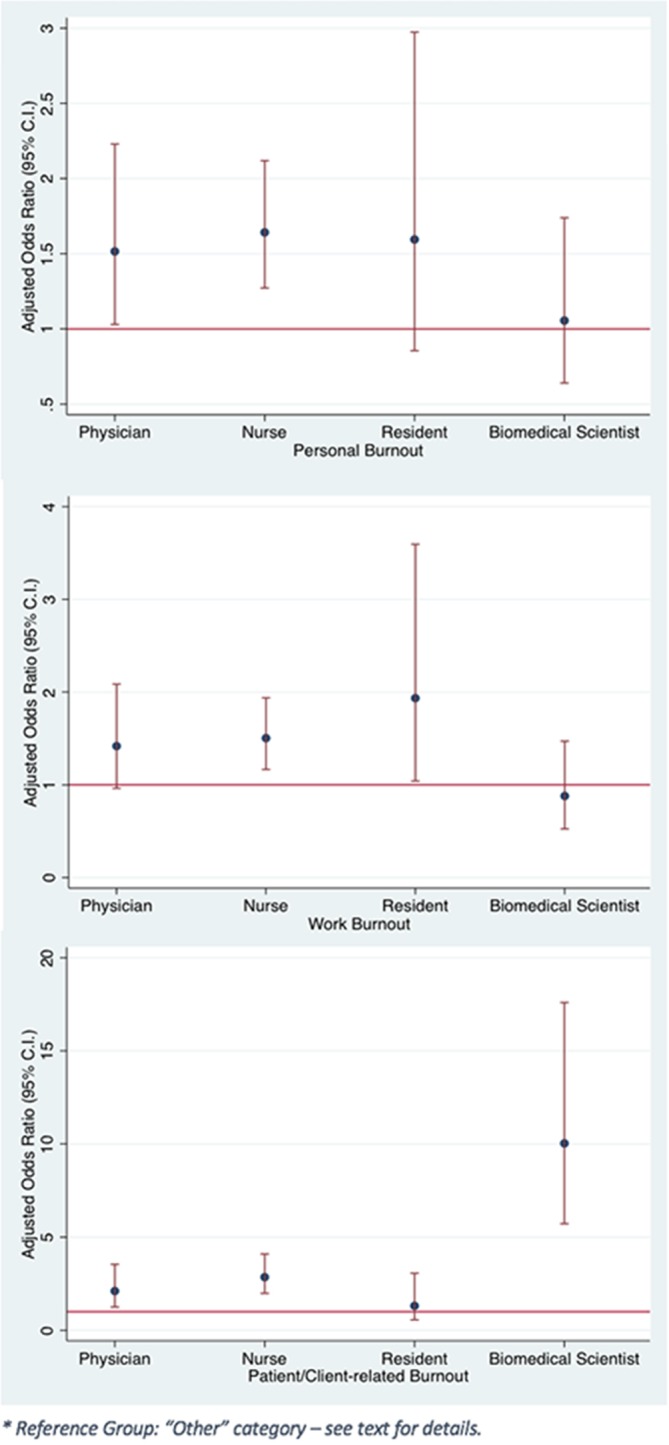
Type of burnout varies across professional categories, with significant differences between clinicians and scientists. The prevalence of personal burnout was 52.7% (95%CI 50% to 55%), work-related burnout 47.5% (95%CI 45% to 49%) and patient/client-related burnout 20.3% (95%CI 18% to 22%). The prevalence of personal and work-related burnout was higher among women, while those aged 20-30 had a higher prevalence of all three burnout categories. Overall, clinical professionals had higher personal and work-related burnout, while biomedical scientists had higher client-related burnout. Accounting for the effects of gender and age, a significantly higher risk for personal burnout was found for physicians (AOR 1.64; 95%CI 1.3 to 2.1) and nurses (AOR 1.5; 95%CI 1.03 to 2.2). Significantly higher odds of work-related burnout were found for nurses (AOR 1.5; 95%CI 1.2 to 1.9) and residents (AOR 1.9; 95%CI 1.04 to 3.6). Basic scientists (AOR 10.0; 95%CI 5.7 to 17.6), physicians (AOR 2.8; 95%CI 1.9 to 4.1) and nurses (AOR 2.1; 95%CI 1.3 to 3.5) had higher odds of patient/client-related burnout.
Types of burnout are unevenly distributed in academic medical centres. Physicians have higher risk of personal and patient/client-related burnout, residents have higher risk of work-related burnout, basic scientists are at higher risk of client-related burnout and nurses have higher odds of all three types of burnout. Interventions addressing the problem of burnout in clinical environments may be inadequate to support biomedical scientists.
确定学术医学中临床专业人员和生物医学科学家个人、工作相关和患者/客户相关倦怠的流行率及相关因素。
使用哥本哈根倦怠量表进行患病率调查。
中型学术医疗中心。
邀请临床医生(n=6489)和生物医学科学家(n=248)完成调查。对 1646 份完成的回复(回应率 24.4%)进行了分析。
根据性别、年龄和专业类别对流行率估计值和调整后的比值比(AOR)进行分层。
倦怠类型因专业类别而异,临床医生和科学家之间存在显著差异。个人倦怠的患病率为 52.7%(95%CI 50%至 55%),工作相关倦怠为 47.5%(95%CI 45%至 49%),患者/客户相关倦怠为 20.3%(95%CI 18%至 22%)。女性中个人和工作相关倦怠的患病率更高,而 20-30 岁的人群中所有三种倦怠类别的患病率更高。总体而言,临床医生的个人和工作相关倦怠程度更高,而生物医学科学家的客户相关倦怠程度更高。在考虑到性别和年龄的影响后,发现医生(AOR 1.64;95%CI 1.3 至 2.1)和护士(AOR 1.5;95%CI 1.03 至 2.2)的个人倦怠风险显著更高。护士(AOR 1.5;95%CI 1.2 至 1.9)和住院医师(AOR 1.9;95%CI 1.04 至 3.6)的工作相关倦怠的可能性显著更高。基础科学家(AOR 10.0;95%CI 5.7 至 17.6)、医生(AOR 2.8;95%CI 1.9 至 4.1)和护士(AOR 2.1;95%CI 1.3 至 3.5)发生患者/客户相关倦怠的可能性更高。
学术医学中心中倦怠类型分布不均。医生的个人和患者/客户相关倦怠风险更高,住院医师的工作相关倦怠风险更高,基础科学家的客户相关倦怠风险更高,护士的三种倦怠类型的可能性更高。针对临床环境中倦怠问题的干预措施可能不足以支持生物医学科学家。