Department of Electrical and Computer Engineering, University of Illinois at Urbana-Champaign, Urbana, IL, 61801, USA.
Mayo Clinic, Rochester, MN, 55905, USA.
Sci Rep. 2019 Feb 19;9(1):2235. doi: 10.1038/s41598-019-38793-3.
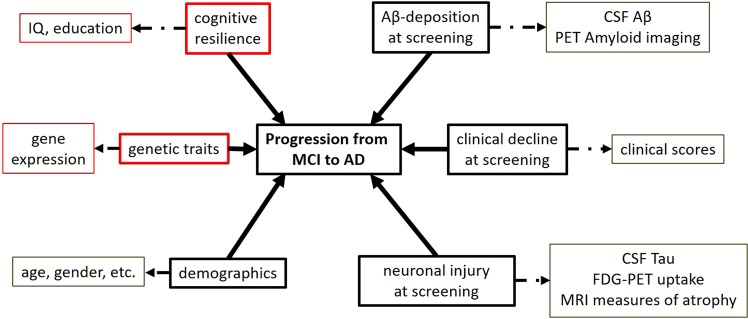
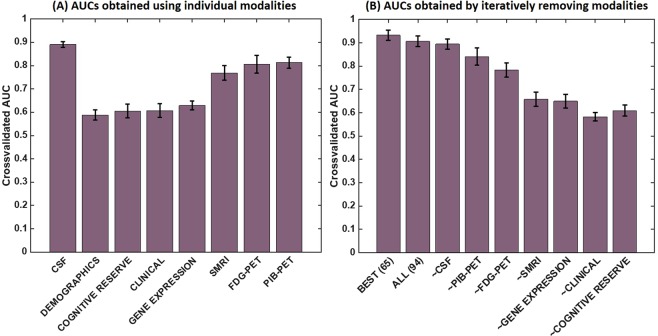
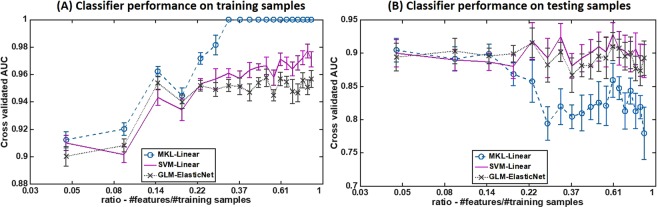
In the Alzheimer's disease (AD) continuum, the prodromal state of mild cognitive impairment (MCI) precedes AD dementia and identifying MCI individuals at risk of progression is important for clinical management. Our goal was to develop generalizable multivariate models that integrate high-dimensional data (multimodal neuroimaging and cerebrospinal fluid biomarkers, genetic factors, and measures of cognitive resilience) for identification of MCI individuals who progress to AD within 3 years. Our main findings were i) we were able to build generalizable models with clinically relevant accuracy (~93%) for identifying MCI individuals who progress to AD within 3 years; ii) markers of AD pathophysiology (amyloid, tau, neuronal injury) accounted for large shares of the variance in predicting progression; iii) our methodology allowed us to discover that expression of CR1 (complement receptor 1), an AD susceptibility gene involved in immune pathways, uniquely added independent predictive value. This work highlights the value of optimized machine learning approaches for analyzing multimodal patient information for making predictive assessments.
在阿尔茨海默病(AD)连续体中,轻度认知障碍(MCI)的前驱状态先于 AD 痴呆,识别有进展风险的 MCI 个体对于临床管理很重要。我们的目标是开发可推广的多变量模型,该模型整合了多维数据(多模态神经影像学和脑脊液生物标志物、遗传因素以及认知弹性的测量),以识别在 3 年内进展为 AD 的 MCI 个体。我们的主要发现是:i)我们能够构建具有临床相关准确性(约 93%)的可推广模型,以识别在 3 年内进展为 AD 的 MCI 个体;ii)AD 病理生理学标志物(淀粉样蛋白、tau、神经元损伤)在预测进展方面占很大比例;iii)我们的方法使我们能够发现,补体受体 1(CR1)的表达,一种参与免疫途径的 AD 易感基因,具有独特的独立预测价值。这项工作强调了优化机器学习方法的价值,用于分析多模态患者信息以进行预测评估。